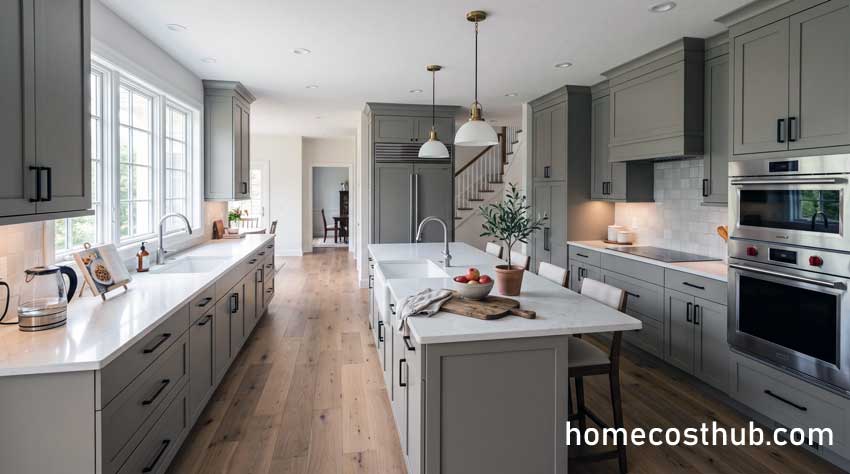
Cabinet Painting Calculator

Cabinet Painting Calculator Cost Guide
A Cabinet Painting Calculator helps homeowners estimate the likely cost of repainting or refinishing kitchen, bathroom, utility-room, or built-in cabinets before requesting professional quotes.
Cabinet painting is typically more detailed than ordinary wall painting because doors, drawer fronts, face frames, edges, hardware, and visible cabinet panels require extensive preparation and careful finishing.
This cost calculator supports both USA cost and UK cost estimates and allows the project size to be entered in square feet or square meters. The resulting price estimate separates material cost, labour cost, installation cost, additional preparation expenses, and removal cost.
Whether you are refreshing existing cabinets, completing a replacement coating, or repairing worn finishes, the calculator can help establish a realistic preliminary budget.
Cabinet Painting Calculator
Estimate cabinet painting costs in the USA or UK based on paintable cabinet area, coating type, material quality, cabinet scope, existing condition, application method, labour difficulty, finish removal, and optional preparation work.
Enter the approximate total paintable surface area of cabinet doors, drawer fronts, frames, and visible cabinet panels.
Please enter a valid value.
Removal Required
Optional Preparation & Finishing
USA Cabinet Painting Estimate
$0
Cabinet Painting Size: 0 ft²
Cost Breakdown
Materials $0
Labour $0
Installation $0
Additional $0
Removal $0
This calculator provides a budgeting estimate only. Actual cabinet painting prices can vary by location, cabinet design, number of doors and drawers, coating system, preparation requirements, spray setup, hardware, surface condition, contractor minimum charges, and local labour rates.
FREE PDF ESTIMATE
Get Your Cabinet Painting Estimate PDF
Enter your details below to receive your cabinet painting estimate, selected options, and complete cost breakdown as a downloadable PDF.
✓ Your PDF is ready!
Free Cabinet Painting Calculator
Material / Project Types
Cabinet painting requires durable coatings that can withstand frequent handling, cleaning, moisture, and everyday household wear.
Acrylic cabinet paint is a practical choice for many residential projects. It offers relatively easy application, good durability, and a wide range of colours and finishes.
Cabinet enamel provides a harder, smoother finish and is commonly used on kitchen cabinets, bathroom vanities, and other high-use surfaces. Its material cost may be higher than basic acrylic paint, but improved resistance to wear can make it worthwhile.
Urethane-alkyd cabinet coatings are popular for projects where a smooth, durable finish is desired. These paints can level well and create a finish similar to traditional oil-based coatings while offering modern application characteristics.
Also Read:
Specialty or factory-style coatings represent the premium end of the market. These finishes may require professional spray equipment, controlled preparation, and additional labour.
Project scope also changes the price estimate. Painting doors and drawer fronts only is usually less expensive than painting doors, drawers, and cabinet frames. A complete cabinet refinish can include visible end panels, trim, moulding, shelving edges, and other detailed surfaces.
Main Factors Affecting Cost
Project size is one of the main factors in a Cabinet Painting Calculator. More cabinet surface area requires additional paint, primer, preparation materials, masking, and labour.
Material quality also affects the final estimate. Budget products can reduce upfront material cost, while standard, premium, and luxury coatings may provide better durability, levelling, adhesion, stain resistance, and finish quality.
Existing condition is particularly important for cabinet projects. New or unfinished surfaces can be relatively straightforward, while a replacement or repaint project may require cleaning, degreasing, sanding, deglossing, and bonding primer. Damaged cabinets can increase repair cost because dents, scratches, peeling coatings, cracks, or deteriorated surfaces may need restoration before painting.
Labour difficulty can vary considerably. Simple flat-panel doors are usually easier to prepare and finish than raised-panel doors, detailed mouldings, glass-front cabinets, decorative end panels, or complex built-ins.
The application method also influences installation cost. Brush-and-roller work can be practical for smaller projects, while professional spray application creates a smoother finish. Fine-finish or factory-style spraying usually requires more extensive setup and preparation and therefore costs more.
Cost Breakdown
Material cost includes cabinet paint, enamel, primer, coatings, masking supplies, and other consumable materials. Premium and specialty coating systems generally increase this portion of the project.
Labour cost covers cleaning, degreasing, sanding, masking, painting, touch-ups, reassembly, and cleanup. Cabinet painting is detail-intensive, so labour cost can represent a large part of the total price.
Installation cost reflects the chosen coating application process. Brush-and-roller application, professional spraying, and factory-style fine finishing require different equipment, preparation, and working time.
Additional cost may include bonding primer, detailed sanding, deglossing, hardware removal, and hardware reinstallation. These tasks can improve adhesion and finish quality but increase the total price estimate.
Removal cost applies when existing paint, varnish, clear coat, or another finish must be stripped before repainting. Light finish removal adds a moderate expense, while extensive stripping can significantly increase replacement cost or repair cost.
Together, these categories create a more useful cabinet painting estimate than relying on one generic rate.
Why Use This Calculator?
A Cabinet Painting Calculator can help homeowners determine whether cabinet repainting fits their remodeling budget before contacting contractors.
Instead of using a single average cost, the calculator considers material type, coating quality, project scope, existing condition, installation method, labour difficulty, finish removal, and optional preparation features.
Homeowners can compare budget, standard, premium, and luxury coating options and see how bonding primer, sanding, hardware removal, and stripping affect the estimate. It is also helpful when comparing the replacement cost of a complete cabinet refinish with the repair cost of restoring damaged existing cabinets.
The calculator supports both USA cost and UK cost assumptions and displays results in USD or GBP. Measurement units are independent of country selection, so users can work in either square feet or square meters.
Actual professional pricing can vary according to cabinet count, door style, paint brand, contractor minimum charges, spray setup, number of coats, hardware, preparation requirements, local labour cost, and project location. The result should therefore be used as a preliminary budgeting estimate rather than a guaranteed quotation.
Cabinet Painting Calculator: From Estimate to Decision
Quick Answer
Use your Cabinet Painting Calculator result as a budgeting benchmark, then compare it with the exact surfaces, preparation, coating system, repairs, and exclusions in each contractor quote. A quote is only comparable to the estimate when both describe substantially the same work.
How Should You Read Your Cabinet Painting Calculator Result?
Your estimate is most useful as a reference point, not as a target price that every painter should match. Before judging a professional quote, check whether the contractor is pricing the same cabinet surfaces, preparation standard, finish quality, and optional work represented in your estimate.
Start by separating the project into what is actually being coated. A kitchen with 20 doors can produce very different scopes depending on whether the price also includes drawer fronts, face frames, exposed cabinet ends, an island, crown molding, shelving edges, or cabinet interiors.
Then check the preparation assumptions. If your calculated scenario assumes standard cleaning, sanding, and primer but the contractor finds peeling coatings, heavy grease contamination, damaged MDF, open wood grain, or adhesion problems, the real scope may legitimately become more expensive.
The reverse can happen too. A quote may come in below the estimate because the painter is coating fewer surfaces, using a different application method, excluding repairs, or pricing only the doors and drawer fronts.
Expert Tip
Before comparing total prices, write down the exact surfaces included in your calculator scenario. Use that list as a scope checklist when reading contractor proposals. A lower price is not a saving if several surfaces or preparation steps have simply been excluded.
Cabinet finishing is also much more detail-sensitive than ordinary room painting. Homeowners budgeting other painted surfaces can use the Interior Painting Cost Calculator for broader interior work, but cabinet quotes should be evaluated as a separate finishing scope.
Why Can a Painter’s Quote Differ From the Estimate?
A contractor sees conditions that a preliminary estimate cannot fully verify: coating failure, grease buildup, damaged edges, awkward access, detailed door profiles, spray containment needs, and the compatibility of the existing finish with the proposed coating system. Those conditions can change the work without changing the visible size of the kitchen.
The Contractor May Be Pricing More Surfaces
“Paint the cabinets” can mean different things in different quotations. One painter may include doors, drawer fronts, cabinet frames, toe kicks, end panels, trim, and an island. Another may quote doors and drawer fronts while treating boxes or decorative panels as optional work.
This is why cabinet count alone cannot tell you whether two quotations are equivalent.
The Preparation Standard May Be Different
A short proposal might state “prep and paint,” while a detailed proposal may specify degreasing, scuff sanding, adhesion primer, spot repairs, masking, and separate treatment for stained or damaged areas.
The longer proposal is not automatically better, but it gives you more information about what you are buying. Ask the lower bidder to clarify the same items before assuming the price difference represents better value.
Application and Handling Can Change the Scope
A contractor who removes doors and drawer fronts, labels them, transports them for off-site finishing, and reinstalls them is offering a different service from someone completing most work in place.
Likewise, spray finishing often requires greater control of masking, overspray, ventilation, and work-area separation. The application method should be compared together with the preparation and coating specification, not as a standalone label.
Repairs May Be Provisional
Minor filling may be included while swollen panels, failed veneer, loose hinges, cracked joints, water damage, or substantial coating removal are excluded. These exclusions matter because some cabinet defects are not painting problems at all.
Compare Cabinet Painting Quotes by Scope, Not Headline Price
Two cabinet painting quotes should be compared line by line before their totals are compared. The most useful question is not “Which quote is cheaper?” but “What work, finish standard, and risk allocation does each price actually cover?”
| Scope Item | Calculator Assumption | Quote A | Quote B | What to Verify |
|---|---|---|---|---|
| Doors and drawer fronts | Included | Included | Included | Confirm quantity and whether both sides/edges are included where applicable. |
| Cabinet boxes and face frames | Included | Included | Not clearly stated | Ask whether visible fixed cabinetry is part of the price. |
| End panels and island | Included | Included | Optional | Check every visible panel rather than assuming “all cabinets” covers them. |
| Degreasing and sanding | Standard prep | Specified | “Prep as needed” | Clarify what the contractor considers adequate preparation. |
| Primer | Included where required | Specified | Conditional | Ask when primer will be used and whether it changes the price. |
| Door removal and reinstallation | Included | Included | Included | Check hardware labeling, storage, and adjustment after reinstallation. |
| Repairs | Minor preparation only | Minor filling included | Excluded | Identify what becomes a separately priced repair. |
| Taxes or VAT | Depends on project setting | Check proposal | Check proposal | Compare totals on the same tax basis. |
The table above is a scope-comparison example, not a statement about how every contractor prices work. Proposal formats vary by company and market.
Also Read:
If one bid remains substantially lower after the scopes are aligned, ask what creates the difference. It could be business overhead, workload, application method, coating selection, or production efficiency. It could also reveal an omission that would otherwise become a change in scope later.
What Should Be Explicit in a Cabinet Painting Quote?
A useful quote should make it possible to identify what will be coated, how the surfaces will be prepared, what coating system is proposed, and what is excluded. It does not need to be pages long, but vague language makes fair comparison difficult.
Cabinet Painting Quote Checklist
- Confirm the number and type of doors and drawer fronts included.
- Confirm whether face frames, cabinet boxes, end panels, toe kicks, trim, and island panels are included.
- Ask what cleaning, degreasing, sanding, deglossing, and repair work is included.
- Identify the primer and finish-coat system or the performance specification being proposed.
- Confirm whether doors and drawer fronts are removed for finishing and who handles reinstallation.
- Clarify whether hardware removal, labeling, adjustment, and reinstallation are included.
- Identify repairs or coating-removal work that would trigger an additional charge.
- Confirm protection, masking, cleanup, and disposal responsibilities.
- Check whether sales tax, VAT, travel charges, or minimum project charges are included where applicable.
- Make sure significant exclusions and assumptions are written into the proposal.
When Cabinet Condition Changes the Decision, Not Just the Price
Some cabinet defects justify more preparation. Others raise a different question: should the cabinets be painted at all? Painting can renew an intact surface, but it cannot restore structural strength or correct a layout that no longer works for the household.
Swollen MDF or Particleboard
Moisture-damaged engineered wood can swell, soften, distort, or lose a clean edge. A coating may improve appearance after limited repairs, but paint does not return damaged material to its original structure.
Loose or Failing Substrate
If veneer is separating, joints are failing, shelves are sagging, or hinge fixing points are badly deteriorated, spending heavily on a premium finish can be poor value unless those defects are addressed first.
Water Damage
Staining alone may be a finishing issue. Active leakage or repeated moisture exposure is not. The moisture source should be corrected before refinishing so the new coating is not being asked to conceal an unresolved building or plumbing problem.
Poor Layout or Storage
If the cabinet arrangement itself is the problem, repainting may make an outdated layout look newer without making the kitchen more functional. Homeowners already considering new storage, appliance positions, or major layout changes should compare the finishing budget with a broader Kitchen Remodel Cost Calculator scenario before committing to premium refinishing.
Older Painted Cabinets Can Require a Different Safety Conversation
Preparation can involve sanding, scraping, or other activities that disturb an existing painted surface. In older homes, that can create concerns that go beyond finish quality.
United States: Pre-1978 Housing
For US homes built before 1978, do not assume an existing painted cabinet or surrounding painted component is lead-free merely because it looks sound. The U.S. Environmental Protection Agency explains that renovation activities such as sanding and scraping can disturb painted surfaces and generate paint dust. Its guidance on renovation activities that disturb painted surfaces describes how these activities fit within the federal Renovation, Repair and Painting framework.
For qualifying projects performed for compensation, the EPA’s RRP requirements can apply to firms and renovators working in pre-1978 housing. Homeowners and professionals can review the agency’s current U.S. EPA lead-safe renovation guidance, updated in March 2026.
This does not mean every old cabinet contains lead-based paint. It means the age and existing coating history can affect how paint-disturbing preparation should be approached.
United Kingdom: Coating and Spray Exposure
For UK projects, product selection and application method also deserve practical attention. The Health and Safety Executive notes that paints and coatings can contain solvents and other substances and that spraying can increase exposure compared with many lower-risk brush or roller tasks. Its paint and coatings safety guidance explains relevant risks and control considerations.
UK rules also limit volatile organic compound content in categories of decorative paints and varnishes placed on the market. The government’s 2025 review of the regulations provides current regulatory context through the UK review of VOC rules for paints and varnishes.
Is DIY Cabinet Painting Actually Cheaper?
DIY can reduce paid labor, but the meaningful comparison is the full project burden rather than paint cost alone. Equipment, preparation materials, work space, cabinet downtime, rework risk, and the finish standard you expect all affect whether DIY represents good value for a particular kitchen.
| Consideration | DIY | Professional |
|---|---|---|
| Cash labor cost | Usually lower because you provide the labor. | Higher because skilled labor, preparation, handling, and business costs are included. |
| Time commitment | Can be substantial, especially around cleaning, preparation, labeling, drying, and reassembly. | Homeowner time commitment is generally lower. |
| Finish consistency | Depends heavily on preparation, equipment, environment, and skill. | A suitable cabinet-finishing specialist may provide more controlled and repeatable results. |
| Spray setup | Requires suitable equipment, containment, ventilation, and safe working practices. | May be incorporated into the contractor’s work method and price. |
| Rework risk | You absorb the time and material cost of correcting adhesion, runs, contamination, or finish defects. | Responsibility should be clarified in the written agreement and warranty terms. |
| Project disruption | Often lasts longer when completed around work and family commitments. | Usually follows a defined work sequence, though actual duration still varies by scope and curing requirements. |
A small vanity with sound surfaces and modest finish expectations is a very different DIY decision from a large kitchen with detailed doors, an island, failed coatings, and a high-gloss spray finish.
If painting is only one part of a larger decorating plan, HomeCostHub’s Painting & Finishing section can help separate cabinet costs from other finishing work.
Spray Finish vs Brush-and-Roll: Which Quote Fits the Project?
Spraying and brush-and-roll application should be judged by the required finish, the environment, preparation quality, and total scope—not by assuming one method is universally superior. A good coating applied to a poorly prepared cabinet can fail regardless of how smooth the application initially looks.
A spray proposal may make sense when a smooth, uniform appearance is a priority and the contractor has a suitable system for removal, masking, ventilation, overspray control, drying, handling, and reinstallation.
Brush-and-roll work can be practical where a slight application texture is acceptable, the project is smaller, or spray containment would be disproportionate to the scope. The choice becomes less useful if the two quotes also differ in primer, repairs, surface preparation, or number of surfaces included.
Ask each bidder what finish standard the proposed method is intended to achieve. That question is more useful than simply asking, “Do you spray?”
Should You Paint, Reface, or Replace the Cabinets?
Painting is strongest when the cabinet structure, layout, and doors still meet your needs and the main problem is appearance. Refacing changes more of the visible cabinetry while retaining much of the existing structure. Replacement makes more sense when the boxes, layout, storage, or structural condition need substantial change.
| Option | What It Changes | Best Fit | Main Limitation |
|---|---|---|---|
| Paint | Color and finish of suitable existing surfaces | Sound cabinets with an acceptable layout and door design | Does not correct structural or layout problems |
| Reface | Visible doors/drawer fronts and exterior treatment, depending on system | Sound cabinet boxes when a more substantial appearance change is desired | Retains much of the existing cabinet structure and layout |
| Replace | Cabinetry itself and potentially layout/storage configuration | Failed cabinets, major layout changes, or significant storage redesign | Greater project scope and disruption than cosmetic refinishing |
One practical test is to imagine the cabinets in your preferred color. If you would still dislike the door style, storage, layout, damaged boxes, or appliance arrangement, painting alone may not solve the real problem.
US vs UK Cabinet Painting Quotes: Do Not Compare Them as One Market
US and UK homeowners can use the same decision process, but terminology, currency, taxes, quotation structure, labor markets, and business practices differ. A dollar price should not be converted into pounds and treated as evidence of a UK market rate.
United States
US proposals will usually refer to kitchen cabinets, cabinet doors, drawer fronts, boxes, face frames, and cabinet refinishing or painting. Some businesses may quote by project, door/drawer count, linear measurement, or another internal pricing method.
If sales tax applies to part of the work or materials, confirm whether it is already included. Local requirements and contractor practices can vary, so the written project total matters more than assuming a single nationwide quoting format.
United Kingdom
UK searches and quotations may use terms such as kitchen units, cupboards, cupboard doors, kitchen respray, cabinet spraying, or kitchen spraying. Confirm whether the quoted scope covers doors only or the visible fixed parts of the units as well.
VAT also needs to be checked rather than assumed. When comparing UK quotations, establish whether each total includes VAT where applicable so that one VAT-exclusive figure is not compared with another contractor’s VAT-inclusive total.
Because the two countries operate as separate markets, use the calculator’s US and UK results independently rather than treating currency conversion as a substitute for local pricing evidence.
Illustrative Scenario: A Higher Quote That Is Not Necessarily More Expensive
Illustrative Scenario: The figures below are hypothetical and are used only to show how scope can change a quote comparison. They are not US or UK market averages.
A homeowner has a medium-size kitchen with 18 doors, 7 drawer fronts, sound cabinet boxes, one exposed island end, and no planned layout changes.
The calculator produces an illustrative planning estimate of $3,600 for the selected assumptions.
The homeowner then receives two hypothetical proposals:
- Quote A: $3,350. Doors and drawer fronts are included, but the island end panel is excluded. Repairs are extra, primer is described as “if needed,” and the proposal does not clearly state whether cabinet frames are included.
- Quote B: $4,050. Doors, drawer fronts, face frames, and the island end panel are included. Degreasing, sanding, adhesion primer where specified, minor filling, hardware removal/reinstallation, and cleanup are listed in the scope.
Looking only at totals makes Quote A appear $700 cheaper than Quote B. The scope review shows that the two prices do not yet describe equivalent work.
The right next step is not to accept Quote B automatically. It is to ask Quote A to clarify the missing items. If those items are included for the original price, Quote A becomes more directly comparable. If they require extras, the homeowner can compare revised totals on a like-for-like basis.
The calculator still served its purpose: its $3,600 illustrative estimate provided a benchmark that prompted better questions rather than acting as a guaranteed bid.
Decision Tree: Is Cabinet Painting Still the Right Next Step?
Are the cabinet boxes and doors structurally sound?
→ No: Identify the damaged components first. If moisture damage, failed substrate, major delamination, or structural defects are widespread, compare repair, refacing, and replacement before paying for a premium finish.
→ Yes: Continue.
Does the existing cabinet layout still work for storage, appliances, circulation, and daily use?
→ No: Compare a wider kitchen remodeling scope before investing heavily in refinishing.
→ Yes: Continue.
Also Read:
Is the existing surface suitable for recoating after reasonable preparation?
→ Uncertain: Clarify the substrate and existing finish before selecting the coating approach or accepting a fixed-price proposal.
→ Yes: Continue.
Are finish expectations modest and the project manageable as DIY work?
→ Yes: Compare the value of your time, equipment, preparation burden, and rework risk against professional pricing.
→ No: Compare professional quotations using the same written scope.
Do the shortlisted contractor quotes cover equivalent surfaces, preparation, finish, repairs, and taxes?
→ No: Normalize the scope before comparing total prices.
→ Yes: Evaluate price together with specification, exclusions, project method, schedule, and warranty terms.
Cabinet Painting Myths That Can Distort the Budget
Fact
Paint can renew a suitable surface, but it does not repair swollen substrate, structural weakness, active moisture problems, or an unsuitable kitchen layout.
Fact
A lower total may cover fewer surfaces, less preparation, different materials, or more exclusions. Compare equivalent scope before comparing price.
Fact
Application method is only one part of the result. Surface preparation, coating compatibility, environment, workmanship, and handling also affect finish quality and durability.
Fact
The calculator provides a planning benchmark. A contractor quote incorporates the actual cabinet condition, proposed scope, business pricing, exclusions, and project-specific requirements.
Questions to Resolve Before Accepting the Quote
A strong final decision is usually based on fewer unanswered assumptions, not simply on finding the lowest number.
- Which exact cabinet surfaces are included?
- Are both the fixed cabinet components and removable fronts included?
- What preparation is included before primer or finish coats?
- What happens if the existing coating has adhesion problems?
- What repairs are included and what repairs become extras?
- Are doors and drawers finished on-site or elsewhere?
- Who removes, labels, stores, and reinstalls hardware?
- Is the finish specification clear enough to compare with another quote?
- Are cleanup and disposal included?
- Are sales tax or VAT included where applicable?
- How are unforeseen conditions approved and priced?
- What workmanship or coating warranty is provided, if any?
If answering those questions reveals that the cabinet work is only one part of a larger renovation, compare the cabinet decision with the wider project before committing funds. A finish upgrade that will be removed during a near-term kitchen redesign rarely makes financial sense.
Cabinet Painting Calculator FAQs
How accurate is a Cabinet Painting Calculator?
It is best used as a preliminary budgeting tool. Accuracy improves when the project size, cabinet condition, surfaces included, preparation level, application method, and finish assumptions closely match the actual project. A site-specific contractor quote can account for conditions the calculator cannot inspect.
Why is my cabinet painting quote higher than the calculator estimate?
The contractor may be including more surfaces, heavier preparation, repairs, primer, off-site door finishing, masking, hardware handling, taxes, or other project-specific work. Compare the written scope before deciding that the quotation is overpriced.
Why might a contractor quote be below the calculator result?
The quote may cover a narrower scope, fewer cabinet surfaces, simpler preparation, a different application system, or different business pricing. A lower number can be perfectly valid, but confirm the inclusions and exclusions before comparing it with your estimate.
Can laminate cabinets be painted?
Some laminate surfaces can be recoated when the substrate is sound and the preparation and coating system are suitable. Adhesion is a critical issue, so damaged, peeling, or poorly bonded surfaces need to be assessed rather than treated like ordinary painted wood.
Can thermofoil cabinets be painted?
Painting may be possible in some circumstances, but peeling, lifting, heat-damaged, or poorly bonded thermofoil can make refinishing impractical. The condition of the film and underlying substrate should be evaluated before spending heavily on surface preparation and coating.
Can oak cabinets be painted?
Yes, sound oak cabinetry can be painted, but the visible grain and existing finish may affect the preparation and appearance of the final surface. Homeowners expecting a very smooth finish should clarify whether grain filling or other additional preparation is included in the proposed scope.
Does every cabinet painting project need primer?
Primer requirements vary with the substrate, existing coating, adhesion, stains, color change, and selected finish system. Rather than assuming primer is always required or always unnecessary, confirm what the coating manufacturer and project conditions call for.
Is cabinet spraying worth paying more for?
It can be worthwhile when a smooth finish is a high priority and the contractor’s preparation, containment, application, drying, and handling procedures support that result. Paying more solely for the word “sprayed” does not guarantee better performance.
Is painting cheaper than replacing kitchen cabinets?
Painting retains the existing cabinetry, so its scope is generally much narrower than full cabinet replacement. Price alone should not decide the issue. If the boxes are damaged, the storage is poor, or the layout needs to change, replacement may solve problems that painting cannot.
What should a cabinet painting quote include?
At minimum, the proposal should make the intended surfaces, preparation, coating scope, door and drawer handling, important exclusions, and total commercial terms clear enough to compare with another bid. Repair allowances, hardware work, tax or VAT, and cleanup should also be clarified when relevant.
Use the Estimate to Test the Quote, Not Replace It
Cost Summary
A Cabinet Painting Calculator is most valuable when its assumptions are compared with an equivalent contractor scope. Match surfaces, preparation, coating specification, repairs, exclusions, and taxes before deciding whether a quote is above, below, or reasonably aligned with your planning estimate.
If the cabinets are structurally sound and the existing layout still works, painting can remain a focused finish upgrade. If the estimate uncovers substantial repair work, failed substrate, or a kitchen that needs wider changes, redirect the budget toward the underlying problem rather than paying for a finish that will not solve it.
About the Author
Arden Cole Linscott
Expert — Residential Construction & Remodeling Cost Analysis
Arden Cole Linscott focuses on residential construction and remodeling cost analysis, with an emphasis on practical budgeting, project-scope evaluation, contractor quote interpretation, and helping homeowners compare renovation options using clear assumptions rather than headline prices.
Scroll to bottom
Remodeling Cost Calculators