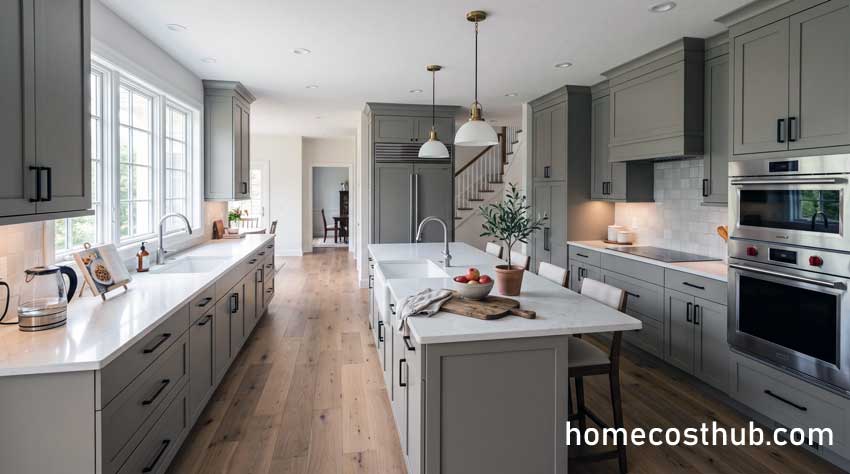
Interior Painting Cost Calculator

Interior Painting Cost Calculator Cost Guide
An Interior Painting Cost Calculator helps homeowners estimate the potential cost of painting interior walls, ceilings, trim, and multiple rooms before requesting professional quotations.
Interior painting prices can vary depending on total surface area, paint type, material quality, project scope, wall condition, application method, labour difficulty, removal requirements, and optional preparation work.
This cost calculator supports both USA cost estimates in US dollars and UK cost estimates in pounds sterling.
Users can enter the painting area in square feet or square meters and compare different project scenarios, from walls-only painting to a whole-house interior repaint. The resulting price estimate separates material cost, labour cost, installation cost, additional work, and removal expenses, making it easier to develop a realistic painting budget.
Interior Painting Cost Calculator
Estimate interior painting costs in the USA or UK based on project size, paint type, material quality, room scope, existing condition, application method, labour difficulty, removal work, and optional finishing features.
Please enter a valid value.
Removal Required
Additional Features
Additional features may include primer, trim and baseboards, doors, accent walls, stain blocking, crack filling, caulking, high-ceiling access, decorative finishes, or specialty coatings.
USA Interior Painting Cost Estimate
Total Estimate
$0
Painting Area: 0 ft²
Cost Breakdown
Materials $0
Labour $0
Installation $0
Additional $0
Removal $0
This calculator provides a preliminary planning estimate. Actual interior painting costs may vary based on wall height, surface preparation, paint coverage, number of coats, trim details, colour changes, repairs, room access, local labour rates, contractor pricing, taxes, and project-specific conditions.
FREE PDF ESTIMATE
Get Your Interior Painting Cost PDF
Enter your details below to receive your interior painting estimate, selected options, and complete cost breakdown as a downloadable PDF.
✓ Your PDF is ready!
Free Interior Painting Cost Calculator
Material / Project Types
Interior paint products vary in durability, washability, moisture resistance, finish quality, and price.
Standard interior latex or emulsion paint is suitable for many bedrooms, living rooms, hallways, and other general interior spaces. It typically provides a good balance between affordability, coverage, and durability.
Washable or scrubbable paint is useful for high-traffic areas such as hallways, family rooms, children’s rooms, and kitchens because the finished surface is easier to clean.
Moisture-resistant interior paint is commonly used in bathrooms, laundry rooms, kitchens, and other spaces exposed to higher humidity. These coatings generally cost more than basic interior paint.
Also Read:
Designer or specialty interior paint may include premium formulas, specialty finishes, enhanced durability, decorative coatings, or designer colour systems. These products can significantly increase material cost.
Project type also affects pricing. Painting walls only is generally less expensive than painting walls and ceilings, while a full-room project can include trim, baseboards, doors, and other detailed surfaces. Multiple-room and whole-house projects involve more total work but may benefit from economies of scale.
Main Factors Affecting Cost
Project size has a direct effect on paint quantity, primer, masking materials, rollers, brushes, and labour. Larger painting areas generally produce a higher total price estimate.
Material type influences material cost because specialty, moisture-resistant, washable, and designer coatings can cost more than standard paint.
Material quality affects coverage, durability, finish consistency, washability, and expected service life. Premium and luxury paint selections can increase the total project budget.
Project type determines the surfaces included. Walls-only projects are usually simpler than jobs involving ceilings, trim, doors, multiple rooms, or whole-house interiors.
Existing condition can substantially affect repair cost. Smooth, clean walls require less preparation, while cracks, stains, peeling paint, damaged plaster, damaged drywall, or uneven surfaces require additional work.
Installation type influences preparation and application. Basic application generally costs less than a standard prep-and-two-coat system, while custom work can include detailed cutting-in, specialty finishes, or complex colour schemes.
Labour difficulty accounts for high ceilings, stairwells, difficult access, detailed trim, occupied spaces, complex architecture, and other conditions that increase working time.
Removal requirements add cost when old wallpaper, peeling paint, loose coatings, or damaged finishes must be stripped or scraped before repainting.
Cost Breakdown
The Interior Painting Cost Calculator divides the estimated project total into five main categories.
Material Cost: Material cost includes paint, primer, caulk, filler, masking products, rollers, brushes, protective coverings, and other consumables required for the selected project.
Labour Cost: Labour cost covers surface preparation, masking, cutting-in, rolling, brushing, spraying where appropriate, cleanup, and other painting tasks.
Installation Cost: Installation cost represents the selected application standard. Standard preparation and two coats generally cost more than basic application, while custom finishes can increase installation cost further.
Additional Cost: Additional features may include primer, trim and baseboards, doors, accent walls, stain blocking, crack filling, caulking, high-ceiling access, decorative finishes, or specialty coatings.
Removal Cost: Removal cost covers scraping, stripping wallpaper, removing loose paint, and preparing deteriorated surfaces before new coatings are applied. If removal is not required, this category remains visible with a zero value.
Actual USA cost and UK cost figures can vary based on local labour rates, paint brand, room height, surface condition, number of coats, colour changes, taxes, contractor pricing, and project complexity.
Why Use This Calculator?
An Interior Painting Cost Calculator gives homeowners a convenient way to estimate an initial painting budget before contacting decorators, painters, or remodeling contractors.
Instead of relying on a single generic price-per-square-foot figure, the calculator adjusts the price estimate according to painting area, paint type, material quality, project scope, existing condition, installation method, labour difficulty, removal requirements, and optional features.
It can also help compare different project scenarios. Homeowners can evaluate walls-only painting against a full-room project, compare standard paint with premium washable coatings, or estimate the difference between painting one room and repainting an entire home.
The detailed breakdown makes it easier to understand how projected spending may be divided among material cost, labour cost, installation cost, additional preparation or upgrades, and removal.
The estimate should be treated as a preliminary planning guide rather than a guaranteed contractor quotation. Final pricing may also include drywall repair, plaster repair, wallpaper removal, trim replacement, ceiling repair, stain treatment, repair cost, replacement cost, and other property-specific requirements.
Interior Painting Cost Calculator: Understanding Your Estimate
Quick Answer
Use your Interior Painting Cost Calculator result as a budgeting benchmark, then compare contractor quotes against the same rooms, surfaces, preparation level, paint specification, and finish coats. A higher or lower quote is meaningful only when the underlying scope is comparable.
How to Read Your Interior Painting Cost Calculator Result
Your calculator result is a planning estimate based on the project conditions you selected. A painter’s quotation is a commercial offer based on an actual scope, while the final invoice may reflect approved changes or unforeseen work. Compare those three numbers only after confirming that they refer to substantially the same job.
The most useful first step is to stop looking at the total for a moment and check what the estimate assumes.
A $4,000 planning estimate and a $4,800 contractor quote may be closer than they first appear if the quote includes work that was not part of the calculator scenario. The reverse is also true: a $3,600 quote may look attractive until you find that ceilings, doors, substantial preparation, or a second finish coat are excluded.
Match the Rooms First
Confirm that both the estimate and the quotation cover the same rooms. A proposal described as “main living areas” may exclude closets, hallways, stairwells, utility rooms, or small connecting spaces.
For a project that needs a more focused single-room estimate, the Room Painting Calculator can help separate one room from a larger whole-house budget.
Then Match the Surfaces
“Paint bedroom” is not a complete scope description.
One contractor may mean walls only. Another may include the ceiling, baseboards, door frame, window trim, closet interior, and two doors.
Before judging the price, identify exactly which of these surfaces are included:
- Walls
- Ceilings
- Baseboards or skirting boards
- Crown molding, coving, or other trim
- Doors and door frames
- Window trim and returns
- Closet interiors
- Built-in shelving or painted joinery
Check the Preparation Standard
A quote that says “prep included” still needs context.
Light preparation may mean filling a few nail holes, sanding minor imperfections, and caulking limited gaps. Another contractor may include more extensive patching, stain blocking, adhesion work, or repair of deteriorated surfaces.
The word prep is not a standardized unit of work. The written proposal should make the intended preparation reasonably clear.
Check the Coating Specification
Confirm:
- paint product or product grade;
- finish or sheen;
- primer requirements;
- number of finish coats;
- special treatment for stains or color changes;
- who supplies the paint.
A quote stating “two finish coats of specified washable eggshell after spot priming repaired areas” gives far more information than “paint walls.”
Also Read:
Expert Tip
Compare scope before comparing price. Put each quote beside your calculator assumptions and mark every surface, preparation task, coating step, exclusion, and commercial term that differs. Once the scope is normalized, the price comparison becomes much more useful.
Why a Painter’s Quote May Not Match the Calculator
A contractor sees site conditions that a planning estimate cannot fully capture. Occupancy, difficult access, detailed cutting-in, protection requirements, uncertain substrates, minimum charges, and repair risk can all change the commercial quote without making the calculator estimate or the contractor price inherently wrong.
A site visit often reveals the difference between a straightforward repaint and a project that requires more labor control.
For example, an empty rectangular bedroom with clear access is easier to sequence than the same-size room filled with furniture, built-in shelving, multiple doors, intricate trim, and a ceiling that must remain usable between work stages.
Occupied Rooms Can Add Work Without Adding Paintable Area
Furniture may need to be moved, grouped, covered, and repositioned. Floors need protection. Access routes may need to remain open. Work may have to be split into smaller stages so the household can continue using the property.
None of these conditions increases wall square footage, yet each can affect labor time.
Access Can Matter More Than Room Size
A small stairwell with tall walls may require more setup and careful ladder or platform work than a larger bedroom with standard-height walls.
If the ceiling is a meaningful part of the project, a separate Ceiling Painting Calculator can help isolate that scope before you compare it with a contractor’s ceiling allowance.
Detail Work Changes Production Speed
Open wall areas can usually be coated faster than areas interrupted by:
- multiple windows;
- door casings;
- built-in cabinets;
- decorative molding;
- radiators or fixed features;
- closely spaced color transitions.
Less wall area does not always mean less labor. Openings reduce the broad painted surface but create more edges that may require cutting-in and masking.
Minimum Charges and Business Costs Are Real Commercial Factors
A contractor price is not simply an employee wage multiplied by painting hours.
For context, the U.S. Bureau of Labor Statistics painter wage data reports a median annual wage of $49,400 for construction and maintenance painters in May 2025. That is an employee wage statistic, not a residential contractor billing rate.
A contractor’s customer price may also need to cover estimating time, transportation, insurance, equipment, supervision, administration, business overhead, risk, and profit. A small project may therefore carry a minimum charge even when the paintable area is limited.
A quote above the calculator estimate is not automatically overpriced. A quote below it is not automatically a bargain. The useful question is: What explains the difference?
Compare Painter Quotes by Scope, Not Headline Price
A practical quote comparison has three layers: scope, specification, and commercial terms. If two proposals differ materially in any of those areas, comparing only the final totals can produce the wrong decision.
1. Scope
Scope answers:
What work is actually included?
It covers rooms, surfaces, preparation, repairs, access work, protection, cleanup, and any removal or restoration.
2. Specification
Specification answers:
What finish is being promised?
It may identify the paint system, primer, finish coats, sheen, product grade, color scheme, and treatment of repaired or stained areas.
3. Commercial Terms
Commercial terms answer:
Under what financial and contractual conditions is the work being offered?
They include exclusions, allowances, tax or VAT, payment stages, change-order treatment, and sometimes responsibility for moving furniture or supplying paint.
| Quote Item | Quote A | Quote B | What to Verify |
|---|---|---|---|
| Rooms included | Living areas | Named rooms listed | Are hallways, closets, and stairs included? |
| Walls | Included | Included | Are all walls included or only specified rooms? |
| Ceilings | Not stated | Selected ceilings included | Identify each ceiling in scope. |
| Trim / baseboards / skirting | Excluded | Included in named rooms | Which trim elements and how many coats? |
| Doors and frames | Extra | Four doors and frames included | Confirm faces, edges, frames, and finish. |
| Preparation | “Standard prep” | Localized filling and sanding listed | Ask what defects are included. |
| Repairs | Extra if required | Minor localized repairs included | Define the boundary between prep and repair. |
| Primer | As needed | Spot primer on repairs and stains | Clarify when full or spot priming applies. |
| Finish coats | Not stated | Two specified finish coats | Do not assume coat count. |
| Paint product | Contractor grade | Named product and sheen | Compare product specification, not brand name alone. |
| Surface protection | Basic covering | Floors and furniture protected | Clarify who moves and covers contents. |
| Cleanup | Not stated | Daily and final cleanup included | Confirm final condition and disposal responsibility. |
| Exclusions | Repairs, trim, furniture movement | Major substrate repairs | Identify work that may become an extra. |
| Tax / VAT | Check proposal | Check proposal | Confirm whether applicable tax is included. |
A price difference becomes much easier to evaluate once the comparison reaches this level.
What Is Often Missing From an Interior Painting Quote?
The most troublesome omissions are often small surfaces and support tasks rather than the main walls.
“Paint walls and trim” may sound specific, yet it can still leave several unanswered questions.
Detailed Surfaces
Check the written scope for:
- closet interiors;
- window returns;
- door edges;
- door frames;
- baseboards or skirting boards;
- crown molding or coving;
- architraves;
- stair rails, strings, or other painted stair components;
- built-in shelving;
- other existing painted woodwork.
If trim represents a significant share of the work, the Trim Painting Calculator can help separate detailed woodwork from the broad wall-painting budget.
Preparation Tasks
Ask how the contractor treats:
- old screw and nail holes;
- localized cracking;
- failed caulk joints;
- patched drywall or plaster;
- water stains after the moisture source has been resolved;
- spot primer;
- stain-blocking primer;
- minor sanding between preparation and coating.
Room Protection and Handover
The proposal should make practical responsibilities clear where they matter.
Questions worth asking include:
- Who moves large furniture?
- Who removes wall-mounted items?
- Who protects floors and remaining furniture?
- Is daily cleanup included?
- Who disposes of masking materials and project debris?
- Does the room need to be empty before work starts?
Not every painter needs to include every task. The problem arises when one party assumes an item is included and the other assumes it is not.
When Wall or Ceiling Damage Becomes a Separate Repair Decision
Minor filling and sanding normally sit within painting preparation. Widespread drywall failure, loose plaster, active moisture, recurrent cracking, or extensive peeling can cross into separate repair work. Price those conditions separately when they affect the substrate rather than treating every defect as ordinary paint preparation.
Typical Painting Preparation
Small defects that may fit within normal prep include:
- small nail or screw holes;
- minor localized filling;
- light sanding;
- limited caulking;
- spot priming repaired areas.
The exact inclusion still needs to be confirmed in the proposal.
Conditions That May Need Separate Repair Scope
Treat the issue more cautiously when you see:
- widespread damaged drywall;
- loose or hollow plaster;
- recurrent cracks;
- significant water damage;
- active dampness or moisture;
- soft or failed substrate;
- large areas of peeling linked to an unresolved underlying condition.
Painting over a substrate problem may improve appearance temporarily without solving the reason the finish failed.
For older plaster surfaces, the Plaster Repair Calculator can help frame the repair budget separately. Where damaged gypsum board needs more than minor patching, use the Drywall Calculator to separate repair scope from repainting.
Do not ask a painting estimate to carry the uncertainty of unresolved moisture, structural movement, or substrate failure. Resolve or define the repair scope first.
US vs UK Interior Painting Quotes: What Changes?
US and UK painting estimates should be treated as separate market contexts. The US commonly uses square feet, gallons, labor, and baseboards; UK quotes may use square metres, litres, labour, skirting boards, and architraves. VAT also requires specific attention in UK proposals.
| Quote Context | United States | United Kingdom |
|---|---|---|
| Trade wording | Painter / painting contractor | Painter and decorator |
| Labor spelling | Labor | Labour |
| Typical area units | Square feet | Square metres |
| Paint volume | Gallons / quarts | Litres |
| Lower wall trim | Baseboards | Skirting boards |
| Door/window trim | Casing / trim | Architraves |
| Tax issue to check | Applicable state/local tax treatment | VAT where applicable |
Do Not Treat Currency Conversion as Market Pricing
Converting a US estimate from dollars to pounds does not create a UK painting price.
The two markets can differ in labor conditions, contractor overhead, measurement conventions, product distribution, tax treatment, regional demand, housing stock, and quoting practice.
A valid US comparison should remain in USD and the relevant US market context. A UK comparison should use GBP and UK-specific assumptions.
Check VAT on UK Quotations
According to GOV.UK VAT rates, the standard UK VAT rate is 20% for most goods and services.
That does not mean every decorating quote should simply receive another 20% at the end. VAT treatment depends on the supplier’s circumstances and the applicable rules. Check whether the contractor is charging VAT and whether the quoted figure is VAT-inclusive or VAT-exclusive.
Also Read:
A proposal stating:
£X including VAT
is commercially different from one stating:
£X plus VAT
if VAT applies.
Older Painted Surfaces Can Change the Risk, Not Just the Price
Old coatings deserve attention when the planned preparation could disturb them. The concern is not the age of the room by itself; it is the possibility that sanding, scraping, cutting, or stripping may release hazardous material from older paint layers.
United States: Pre-1978 Housing
The EPA Renovation, Repair and Painting guidance for homeowners explains that pre-1978 homes are more likely to contain lead-based paint and that renovation, repair, and painting activities that disturb old painted surfaces can create hazardous lead dust.
Paid contractors performing covered work in pre-1978 housing can be subject to EPA Renovation, Repair and Painting requirements. EPA guidance also distinguishes ordinary homeowner DIY situations from compensated renovation work, while still recommending lead-safe practices for DIY projects involving relevant surfaces.
A routine repaint over sound, undisturbed coatings is not the same risk scenario as aggressive sanding or removal.
United Kingdom: Older Paint Layers
The HSE guidance on removing old lead-containing paint identifies old paint removal and dry sanding as situations where lead exposure can become a concern.
Older paint does not automatically contain lead. Age, coating history, condition, and the type of preparation matter.
If a contractor expects substantial sanding, stripping, or removal of old coatings, clarify the safety approach and scope before comparing that proposal with a quote based on simple repainting.
DIY vs Professional Interior Painting: What Are You Trading?
DIY can reduce paid labor but transfers preparation, protection, application, cleanup, scheduling, and finish risk to the homeowner. Professional work becomes more attractive as repairs, access difficulty, detailed trim, occupied-room sequencing, or finish expectations become more demanding.
DIY Interior Painting
Pros
- Direct control over schedule and pace.
- No paid painting labor for work you perform yourself.
- Practical for limited, accessible rooms with sound surfaces.
- Easy to pause between rooms when the project is not time-sensitive.
Cons
- Preparation and masking can take longer than expected.
- High ceilings and stairwells create access challenges.
- Detailed cutting-in and trim work require patience.
- The project can keep rooms disrupted for longer.
- Old coatings may introduce safety considerations during aggressive preparation.
Professional Interior Painting
Pros
- More predictable labor sequencing.
- Better suited to large multi-room projects.
- Useful where access and detailed trim slow production.
- Clearer assignment of responsibility when written scope is strong.
- Can reduce the homeowner’s time commitment.
Cons
- Higher cash outlay than supplying only DIY materials.
- Poorly defined quotes can make comparison difficult.
- Exclusions or changes can increase final cost if scope is vague.
- Scheduling must fit contractor availability and household access.
The decision is less about finding a universal “cheapest” approach and more about deciding which risks and responsibilities you want to retain.
Decision Tree: What Should You Do After Getting Your Estimate?
1. Does the contractor quote describe the same rooms and surfaces as your calculator scenario?
→ Yes: Compare preparation and coating specification.
→ No: List the missing or additional surfaces and normalize the scope before comparing totals.
2. Are preparation, primer, paint product, coat count, protection, and cleanup reasonably clear?
→ Yes: Move to exclusions and commercial terms.
→ No: Request written clarification before treating the quote as comparable.
3. Are there widespread damaged surfaces, active moisture, loose plaster, or major substrate problems?
→ Yes: Resolve or separately price the repair issue before relying on the painting quote as a full project cost.
→ No: Continue the comparison.
4. Will old painted surfaces require substantial sanding, scraping, or stripping?
→ Yes: Check the applicable safety requirements and the contractor’s proposed preparation method.
→ No: Continue to commercial comparison.
5. Are the remaining quotes based on materially similar scope?
→ Yes: Compare total price, contractor suitability, schedule, payment terms, exclusions, and warranty language if provided.
→ No: Do not choose based on headline total alone.
Illustrative Case Study: Same Interior, Different Quote Scope
Illustrative Scenario — Not Market Data
These figures are illustrative only and are not market averages.
Consider a US homeowner planning to repaint several rooms. The surfaces are generally sound, with minor nail holes and localized patching. The calculator scenario includes the primary walls, selected ceilings, and painted trim.
The planning estimate is:
$4,500
Two hypothetical quotations arrive.
Quote A: $4,150
The proposal includes:
- walls in the named rooms;
- limited surface preparation;
- paint supplied by the contractor;
- basic cleanup.
But the proposal:
- excludes trim;
- does not clearly include the selected ceilings;
- does not state the finish-coat count;
- excludes furniture moving;
- prices repairs beyond basic filling separately.
Quote B: $5,050
The second proposal includes:
Also Read:
- the same walls;
- the selected ceilings;
- baseboards and specified trim;
- localized filling;
- spot priming of repaired areas;
- two specified finish coats;
- floor and furniture protection;
- final cleanup.
Quote A appears $900 below Quote B, but the two offers are not yet pricing the same finished project.
The homeowner’s next step is not to select Quote A because it is cheaper or Quote B because it is more detailed. The useful next step is to ask Quote A for the price and specification needed to include the missing ceilings, trim, coat requirements, and comparable protection.
After that adjustment, one of three things may happen:
- Quote A remains materially cheaper for equivalent work.
- The prices become much closer.
- The homeowner chooses a reduced scope because the lower specification better matches the budget.
Each outcome can be rational. The decision becomes defensible only after the comparison is based on equivalent work.
Interior Painting Quote Checklist
Interior Painting Quote Checklist
- Confirm every room included in the quotation.
- Confirm whether walls, ceilings, trim, doors, and closets are included.
- Define what the contractor means by surface preparation.
- Identify repair work that is included and work treated as an extra.
- Confirm primer requirements and stain treatment where relevant.
- Confirm paint product or grade, sheen, and finish-coat count.
- Confirm who moves furniture and protects floors and contents.
- Confirm daily and final cleanup responsibilities.
- Identify exclusions, allowances, and potential change-order items.
- Check whether applicable sales tax or VAT is included.
- Compare each proposal against the same scope before comparing totals.
Interior Painting Estimate Myths That Distort Quote Comparisons
Fact
A real quote can reasonably differ because it reflects actual scope, preparation, coating specification, access, exclusions, and commercial terms that may not match the planning scenario.
Fact
A lower price can reflect fewer surfaces, less preparation, fewer specified coats, more exclusions, or a different paint specification. Compare equivalent scope before judging value.
Fact
Preparation can range from light filling and sanding to more substantial patching, stain treatment, or substrate work. The proposal should define the intended preparation standard.
Fact
Currency conversion does not reproduce UK labour conditions, contractor overhead, housing characteristics, trade terminology, VAT treatment, or regional pricing.
Fact
Openings reduce broad wall surface, but they can add edges, cutting-in, masking, trim, frames, and detail work that slow production.
Interior Painting Cost Calculator FAQs
How accurate is an Interior Painting Cost Calculator?
It is best used as a planning estimate rather than a guaranteed quotation. Accuracy improves when the selected area, surfaces, condition, preparation level, material assumptions, and project scope closely reflect the actual property.
Why is my painter’s quote higher than the calculator estimate?
The quotation may include additional surfaces, more preparation, difficult access, higher coating specifications, protection work, minimum charges, repairs, taxes, or other project-specific requirements. Ask the contractor to identify the scope behind the difference.
Why is my painter’s quote lower than the estimate?
The contractor may be pricing a narrower scope, using different preparation assumptions, excluding ceilings or trim, specifying fewer coating steps, or simply operating with a different commercial cost structure. Confirm the inclusions before treating the lower figure as equivalent.
Should ceilings be included in an interior painting quote?
Only if the written scope says they are included. “Interior painting” does not guarantee that ceilings are part of the proposal. Ask for the included ceilings to be identified by room.
Are baseboards or skirting boards normally included?
Do not assume they are. Some contractors price walls separately from trim or woodwork. The proposal should identify baseboards in the US or skirting boards in the UK when they form part of the project.
Should paint and primer be itemized separately?
They do not have to appear as separate prices for a quote to be useful, but the coating system should be clear enough to understand what is promised. Ask when primer will be used, which finish coats are included, and who supplies the products.
Can a contractor quote change after work starts?
A quote can change when the agreed scope changes or when previously hidden conditions require work that was not included. Before work begins, review the proposal’s exclusions and ask how additional work will be authorized and priced.
Does changing from a dark color to a light color affect the scope?
It can. Strong color changes may affect primer choice, coverage, and the number of coating steps needed to reach an even finish. Ask the painter to specify the proposed coating system rather than assuming every color change receives the same treatment.
How should UK homeowners check whether VAT is included?
Read the quotation for wording such as “including VAT,” “plus VAT,” or a separate VAT line. If the treatment is unclear, ask the painter and decorator to confirm it in writing before comparing the total with another proposal.
Cost Summary
Treat your calculator result as a planning benchmark, not the final measure of a contractor’s price. Compare real quotations only after the rooms, surfaces, preparation standard, paint specification, coat count, exclusions, repair responsibilities, and applicable tax or VAT treatment are reasonably aligned.
If the same project also includes outdoor repainting, price that work separately with the Exterior Painting Cost Calculator rather than blending exterior access, preparation, and coating requirements into the interior estimate.
For related wall, ceiling, trim, and painting budget tools, continue through the Painting & Finishing section.
About the Author
Arden Cole Linscott
Expert — Residential Construction & Remodeling Cost Analysis
Arden Cole Linscott focuses on residential construction and remodeling cost analysis, with an emphasis on practical homeowner budgeting, project-scope interpretation, quote comparison, and evidence-based decision support.
Scroll to bottom
Remodeling Cost Calculators