Appliance Upgrade Calculator

Appliance Upgrade Calculator Cost Guide
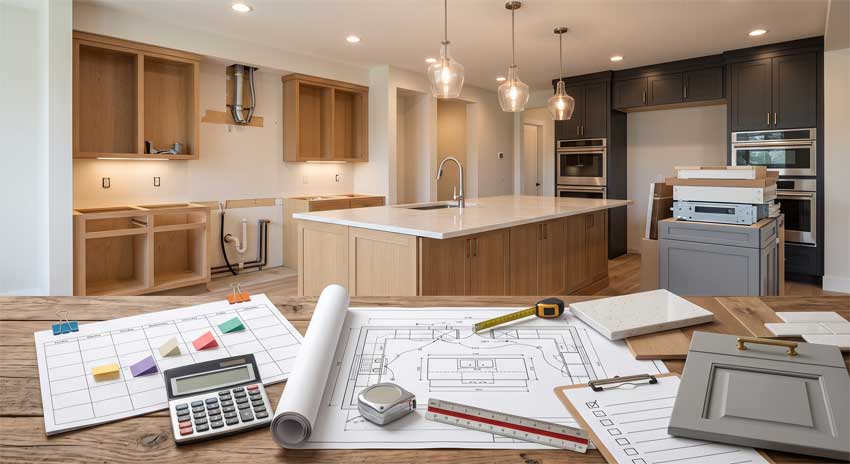
An Appliance Upgrade Calculator helps homeowners estimate the potential cost of replacing or upgrading kitchen appliances before requesting detailed quotations from retailers, installers, electricians, plumbers, or remodeling contractors.
Appliance costs can vary widely depending on kitchen size, appliance package, brand level, product quality, project scope, existing condition, installation complexity, labour difficulty, removal, and utility modifications.
This cost calculator supports both USA cost and UK cost estimates, displaying results in USD or GBP while allowing kitchen size to be entered in square feet or square meters.
It separates material cost, labour cost, installation cost, additional upgrades, and removal expenses to provide a practical price estimate for standard stainless packages, premium appliances, professional-style equipment, and smart or integrated kitchen appliance projects.
Appliance Upgrade Calculator
Estimate kitchen appliance upgrade costs in the USA or UK based on kitchen size, appliance package, quality, project scope, existing condition, installation complexity, labour difficulty, removal, and optional upgrades.
Please enter a valid value.
USA Appliance Upgrade Estimate
$0
Kitchen Size: 0 ft²
Cost Breakdown
Materials $0
Labour $0
Installation $0
Additional $0
Removal $0
This estimate is intended for preliminary budgeting. Actual appliance upgrade costs may vary based on appliance brand, model, dimensions, efficiency, delivery, built-in cabinetry, ventilation, electrical service, plumbing connections, gas work, local labour rates, taxes, and installer pricing.
FREE PDF ESTIMATE
Get Your Appliance Upgrade Estimate PDF
Enter your details below to receive your appliance upgrade estimate, selected package and upgrade options, and complete cost breakdown as a downloadable PDF.
✓ Your PDF is ready!
Free Appliance Upgrade Calculator
Material / Project Types
Kitchen appliance upgrades can range from replacing one outdated appliance to installing a complete premium or integrated appliance package.
Basic appliance packages generally include entry-level refrigerators, ranges, dishwashers, and other essential appliances. These products are suitable for Budget remodeling projects where functionality and initial purchase price are the main priorities.
Standard stainless appliance packages are a popular option for many kitchen remodels. They typically combine modern finishes, improved efficiency, useful features, and mid-range pricing.
Premium appliance packages can include higher-capacity refrigerators, induction or upgraded cooking equipment, quieter dishwashers, advanced controls, and higher-quality finishes.
Also Read:
Professional-style appliances may include larger ranges, powerful cooktops, commercial-inspired ovens, premium refrigeration, and upgraded ventilation. These products often require additional installation work and utility capacity.
Smart or integrated appliance packages can include connected appliances, built-in refrigeration, concealed dishwashers, integrated ovens, smart controls, and appliances designed to align closely with cabinetry.
Project type also affects the estimate. A single appliance replacement is generally much less expensive than a full kitchen upgrade. Integrated installations can require cabinetry modifications, specialty panels, precise fitting, electrical changes, plumbing work, and ventilation improvements.
Main Factors Affecting Cost
Appliance package type is one of the biggest factors affecting material cost. Entry-level products can be relatively affordable, while premium refrigeration, professional ranges, and integrated appliances can increase the budget significantly.
Material quality also changes the price estimate. Budget appliances generally offer essential features, while Premium and Luxury selections may include advanced cooking technology, quieter operation, higher-capacity refrigeration, smart connectivity, premium finishes, and designer styling.
Project scope has a major influence on replacement cost. Replacing one appliance in the same opening is typically straightforward, while changing multiple appliances or switching to built-in models can require modifications to cabinetry, countertops, electrical supplies, plumbing, or ventilation.
Existing condition affects repair cost and installation complexity. A kitchen with suitable electrical outlets, water connections, gas supply, and ventilation may require only minor installation work. Older or damaged connections may need repairs before new appliances can be safely installed.
Installation type also affects labour cost. Plug-in appliances are generally simpler, while built-in refrigerators, wall ovens, cooktops, ventilation systems, and integrated dishwashers require more precise fitting.
Labour difficulty can increase when appliances are oversized, access is restricted, floors need protection, cabinetry must be modified, or electrical, plumbing, gas, or ventilation systems need adjustment.
Additional features such as refrigerator replacement, upgraded ranges, wall ovens, dishwashers, range hoods, and utility modifications can significantly increase the total project cost.
Cost Breakdown
Material Cost: Material cost represents the estimated purchase value of the appliance package and associated components. It changes according to kitchen size, appliance type, quality level, project scope, and existing condition.
Labour Cost: Labour cost covers handling, positioning, fitting, adjustments, preparation, connection assistance, and other professional work required during the appliance upgrade.
Installation Cost: Installation cost represents the work associated with the selected installation type. Basic appliance swaps generally cost less, while built-in and custom installations can require cabinet modifications, dedicated connections, precise leveling, and specialist fitting.
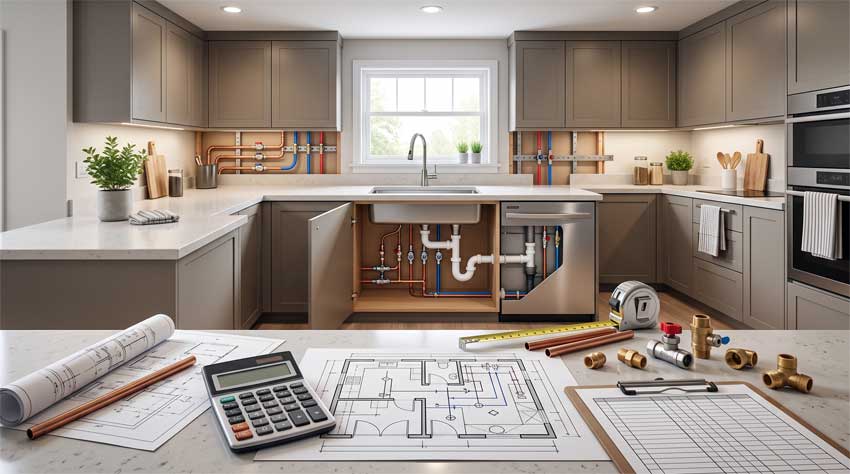
Additional Cost: Additional expenses can include refrigerator upgrades, ranges or cooktops, wall ovens, microwaves, dishwashers, range hoods, ventilation improvements, and electrical or plumbing modifications. Basic, Standard, and Advanced feature levels adjust these allowances.
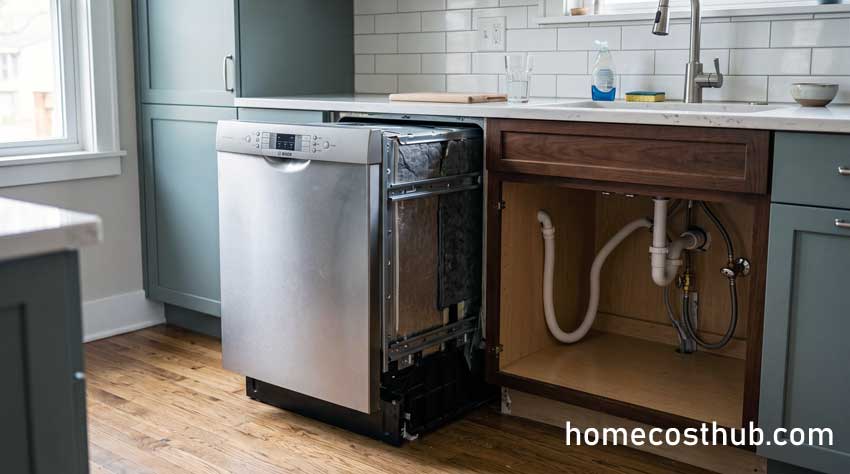
Removal Cost: Removal cost applies when old appliances must be disconnected, moved, hauled away, or disposed of before new equipment is installed. Heavy, oversized, built-in, or integrated appliances can increase removal requirements.
The calculator combines material cost, labour cost, installation cost, additional cost, and removal cost to generate the estimated total project price.
Why Use This Calculator?
The Appliance Upgrade Calculator provides homeowners with a practical starting point for budgeting before visiting appliance retailers or contacting installers and remodeling professionals.
It makes it easier to compare different upgrade strategies. Homeowners can compare a Standard appliance package with Premium, Professional, or Smart options, evaluate a single appliance replacement against a complete kitchen package, or see how custom installation affects the price estimate.
The calculator also helps identify costs beyond the appliance purchase price. Kitchen appliance projects can require delivery, removal, cabinet modifications, water connections, dedicated electrical circuits, ventilation changes, gas work, trim kits, mounting hardware, and professional installation.
USA and UK pricing are selected independently from the measurement system. USA estimates are displayed in dollars, while UK estimates are shown in pounds. Users may choose square feet or square meters regardless of country. When square meters are entered, the calculator converts the area internally using 1 square meter = 10.7639 square feet while continuing to display the original kitchen size in square meters.
The result is intended as a preliminary budgeting tool rather than a guaranteed retailer or contractor quotation, but it provides a useful starting point for comparing appliance installation cost, replacement cost, repair cost, material cost, labour cost, USA cost, UK cost, and an overall kitchen appliance price estimate.
Appliance Upgrade Calculator: Is an Upgrade Worth the Cost?
Quick Answer
An Appliance Upgrade Calculator helps compare the cost of keeping, repairing, or replacing an appliance against potential operating savings and payback. The strongest upgrade case usually combines an aging or unreliable appliance with meaningful annual savings and a replacement you expect to use long enough to recover the added cost.
A lower energy bill does not automatically make a new appliance a good investment. A refrigerator that saves $80 a year but requires a $1,500 upgrade is a very different financial decision from replacing a failing refrigerator that would have needed replacement soon anyway.
That is where the Appliance Upgrade Calculator becomes useful. Rather than looking only at the purchase price or efficiency label, the result can be interpreted alongside appliance age, repair history, expected remaining life, local energy rates, water use, and how long you expect to keep the property.
The goal is not always to find the newest appliance. It is to identify the point where keeping an existing unit stops being the stronger financial choice.
How to Read Your Appliance Upgrade Calculator Results
The Appliance Upgrade Calculator is most useful when its outputs are read together rather than as separate numbers. A low annual operating cost sounds attractive, but it matters far less if achieving that saving requires a large upfront investment.
Focus on four results.
Estimated upgrade investment represents the money committed to making the change after relevant credits, rebates, or other reductions are considered.
Annual operating savings shows the estimated difference between operating the existing appliance and the proposed replacement.
Payback period estimates how long those annual savings would take to recover the net upgrade investment.
Long-term savings looks beyond one year and helps show what may happen if the replacement remains in service long enough for the efficiency benefit to accumulate.
Suppose an appliance upgrade requires a $900 net investment and is estimated to reduce household operating costs by $90 per year. The simple energy-cost payback is about 10 years. That result does not mean the upgrade is automatically good or bad.
If the current appliance is failing and replacement is already likely, the $900 may represent money that would soon have been spent anyway. If the existing appliance is four years old, performs well, and has no repair history, replacing it solely for $90 in annual savings deserves much more scrutiny.
Treat the Appliance Upgrade Calculator as a planning and comparison tool, not a retailer quotation or guarantee of future utility savings. Energy prices, household use, repairs, and product performance can change after the estimate is made.
Also Read:
Is Upgrading an Old Appliance Actually Worth It?
Upgrading an old appliance is usually more attractive when the existing unit has high operating costs, declining reliability, limited remaining useful life, or a significant repair looming. An upgrade is less compelling when the current appliance is reliable, annual savings are small, and the replacement cost would take many years to recover.
Age gives the decision context, but age by itself is not a replacement order.
Two refrigerators of the same age may deserve different decisions. One may have needed several repairs and run continuously under heavy use. The other may still perform reliably with acceptable electricity consumption.
The Appliance Upgrade Calculator becomes more informative when you ask several questions alongside the result:
- Is the appliance working reliably today?
- Has repair frequency increased?
- Is a costly repair likely soon?
- How much does the appliance cost to operate each year?
- What would a realistic replacement cost to operate?
- How many years do you expect to keep the replacement?
- Will you remain in the home long enough to benefit from the savings?
- Is the upgrade solving a real functional problem or mainly adding features?
A new appliance may be more efficient without being cheaper on a total-cost basis. The financial case becomes stronger when replacement is already approaching for reliability reasons and the new model also reduces operating expenses.
Keep, Repair, Replace, or Upgrade?
The decision is broader than choosing between “old” and “new.” A homeowner normally has four realistic paths.
| Decision | Usually Makes Sense When | Main Financial Risk |
|---|---|---|
| Keep | The appliance works reliably and operating cost remains reasonable | An unexpected future breakdown |
| Repair | The fault is repairable at a reasonable cost and useful service life remains | Paying for repeated repairs |
| Replace | The appliance is failing, unsuitable, or approaching the point where continued repair is unattractive | Large upfront expense |
| Upgrade | A replacement solves reliability, performance, or efficiency problems and the added investment is justified | Savings taking too long to recover |
Keeping an appliance protects cash today. That has real value when the unit remains reliable and the efficiency difference between old and new equipment is modest.
Repairing can be financially sensible when one repair restores dependable operation without approaching the cost of a suitable replacement.
Replacing becomes more reasonable when reliability deteriorates, parts become difficult to obtain, or repair spending begins competing with the cost of replacement.
Upgrading goes a step further. You are not simply replacing a failed unit; you may be paying more for better efficiency, capacity, performance, convenience, or integration with a remodel.
The Appliance Upgrade Calculator helps put a number around that extra investment so the upgrade can be judged on more than product features.
Appliance Upgrade Payback Period Explained
Payback measures how long estimated operating savings would take to recover the net cost of the upgrade.
Appliance Upgrade Payback Formula
Payback Period = Net Upgrade Cost ÷ Annual Operating Savings
A shorter payback means the financial benefit is recovered sooner. A longer payback is not automatically unacceptable, but it should be compared with expected ownership, appliance life, and the alternative cost of keeping or repairing the existing unit.
Net Upgrade Cost
For decision-making purposes, net upgrade cost is the amount you actually need to spend to make the change after applicable incentives are deducted.
A simplified calculation is:
Net Upgrade Cost = Purchase and Upgrade-Related Cost − Applicable Rebates or Incentives
Do not reduce this figure by a rebate until you have confirmed that the appliance and household qualify.
US homeowners can check the official ENERGY STAR Rebate Finder for rebates and special offers available by ZIP code. ENERGY STAR states that products earning its label meet energy-efficiency specifications set by the U.S. Environmental Protection Agency.
Annual Operating Savings
Annual operating savings compare the cost of running the current appliance with the estimated cost of running the replacement:
Annual Operating Savings = Current Annual Operating Cost − New Annual Operating Cost
For appliances that use both electricity and water, a more useful comparison may include both.
The calculation should use the same assumptions on each side. Comparing the current refrigerator at your actual local electricity rate with a replacement using an outdated national rate can distort the result.
Simple Payback Example
Illustrative example — not a national average
Assume:
- Existing refrigerator annual operating cost: $180
- New refrigerator annual operating cost: $80
- Estimated annual savings: $100
- Net upgrade investment: $1,000
The calculation is:
$1,000 ÷ $100 = 10 years
The Appliance Upgrade Calculator would therefore show a simple payback of approximately 10 years.
A 10-year result needs context.
If the old refrigerator is around 15 years old, has begun showing reliability problems, and would probably require replacement regardless of efficiency, the decision may be reasonable because much of the purchase is replacing an aging asset.
If the refrigerator is only four years old and operating reliably, spending $1,000 today to recover the investment slowly through energy savings may be much harder to justify.
Upgrade Now or Wait Until the Appliance Fails?
Replacing before failure buys certainty, but waiting preserves the remaining economic value of equipment you already own. Neither approach is automatically cheaper.
Upgrade Now
Planned replacement gives you time to compare suitable products instead of buying under pressure after a breakdown.
Potential advantages include:
- lower operating expenses starting sooner;
- more time to compare efficiency and capacity;
- reduced exposure to an inconvenient breakdown;
- an opportunity to check rebates before purchasing;
- easier coordination with remodeling work already scheduled.
The financial drawback is straightforward: you spend money earlier.
Replacing a reliable appliance also gives up whatever usable life remained in the existing unit. When annual savings are small, that lost service life can matter more than the efficiency improvement.
Wait Until Replacement Is Necessary
Waiting allows a functioning appliance to continue producing value without another major purchase.
Potential benefits include:
- delaying capital spending;
- using more of the existing appliance’s service life;
- avoiding a replacement motivated only by cosmetic changes;
- retaining cash for higher-priority home repairs.
The trade-off is uncertainty. A sudden failure can mean emergency shopping, fewer model choices, food loss in the case of refrigeration, or a repair bill incurred shortly before replacement.
Consider a household whose working dishwasher could save an estimated $35 per year with a newer model. If replacing it costs hundreds of dollars and the present unit remains dependable, waiting may be reasonable.
Change the facts—a recurring leak, an expensive pending repair, and a kitchen renovation already underway—and planned replacement becomes easier to defend even if the energy-only payback remains long.
The Appliance Upgrade Calculator should therefore be read as part of a timing decision, not as a command to replace an appliance whenever savings appear.
Which Appliances Are Usually Worth Evaluating First?
There is no universal appliance that every household should replace first. A useful priority list combines energy use, age, usage frequency, repair risk, replacement price, and the efficiency difference between the old and new models.
Refrigerator
Refrigerators deserve close attention because they operate continuously. A particularly old or inefficient refrigerator may produce a more meaningful operating-cost gap than a lightly used appliance.
ENERGY STAR provides an official Flip Your Fridge Calculator specifically to estimate what an existing refrigerator or freezer costs to operate and potential savings from replacement.
The decision still needs to include condition and replacement cost. A refrigerator that is expensive to run and showing signs of failure is a different case from a reliable unit with only modest potential savings.
Also Read:
Once replacement looks likely, the Refrigerator Installation Calculator can help with the installation-planning side of the project.
Dishwasher
Dishwasher economics depend partly on how often the machine runs and how much electricity and hot water are involved.
Compare models using:
- annual or cycle-based energy consumption;
- water consumption;
- household usage;
- capacity;
- reliability;
- expected replacement cost.
A lightly used dishwasher may have a very different payback from one running almost every day.
Washing Machine
A washing machine can affect both energy and water consumption, so electricity alone may understate the operating difference.
Household habits matter too. Load frequency, wash temperature, machine capacity, and local water costs can change the result.
UK energy labels for washing machines include product-specific information such as energy consumption per 100 washes, capacity, program duration, water consumption, and noise information, according to Energy Saving Trust.
Clothes Dryer or Tumble Dryer
Dryers use energy to heat and move air, which makes usage frequency especially important.
A household drying several loads each week has more opportunity to recover an efficiency premium than a household that usually air-dries clothing and runs the dryer occasionally.
Compare the Appliance Upgrade Calculator result with actual household usage rather than assuming the same savings apply to every family.
Oven or Range
Cooking equipment should also be evaluated, but the financial case for an upgrade may be driven by more than energy consumption.
Reliability, cooking performance, fuel type, capacity, controls, and compatibility with the kitchen can matter as much as annual energy savings. If an oven is used relatively lightly, efficiency alone may produce a slower payback than expected.
Appliance Age and Remaining Useful Life Matter More Than Most People Expect
Calendar age is a clue, not an automatic replacement deadline.
A better question is: How much useful and reliable service is probably left?
Remaining useful life is influenced by:
- present condition;
- repair history;
- usage intensity;
- maintenance;
- availability of replacement parts;
- severity of current faults;
- whether previous repairs solved the underlying problem.
Suppose two appliances each produce projected savings of $75 per year after replacement.
One is operating reliably and has never required a major repair. The second has failed twice in the past year and now needs another costly service visit.
The Appliance Upgrade Calculator may show the same energy savings for both, but the replacement decision is not the same. Repair exposure makes the second appliance financially riskier to keep.
Expected homeownership also matters. A long payback is less useful to someone expecting to move in two years unless the upgrade has a separate resale, reliability, or remodeling benefit.
Old vs New Appliance Operating Costs
Operating cost is the recurring expense of using the appliance. It is separate from the purchase or upgrade cost.
For electric appliances, a basic annual energy calculation is:
Annual Electricity Cost = Annual kWh × Electricity Rate per kWh
Gas use and water consumption should be added where relevant.
Frequency matters as well. A manufacturer’s consumption estimate based on standardized testing provides a useful comparison between products, but it cannot reproduce every household’s behavior.
Illustrative example — not a national average
| Item | Existing Appliance | New Appliance |
| Annual electricity use | 700 kWh | 400 kWh |
| Electricity rate | $0.18/kWh | $0.18/kWh |
| Annual energy cost | $126 | $72 |
| Annual water cost | $0 | $0 |
| Total operating cost | $126 | $72 |
In this example, estimated annual savings are $54.
If the net upgrade investment were $900, the simple payback from electricity savings alone would be:
$900 ÷ $54 = about 16.7 years
That result is far less persuasive for a reliable, relatively young appliance than it may be for a unit already nearing replacement.
The Appliance Upgrade Calculator is most useful when the old and new assumptions are comparable and based on household-specific rates where possible.
How Electricity Prices Change the Upgrade Decision
The same appliance can produce different savings in different homes because electricity prices differ by location and tariff.
A 300-kWh annual reduction is worth:
- $45 per year at $0.15/kWh;
- $75 per year at $0.25/kWh.
The equipment did not change. The value of each saved kilowatt-hour did.
United States
The U.S. Energy Information Administration publishes official electricity sales and price data, including residential prices by state. Its Electric Power Monthly state price table demonstrates why a single US electricity assumption cannot accurately represent every household.
For the most useful Appliance Upgrade Calculator result, enter your recent electricity rate from your utility bill when that input is available.
United Kingdom
UK consumers also need to distinguish their actual tariff from a broad national assumption.
Ofgem’s price-cap information changes periodically. For July 1 through September 30, 2026, Ofgem lists an average electricity unit rate of 26.11 pence per kWh for a standard-variable-tariff customer paying by Direct Debit, based on an average across England, Scotland, and Wales. A household on another tariff or payment arrangement can pay a different rate.
That is exactly why a calculator should use the homeowner’s real rate whenever possible.
ENERGY STAR, EnergyGuide, and UK Energy Labels
Efficiency labels help compare products, but they answer different questions from an Appliance Upgrade Calculator.
A label may tell you how a product performs against an efficiency standard or comparable appliances. It does not know your existing appliance’s repair history, your purchase price, your planned ownership period, or the amount you will spend to make the change.
United States: ENERGY STAR
ENERGY STAR is administered by the U.S. Environmental Protection Agency. Products earning the label must meet program-specific efficiency requirements.
Use the official ENERGY STAR Product Finder to compare certified products and product details.
Certification can help identify efficient options, but it does not guarantee that replacing your current appliance will produce a short payback. That still requires comparing the old unit, new unit, purchase cost, operating savings, and expected service period.
United States: EnergyGuide
The Federal Trade Commission explains that the yellow EnergyGuide label helps consumers compare the energy use of similar appliances. The label includes energy-use information and, for applicable products, estimated operating-cost information.
The FTC also cautions that actual cost varies with household use and local energy prices. That makes the label a comparison input rather than a guaranteed utility bill.
See the FTC’s official guidance on how to use the EnergyGuide label.
Also Read:
United Kingdom: A–G Energy Labels
GOV.UK states that energy labels for certain products are being rescaled from the former A+++–G system to an A–G scale. The first phase of rescaling took place in March 2021.
See the official GOV.UK energy labelling guidance.
Energy Saving Trust also advises buyers to consider appliance size alongside the efficiency rating. Two products can have the same letter rating while the larger product consumes more energy in absolute terms.
That distinction matters when feeding data into an Appliance Upgrade Calculator.
| Market | Label / Program | Best Used For |
| United States | EnergyGuide | Comparing estimated energy consumption and operating cost between similar products |
| United States | ENERGY STAR | Identifying products that meet program efficiency criteria |
| United Kingdom | A–G energy label | Comparing energy performance and product-specific consumption information |
A rating should narrow your choices. Actual consumption, appliance size, usage, purchase price, and payback should finish the financial comparison.
Purchase Price vs Lifetime Cost
The cheapest appliance at checkout is not automatically the cheapest appliance to own.
A simple framework is:
Lifetime Cost Formula
Estimated Lifetime Cost = Purchase/Upgrade Cost + Operating Cost + Expected Maintenance and Repairs
This is an estimate rather than a prediction. No homeowner can know future repairs or energy prices with certainty.
Still, lifetime-cost thinking prevents a common mistake: comparing a $700 appliance with a $900 appliance while ignoring years of operating expense.
Hypothetical example:
Appliance A costs $700 and is expected to use $130 per year in energy.
Appliance B costs $900 and is expected to use $80 per year.
Ignoring repairs and other differences, Appliance B costs $200 more upfront but saves an estimated $50 per year to operate. The extra purchase cost would take four years to recover through operating savings.
That does not automatically make Appliance B the correct choice. Capacity, reliability, warranty terms, features, expected ownership, and household use still matter.
The Appliance Upgrade Calculator helps separate the emotional appeal of a lower utility number from the economics of paying more to obtain it.
When Energy Savings Do Not Justify Replacing a Working Appliance
A working appliance can be inefficient compared with a new model and still be the financially stronger appliance to keep for now.
Replacement based only on energy savings becomes less convincing when:
- the existing appliance is relatively young;
- reliability is good;
- the annual operating-cost difference is small;
- the replacement is expensive;
- the payback extends beyond expected ownership;
- the new model is being purchased mainly for appearance or convenience;
- the current appliance is unlikely to need a major repair soon.
Suppose a new dishwasher would save $25 per year but replacing the present one requires a $750 net investment. The energy-only payback would be 30 years.
If the old dishwasher is working well, the energy argument by itself is weak.
The decision can change when the replacement solves another real problem—poor performance, repeated leaks, reliability concerns, inadequate capacity, or a planned renovation that changes the appliance layout.
An Appliance Upgrade Calculator should clarify the economics, not pressure a homeowner into retiring functional equipment early.
When Replacing Before Failure Can Make Sense
Planned replacement can still be a rational choice before complete failure.
A stronger case exists when several signals appear together:
- reliability has declined;
- repairs are becoming more frequent;
- a significant repair is expected;
- operating cost is unusually high;
- the current appliance no longer fits household needs;
- replacement can be coordinated with work already planned;
- a verified rebate reduces the net upgrade cost;
- sudden failure would create major disruption.
Remodel timing can materially change the practical decision. If cabinets, countertops, plumbing, or electrical systems are already being altered as part of Kitchen Remodeling, coordinating an appliance change at the same time may avoid reopening finished work later.
That does not mean every appliance should be replaced during a renovation. Reliable equipment that fits the new layout may still be worth retaining.
Use the Appliance Upgrade Calculator to distinguish an upgrade that fits naturally into the project from one that merely enlarges the budget.
Repair vs Appliance Replacement
Repair deserves its own financial test because repairing an appliance normally preserves the existing operating efficiency rather than creating a new efficiency gain.
Ask:
- What does the repair cost?
- How serious is the fault?
- Has the same appliance needed repeated repairs?
- How much useful life might remain after repair?
- Are critical parts still readily available?
- How much would a suitable replacement cost?
- Would replacement reduce operating expenses materially?
- How disruptive would another breakdown be?
A $200 repair that provides several more dependable years may be a sensible use of money.
A similar $200 repair on a unit that has failed three times in a year may only postpone a replacement purchase.
If your decision has moved from “upgrade for better efficiency” to “keep repairing or replace the appliance,” compare those paths separately with the Appliance Replacement Calculator.
That distinction prevents energy savings from overshadowing a more immediate reliability problem.
Appliance Upgrade Decision Tree
Use this sequence when interpreting an Appliance Upgrade Calculator result.
1. Is the appliance operating safely and reliably?
No → Identify the fault, repair feasibility, and remaining service potential. Safety-related gas, electrical, or water problems should be handled by an appropriately qualified professional rather than treated purely as a payback decision.
Yes → Continue to Step 2.
↓
2. Is the appliance experiencing repeated repairs or showing clear signs that dependable service is declining?
Yes → Compare repair cost with replacement economics.
No → Continue to Step 3.
↓
3. Is the replacement materially cheaper to operate?
No → The upgrade needs another strong reason, such as function, reliability, capacity, remodeling requirements, or safety.
Yes → Calculate annual savings.
Also Read:
↓
4. Calculate the net upgrade investment.
Subtract confirmed rebates or incentives from the money required to make the upgrade.
↓
5. Calculate simple payback.
Net Upgrade Cost ÷ Annual Operating Savings = Payback Period
↓
6. Is the payback shorter than the period you reasonably expect to use the replacement?
Yes → The financial case becomes stronger.
No → Keeping or repairing may preserve more value unless reliability or practical needs change the decision.
↓
7. Check non-financial constraints.
Verify:
- size and clearance;
- electrical supply;
- water connection;
- gas connection where relevant;
- ventilation;
- household capacity requirements.
The decision tree does not replace professional evaluation of safety-related defects.
Pros and Cons of Upgrading Before an Appliance Fails
Pros
You can shop deliberately. A planned purchase gives you time to compare capacity, actual energy consumption, features, and installation requirements rather than buying whatever is available after an emergency failure.
Operating savings begin sooner. If the old appliance has high consumption, replacing it earlier captures savings earlier.
Breakdown exposure can fall. Replacing an appliance that is already showing reliability problems may reduce the risk of a disruptive failure.
Rebates can improve the economics. A verified incentive lowers net upgrade cost and can shorten payback.
Remodeling work may be easier to coordinate. Appliance selection can be aligned with cabinets, counters, ventilation, plumbing, and electrical work before finishes are complete.
Cons
Money leaves your household sooner. An early replacement consumes capital that could be used elsewhere.
Useful remaining life is lost. A reliable appliance still provides economic value simply by continuing to work.
Energy savings can have a long payback. A newer model may be more efficient without saving enough each year to recover the replacement cost quickly.
Future energy prices are uncertain. Payback calculations depend partly on assumptions about future operating costs.
New equipment can still require repairs. Buying newer or more complex equipment does not remove maintenance and failure risk.
The Appliance Upgrade Calculator helps quantify several of these trade-offs, but homeowners should still consider reliability and practical needs that cannot be reduced to one dollar figure.
Appliance Upgrade Financial Comparison
The table below separates three decisions that are often mixed together.
| Factor | Keep Existing | Repair Existing | Upgrade |
| Upfront spending | Low | Moderate | Highest |
| Near-term operating cost | Existing level | Usually existing level | Potentially lower |
| Breakdown risk | Depends on condition | May improve | Usually lower initially |
| Efficiency improvement | None | Usually none | Possible |
| Payback consideration | Not normally applicable | Compare repair cost with added useful life | Compare net upgrade cost with annual savings |
| Best fit | Reliable appliance | Repairable appliance with useful life remaining | Aging, unreliable, unsuitable, or high-cost appliance |
Actual outcomes vary by appliance, household use, repair cost, utility rates, and the replacement model selected.
Appliance Upgrade Summary
• Upgrade cost alone does not determine whether replacement is worthwhile.<br>
• Compare the existing appliance’s operating cost with a realistic replacement.<br>
• Appliance age matters most when combined with condition and repair exposure.<br>
• Calculate payback using the net upgrade investment and annual operating savings.<br>
• Use your actual electricity, gas, and water rates where possible.<br>
• A working appliance is usually worth replacing early only when the financial or practical case supports it.
Expert Tips Before Upgrading an Appliance
Use your real utility rate. A national average is useful for rough comparison, but your bill provides a better input for the Appliance Upgrade Calculator.
Photograph the existing connections before shopping. Photos of plugs, receptacles, water connections, shutoff valves, gas connections, vents, and surrounding cabinetry can make installation planning more accurate.
Measure the opening, access path, and required clearance. Nominal appliance width alone does not tell you whether the new unit will fit through a doorway, clear a countertop, ventilate properly, or allow doors and drawers to open.
Compare consumption, not marketing language. Energy labels and manufacturer data provide more useful input than broad phrases such as “eco” or “energy saving.”
Compare like with like. A larger refrigerator may consume more electricity than a smaller refrigerator despite having an excellent efficiency rating. Energy Saving Trust specifically advises buyers to consider size alongside the UK energy rating.
Check incentives before buying. Eligibility rules can determine whether a rebate should be included in the payback calculation.
Think about ownership duration. A seven-year payback deserves different treatment if you plan to own the appliance for 12 years than if you expect to move next year.
Do not treat safety repairs as optional financial experiments. Suspected gas, electrical, combustion, or significant water-supply problems should be evaluated by a qualified professional appropriate to the work.
Appliance Upgrade Decision Checklist
Appliance Upgrade Myths That Can Distort the Decision
Fact
Age alone does not determine whether replacement is financially worthwhile. Condition, operating cost, repair risk, replacement cost, and payback all matter.
Fact
Efficiency ratings must be read alongside appliance size, capacity, actual energy consumption, and household usage. A larger appliance can use more total energy even when its efficiency rating is strong.
Fact
Energy savings create a financial benefit only over time. The net upgrade cost, annual savings, ownership period, repair risk, and remaining life of the existing appliance determine whether the upgrade reaches break-even.
Common Appliance Upgrade Mistakes
1. Replacing a Reliable Appliance Based Only on Age
Age can justify closer evaluation. It does not prove that immediate replacement is the lowest-cost option.
2. Looking Only at Purchase Price
Purchase price says little about long-term ownership cost. Operating expenses and repair exposure matter too.
3. Using an Unrelated National Electricity Average
Local utility prices can materially change the Appliance Upgrade Calculator result. Use the rate from a recent bill when possible.
4. Treating an EnergyGuide Estimate as a Guaranteed Bill
The FTC explains that actual operating cost depends on how the appliance is used and local energy prices.
5. Ignoring Water Use
Dishwashers and washing machines can affect both energy and water expenses. Comparing electricity alone may miss part of the operating difference.
6. Treating Appliance Age as Remaining Useful Life
A well-functioning older appliance and a frequently repaired appliance of the same age do not present the same financial risk.
7. Ignoring Repair History
Repeated failures can make continued ownership expensive even when energy consumption is reasonable.
8. Comparing Ratings Without Comparing Size
UK guidance and Energy Saving Trust advice make clear that the rating should be considered with product-specific consumption and size.
9. Subtracting a Rebate Before Confirming Eligibility
An incentive shortens payback only if the household and selected product actually qualify.
10. Comparing Appliances With Different Capacity
A compact refrigerator and a large family refrigerator do not provide the same service. Efficiency comparisons should be made between products that meet the same household requirement.
11. Treating Simple Payback as Guaranteed ROI
Simple payback assumes the estimated savings occur as expected. It does not predict future repairs, energy-price changes, or how long the appliance will actually remain in service.
12. Replacing Several Appliances Without Prioritizing Them
If the budget is limited, calculate each appliance separately. The oldest appliance is not necessarily the one with the strongest financial case for replacement.
Case Study: When an Appliance Upgrade Makes Financial Sense
Illustrative scenario — all figures below are hypothetical and are not national averages.
A homeowner in the United States has an aging refrigerator that still runs but has recently required service. The homeowner is deciding whether to repair it again or purchase a more efficient replacement.
Existing Refrigerator
- Age: 15 years
- Estimated annual operating cost: $190
- Recent repair concern: intermittent cooling problem
- Hypothetical repair quote: $300
Proposed Replacement
- Purchase and basic upgrade-related cost: $1,250
- Hypothetical qualifying rebate: $100
- Net upgrade investment: $1,150
- Estimated annual operating cost: $90
Appliance Upgrade Calculator Result
Annual operating savings:
$190 − $90 = $100 per year
Simple payback:
$1,150 ÷ $100 = 11.5 years
Viewed only through energy savings, 11.5 years is a long recovery period.
Now add the replacement context.
The homeowner is already facing a $300 repair on a 15-year-old refrigerator with a recent cooling problem. If the repair were made, the household would still own the same older appliance with the same estimated $190 annual operating expense and no guarantee that another fault would not occur.
This does not prove that replacement is financially superior. The remaining life after repair is unknown.
It does show why the Appliance Upgrade Calculator should not be interpreted only as “11.5 years is too long.” If replacement is likely soon for reliability reasons anyway, much of the purchase price is a replacement expense rather than an efficiency investment.
ENERGY STAR provides its own refrigerator tool for consumers who want to estimate the operating cost of an older refrigerator and potential savings from replacement.
Change the scenario and the decision changes.
If the same $1,150 net investment were being considered for a reliable four-year-old refrigerator with no repair history, replacing it solely for $100 in annual energy savings would be much harder to justify.
The professional lesson is simple: payback needs a condition and timing context.
Frequently Asked Questions About Appliance Upgrades
Is it worth upgrading old appliances?
An upgrade is more likely to make financial sense when an older appliance combines high operating cost with poor reliability, repeated repairs, limited remaining life, or a replacement that offers meaningful savings. Age alone is not enough. Compare the net upgrade cost with annual savings and the period you expect to use the new appliance.
How much money can energy-efficient appliances save?
Savings depend on the difference between the existing and replacement appliance, household usage, and local utility rates. Compare annual kWh, water use where relevant, and your actual energy price. The Appliance Upgrade Calculator is more useful than a generic savings claim because it relates the operating difference to your upgrade investment.
Is it cheaper to repair or replace an appliance?
Repair can be cheaper when the fault is limited, the repair cost is reasonable, and the appliance still has dependable service life. Replacement becomes more attractive when repair bills repeat, reliability is declining, or a replacement also creates meaningful operating savings. Compare the repair path and replacement path separately.
Which appliance should I replace first?
Prioritize the appliance with the strongest combination of high operating cost, declining reliability, expensive repair exposure, limited remaining useful life, and meaningful replacement savings. Do not rank appliances by age alone. A reliable older oven may deserve lower priority than a younger refrigerator with repeated failures.
Does replacing an old refrigerator save money?
It can. Refrigerators operate continuously, so an inefficient older unit may offer meaningful savings when replaced. ENERGY STAR provides an official refrigerator calculator for estimating old-unit operating cost and potential replacement savings. The actual financial decision still depends on the replacement cost and condition of the existing refrigerator.
Should I replace an appliance before it breaks?
Planned replacement can make sense when reliability is declining, a major repair is approaching, a remodel is already underway, or a confirmed incentive improves the economics. A reliable appliance with modest operating savings may be worth keeping. Compare the cost of replacing now with the value of the useful life you would give up.
How do I calculate appliance payback?
Divide the net upgrade cost by annual operating savings:
Payback Period = Net Upgrade Cost ÷ Annual Operating Savings
If an upgrade costs $800 after rebates and saves $100 per year, simple payback is eight years. Compare those eight years with your expected ownership period and the likely condition of the current appliance.
Are ENERGY STAR appliances worth the extra cost?
ENERGY STAR identifies products that meet efficiency criteria set under the EPA program, but certification alone does not determine financial payback. Compare the certified model’s price and operating cost with a suitable alternative and with the appliance you already own.
Does a better UK energy rating always mean lower running costs?
Not necessarily in absolute terms. The A–G rating helps compare efficiency, while product size and capacity also influence total consumption. Energy Saving Trust advises consumers to consider the appliance size they need as well as its rating.
How does appliance size affect energy use?
Larger appliances often need more total energy because they cool, heat, wash, or dry a larger volume. That means two appliances with the same efficiency rating can have different consumption. Compare annual kWh or the product-specific consumption figure as well as capacity.
How do electricity prices affect appliance upgrade ROI?
Higher electricity rates increase the dollar or pound value of each kilowatt-hour saved. If two homes reduce consumption by the same amount but one pays more per kWh, that household receives greater annual financial savings and reaches payback sooner, assuming all other costs are equal.
Is upgrading several appliances at once cheaper?
It can reduce some project coordination or repeated service costs when appliances are being changed during broader work, but savings are not guaranteed. Each appliance should still have a clear reason for replacement. Do not replace a reliable unit simply because another appliance in the same kitchen has reached the end of its useful life.
How long should an appliance payback period be?
There is no useful universal cutoff. Compare the payback period with how long you expect to own and use the replacement. A six-year payback can be reasonable if the appliance would otherwise need replacement soon and you expect to keep it much longer. The same payback may be weak for a reliable appliance in a home you plan to sell shortly.
Is a working appliance worth replacing just to save energy?
Sometimes, but the savings need to justify giving up the remaining service life. Calculate the net upgrade cost and annual operating savings first. If the payback is very long and the current appliance is reliable, continued use may preserve more financial value.
Can rebates make appliance replacement worthwhile?
A rebate reduces the net amount you invest, so it can shorten the payback period. Confirm eligibility before including the incentive in the Appliance Upgrade Calculator. US consumers can search current offers by ZIP code through the official ENERGY STAR Rebate Finder.
About the Author
Arden Cole Linscott
Expert — Residential Construction & Remodeling Cost Analysis
Arden Cole Linscott focuses on interpreting residential construction, remodeling, appliance installation, replacement, and home-improvement cost factors for practical homeowner budgeting and project planning. His work emphasizes realistic comparisons, project-specific assumptions, and clear explanations of the financial trade-offs behind repair, replacement, and upgrade decisions.
Make the Upgrade Decision Based on Total Cost, Not Age Alone
A lower energy label, an aging appliance, or an attractive sale price is not enough by itself to justify replacement. The better decision combines what the appliance costs to keep, how reliably it is operating, what replacement would cost, and how much of that investment can realistically be recovered through lower operating expenses.
Use the Appliance Upgrade Calculator to compare those numbers, then apply the result to the condition of the appliance and your expected ownership period. A strong upgrade is not simply newer or more efficient—it solves a real household need while producing an acceptable financial trade-off.






Scroll to bottom
Remodeling Cost Calculators