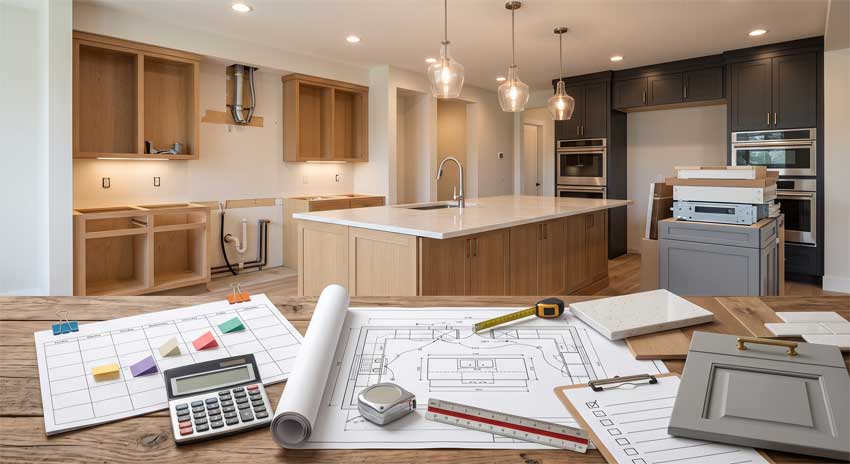
Demolition Cost Calculator

Demolition Cost Calculator Cost Guide
A Demolition Cost Calculator helps homeowners estimate the potential cost of removing existing walls, finishes, structural components, masonry, concrete, and other building materials before a remodeling project begins.
Demolition prices can vary considerably depending on the project area, material being removed, structural complexity, labour requirements, disposal needs, and site accessibility. This cost calculator provides a practical preliminary price estimate for residential demolition projects in both the USA and UK.
Users can enter the project size in square feet or square meters and compare different project types, material conditions, labour difficulty levels, site-protection requirements, and debris removal options. The estimate separates material cost, labour cost, site setup or installation expenses, additional services, and removal costs to make preliminary remodeling budgeting easier.
Demolition Cost Calculator
Estimate demolition and removal costs for residential remodeling projects in the USA and UK.
USA Demolition Cost Estimate
$0
Project Size: 0 ft²
Cost Breakdown
Materials $0
Labour $0
Installation $0
Additional $0
Removal $0
This calculator provides a preliminary demolition budget estimate. Actual prices can vary based on structural conditions, hazardous-material testing or abatement, permits, disposal fees, equipment access, debris weight, local labour rates, and contractor requirements.
FREE PDF ESTIMATE
Get Your Demolition Cost Estimate PDF
Enter your details below to receive your demolition cost estimate, selected options, and complete cost breakdown as a downloadable PDF.
✓ Your PDF is ready!
Free Demolition Cost Calculator
Material / Project Types
Demolition work varies significantly depending on the material being removed. Drywall and other lightweight interior materials are typically easier and less expensive to demolish than masonry or reinforced concrete.
Wood framing and finishes may require more careful dismantling, particularly when structural framing, cabinetry, subfloors, or built-in components are involved. Brick and masonry demolition usually requires heavier tools, additional labour, and more expensive debris disposal because of the weight of the material.
Concrete demolition can be among the more demanding project types. Breaking slabs, walls, foundations, or other heavy structural elements may require specialized demolition equipment and significantly more labour.
Project scope is equally important. Interior demolition may involve finishes and non-structural elements, while room or section demolition can include several building systems. Structural demolition can involve framing and load-bearing components, while whole-house demolition represents the largest and most complex category.
Also Read:
Main Factors Affecting Cost
Project size is one of the primary factors affecting a Demolition Cost Calculator estimate. Larger demolition areas generally require more labour hours, greater equipment use, additional site protection, and more debris disposal capacity.
The material being removed also has a major impact. Lightweight drywall is relatively easy to handle, while masonry and concrete typically increase demolition and removal expenses.
Material quality can affect the complexity of dismantling and disposal. Premium or luxury construction may contain heavier finishes, specialty assemblies, built-in components, or materials that require more careful removal.
Labour difficulty directly influences labour cost. Simple demolition with clear access is generally less expensive than work in restricted spaces, multi-story properties, occupied homes, or locations requiring extensive protection.
Existing condition also matters. Straightforward replacement work may be predictable, while selective demolition for a repair cost project can require slower and more careful removal to preserve adjacent construction.
The final replacement cost of a remodeling project may also be affected by how carefully demolition is performed, since unnecessary damage to surrounding surfaces can increase the amount of rebuilding required afterward.
Cost Breakdown
The calculator separates the estimated demolition expense into five categories.
Materials represents consumable materials and demolition-related supplies associated with the selected material type, project condition, and project complexity. These can include protective materials, blades, fasteners, temporary coverings, and other project consumables.
Labour estimates the workforce expense required to dismantle, break, separate, carry, and prepare demolished materials for disposal. More difficult projects receive a higher labour cost estimate.
Installation represents site setup and protection expenses. Although demolition itself does not involve traditional installation, the installation cost category accounts for temporary protection, containment, work-area preparation, and heavy-duty site setup selected by the user.
Additional costs can include dumpster or skip rental, material salvage and sorting, dust containment, heavy equipment access, and the selected additional-feature level.
Removal covers debris handling and disposal. This amount depends on the type of material, project complexity, existing condition, and labour difficulty. If debris removal is not required, the calculator displays the removal category as zero.
Why Use This Calculator?
The Demolition Cost Calculator gives homeowners a convenient starting point for planning the demolition portion of a renovation or remodeling budget. It can help compare a simple interior strip-out with more complicated structural or whole-house demolition.
Users researching USA cost receive estimates in US dollars based on USA-oriented pricing assumptions. Homeowners researching UK cost receive results in pounds sterling using UK-oriented pricing assumptions. Measurement units remain independent of country selection, so homeowners can work in either square feet or square meters.
The calculator is also useful for understanding how heavy materials, difficult access, debris disposal, specialized equipment, site containment, and material salvage can change a demolition price estimate.
Actual contractor quotations may include additional expenses for permits, utility disconnection, structural engineering, environmental testing, and hazardous-material handling. These project-specific items should be evaluated separately when applicable.
Demolition Cost Calculator: Understanding Your Estimate
Quick Answer
A Demolition Cost Calculator gives you a useful budgeting baseline, not a fixed contractor price. Compare the result with the exact demolition scope, debris disposal, foundation work, utilities, permits or notices, hazardous-material requirements, and site restoration included in each quote.
How to Read Your Demolition Estimate
The most useful way to read a demolition estimate is as a scope-based planning number. It shows what a project may cost under the conditions entered, but a contractor still has to price the actual building, access, work sequence, disposal route, safety measures, and contractual responsibilities.
Four numbers or documents that may look similar can mean very different things:
- Budget estimate: an early planning figure used to decide whether a project is financially realistic.
- Allowance: an amount reserved for a cost that is not yet known precisely, such as disposal or hazardous-material work.
- Contractor quotation: a proposal based on a stated scope, assumptions, inclusions, exclusions, and commercial terms.
- Final project cost: what is actually paid after approved changes, measured quantities, unforeseen conditions, or allowance adjustments are resolved.
A calculator result can be close to a contractor quotation and still cover a different scope. For example, one estimate may assume that demolished material is loaded and removed, while a contractor may price demolition labor separately from dumpster rental and landfill charges.
The same issue applies to structural work. “Remove the building” does not necessarily mean “remove every footing, foundation wall, slab, utility connection, and underground element.” Those responsibilities should be stated rather than assumed.
Expert Tip
Before comparing bids, write one scope list and ask every demolition contractor to price the same work. Comparing identical inclusions and exclusions is more useful than comparing bottom-line totals alone.
What Should a Demolition Quote Clarify?
A demolition quote should make it possible to identify exactly what the contractor intends to remove, what will remain, who handles the waste, and which items could create extra charges.
For selective demolition, the description should be especially precise. Removing drywall while preserving framing, wiring, flooring, cabinetry, or adjacent finishes requires a different approach from stripping a room back to the structure. If your project is limited primarily to gypsum board removal, the Drywall Removal Calculator can provide more focused budgeting context.
Scope of Removal
Look for a clear description of the components included in demolition. A useful scope might distinguish walls, ceilings, finishes, flooring, cabinetry, framing, masonry, concrete, fixtures, or structural elements instead of using a broad phrase such as “demo room.”
It should also identify what must remain undamaged. This matters when the contractor is working beside finished floors, reusable cabinetry, windows, structural framing, mechanical equipment, or adjoining occupied areas.
Site Protection and Containment
For interior projects, ask whether the quote includes temporary barriers, floor protection, dust control, protection of circulation routes, and cleanup. These measures can affect both the price and the condition of the home after demolition is finished.
Equipment and Access Assumptions
A contractor may base the price on being able to place a dumpster near the work area or bring machinery directly to the structure. A narrow driveway, limited overhead clearance, steep grade, occupied building, neighboring property, or restricted rear-yard access can change the method even when the quantity of material stays the same.
Allowances and Exclusions
Words such as allowance, provisional, excluded, by owner, or subject to field conditions deserve attention. They indicate that the quoted total may not represent the entire financial exposure.
If disposal is an allowance, for example, ask what quantity or weight the allowance covers and what happens when the project exceeds it.
How to Compare Two Demolition Quotes Fairly
Do not normalize bids by price alone. Normalize the scope first. A $9,000 proposal with several exclusions may not be cheaper than an $11,000 proposal that includes debris disposal, site protection, equipment, and final cleanup.
The table below shows a practical way to compare bids without relying on fabricated market rates.
| Scope Item | Quote A | Quote B | What to Verify |
|---|---|---|---|
| Demolition labor | Included | Included | Same removal scope and work area? |
| Equipment | Included | Not stated | Excavator, breaker, lifts, or small plant charged separately? |
| Site protection | Included | Excluded | Floors, doors, access routes, dust barriers, adjoining finishes? |
| Debris loading | Included | Included | Does this include moving debris from the work area to the container? |
| Dumpster / skip | Included | Allowance | Container size, rental duration, number of collections? |
| Disposal fees | Allowance | Included | Weight limits and excess-tonnage or tipping charges? |
| Foundation removal | Excluded | Not stated | Slab, footings, basement walls, and below-grade concrete? |
| Utility disconnection | Excluded | Excluded | Who coordinates gas, electric, water, sewer, or other services? |
| Permit / notice responsibility | Owner | Contractor | Who applies, coordinates, and pays required fees? |
| Hazardous materials | Excluded | Excluded | Testing, abatement, notification, and disposal responsibilities? |
| Final grading / backfill | Excluded | Included | Condition in which the site will be left? |
If a line item says “not stated,” do not automatically treat it as included. Ask for clarification in writing before comparing the final totals.
Debris Disposal Can Change the Real Project Budget
Debris disposal is more than placing demolished materials in a container. A contractor may need to account for loading, sorting, container rental, transport, weight limits, disposal fees, multiple trips, and restrictions on mixing certain materials.
For US Projects
Common quote language may refer to dumpsters, cubic yards, hauling, tons, landfill charges, tipping fees, or excess-weight charges. A container price may include a stated weight allowance, with extra charges if heavy concrete, masonry, plaster, roofing, or mixed construction debris pushes the load above that limit.
Also Read:
For UK Projects
Quotes may refer to skips, larger roll-on/roll-off containers, tonnes, cubic metres, haulage, and tipping charges. Waste responsibilities also have a legal dimension. GOV.UK’s Waste Duty of Care Code of Practice for England and Wales states that when a tradesperson produces waste while carrying out work at a domestic property, the tradesperson is responsible for that waste and its transport and disposal. The guidance also addresses householders’ responsibilities when transferring their own waste.
When reviewing a quote, ask whether disposal is fixed, measured after the work, or handled as an allowance. Those three arrangements expose the homeowner to different levels of cost uncertainty.
Foundation Removal Can Be a Separate Demolition Scope
Removing a structure above ground and removing everything below it are not the same job. Foundation work can add concrete breaking, excavation, heavier equipment, loading, disposal, backfill, compaction, and grading.
The difference becomes more important when the building has:
- a slab-on-grade that must be broken out;
- continuous concrete footings;
- a crawlspace foundation;
- basement walls and a basement slab;
- retaining structures;
- deep or reinforced concrete elements.
Before accepting a whole-house demolition quotation, ask what condition the contractor will leave the site in. “Structure removed” could leave an existing slab in place. “Clear site” may still need clarification about footings, imported fill, compaction, rough grading, utility capping, and buried material.
The correct approach also depends on what comes next. A future addition, new house, driveway, landscape area, or replacement foundation may require a different final site condition. Removing something that the next phase could have reused can be just as inefficient as leaving something that later has to be excavated again.
Hazardous Materials Need to Be Resolved Before the Scope Is Final
Suspected asbestos or other regulated materials should not be treated as a minor demolition allowance without investigation. The material type, building type, jurisdiction, planned disturbance, and applicable rules can change the required work method.
In the United States, EPA explains that federal asbestos NESHAP requirements apply to specified demolition and renovation activities, while state and local requirements may also apply. EPA also notes that the federal rules do not apply in exactly the same way to every privately owned small residential building, which is why homeowners should verify the rules governing their specific property and project rather than relying on a generic assumption. See the EPA guidance on asbestos-containing materials and demolition.
Worker safety rules are separate from local permitting and homeowner budgeting. OSHA’s demolition standards identify demolition-specific requirements under 29 CFR 1926 Subpart T. OSHA also requires an engineering survey by a competent person before employees begin demolition operations to assess structural conditions and the potential for unplanned collapse.
In Great Britain, HSE guidance distinguishes management surveys from refurbishment or demolition surveys. Its asbestos guidance explains that refurbishment or demolition surveys are intended to locate asbestos-containing materials that may be hidden in the building fabric before work that disturbs those areas. See HSE’s Asbestos: The Survey Guide (HSG264).
A homeowner should not try to identify suspected asbestos by appearance alone. If the project’s age, existing records, survey information, or material type raises a concern, resolve it through the appropriate professional process before treating the demolition quotation as complete.
US vs UK Demolition Planning: What Changes?
The construction principles are similar, but terminology, authorities, waste rules, and regulatory responsibilities are not interchangeable between the two markets.
| Issue | United States | United Kingdom |
|---|---|---|
| Common estimating unit | US dollars; often discussed per sq ft | Pounds sterling; often discussed per m² |
| Waste terminology | Dumpster, hauling, landfill, tons | Skip, haulage, tipping, tonnes |
| Demolition approval | Permit requirements vary by state and local authority | Local authority requirements may apply; Section 80 is relevant to qualifying demolition in England and Wales |
| Asbestos framework | EPA requirements plus potentially state/local rules | HSE and applicable asbestos regulations |
| Worker safety | OSHA or applicable State Plan requirements | HSE framework |
United States
Demolition permits and administrative requirements are generally handled at state or local level rather than through one nationwide residential permit process. That makes the property location important when comparing a calculator estimate with an actual proposal.
OSHA also notes that approved State Plans may have standards that differ from or are more stringent than federal OSHA requirements.
England and Wales
Section 80 of the Building Act 1984 addresses notice to the local authority for demolition of the whole or part of a building, subject to statutory exceptions. Do not assume that every small demolition task falls into the same process; the scope and local requirements need to be checked for the property concerned.
Scotland and Northern Ireland have their own legal and administrative frameworks, so England-and-Wales guidance should not be applied automatically across the entire UK.
DIY vs Professional Demolition: Where Is the Practical Boundary?
DIY demolition can be realistic when the work is clearly non-structural, the homeowner understands the building systems involved, utilities are controlled, hazardous-material concerns have been resolved, and debris can be handled safely and legally.
That does not make every “small” demolition project simple. Removing a few finish materials is very different from cutting into a wall that carries loads, breaking reinforced concrete, working overhead, disturbing concealed services, or demolishing a structure beside an occupied building.
DIY Demolition
Potential advantages:
- labor savings on straightforward non-structural removal;
- more control over salvage and careful dismantling;
- flexibility to work in stages when the schedule allows.
Potential disadvantages:
- tool, container, hauling, and disposal costs still remain;
- hidden electrical, plumbing, gas, or structural conditions can increase risk;
- damage to finishes that were meant to remain can increase rebuilding costs;
- dust containment and cleanup can be more demanding than expected;
- insurance, local rules, and waste requirements still need to be checked.
Professional Demolition
Potential advantages:
- better suited to structural, heavy-material, equipment-intensive, or high-risk scopes;
- labor, machinery, loading, and waste logistics can be coordinated within one contract;
- the contractor can define responsibility for safety measures and sequencing.
Potential disadvantages:
- higher direct labor and overhead cost;
- quotes can be difficult to compare when contractors define scope differently;
- allowances and exclusions can still lead to additional charges.
A useful boundary is not simply project size. Ask what could happen if the demolition sequence is wrong. If the answer includes structural movement, serious utility damage, uncontrolled hazardous-material disturbance, collapse, or major damage to property that must remain, professional planning becomes much more important.
Illustrative Scenario: Why the Lowest Quote May Not Be the Lowest Cost
Illustrative Scenario — not market data.
A homeowner uses the Demolition Cost Calculator for a selective interior project and receives an estimated planning figure of $8,500. Two contractors then quote the same apparent project.
Contractor A: $7,900
- demolition labor included;
- basic equipment included;
- dumpster excluded;
- landfill fees excluded;
- dust containment excluded;
- hazardous-material testing excluded.
Contractor B: $9,600
- demolition labor included;
- equipment included;
- site protection and dust containment included;
- one defined disposal allowance included;
- final broom-clean condition included;
- hazardous-material testing still excluded.
The $7,900 quote looks $1,700 cheaper at first. It is not yet possible to say that it will cost less because several services included or allowed for in Contractor B’s proposal are absent from Contractor A’s scope.
The homeowner should first obtain prices or allowances for Contractor A’s missing items, then compare both proposals on the same basis. If Contractor A’s dumpster, disposal, and containment add a hypothetical $2,200, the normalized comparison becomes $10,100 versus $9,600.
Those figures are deliberately hypothetical. The point is not the dollar amount. The decision lesson is that scope normalization can reverse which bid appears cheaper.
Demolition Decision Tree
What are you actually removing?
Cosmetic or non-structural finishes only?
→ Confirm hidden utilities, dust control, hazardous-material concerns, disposal, and what must remain undamaged.
→ If those issues are straightforward, DIY or a small demolition crew may be practical.
A wall, opening, framing member, roof element, or other potentially structural component?
→ Confirm whether structural design, temporary support, or engineering input is needed before demolition begins.
→ Do not make the contractor discover the structural scope only after work has started.
Concrete, masonry, slab, footing, or foundation?
→ Confirm machinery access, breaking method, debris weight, disposal restrictions, excavation, and final site condition.
→ Compare equipment and disposal assumptions, not only labor.
A whole structure?
→ Resolve approvals or notices, utilities, hazardous materials, access, debris handling, foundation scope, and site restoration.
→ Ask contractors to identify every major exclusion before comparing totals.
Project Planning Checklist
Project Planning Checklist
- Define exactly what is being removed.
- Identify walls, finishes, structures, landscaping, or equipment that must remain undamaged.
- Confirm whether debris loading and haul-away are included.
- Verify dumpster or skip allowances, weight limits, haulage, and disposal charges.
- State clearly whether slabs, footings, crawlspace walls, or basement foundations are being removed.
- Identify responsibility for gas, electric, water, sewer, and other utility disconnections.
- Confirm who handles required permits, approvals, or demolition notices.
- Resolve suspected asbestos or other hazardous-material issues before finalizing the demolition scope.
- Confirm the contractor’s assumptions about machine, truck, and container access.
- Compare bids against the same written scope instead of comparing totals alone.
- Define the required condition after demolition, including cleanup, patching, backfill, compaction, or grading where applicable.
For other project-specific estimating tools, the Demolition & Removal section can help you compare related removal scopes without treating every demolition project as the same type of work.
Demolition Cost Myths That Can Distort a Budget
Fact
A low quote may exclude disposal, site protection, equipment, utilities, foundation removal, permits or notices, hazardous-material work, or final site restoration. Compare equivalent scopes before comparing totals.
Fact
Contractor scopes vary. Loading, container rental, haulage, disposal fees, and excess-weight charges may be included, excluded, or handled as allowances.
Fact
Removing the above-ground structure and removing slabs, footings, basement walls, and other below-grade concrete can be separate scopes. The quote should state what will remain.
Fact
Suspect materials cannot be ruled out reliably by appearance alone. Applicable survey, testing, and regulatory requirements should be resolved before disturbing materials that may contain asbestos.
Frequently Asked Questions
How accurate is a Demolition Cost Calculator?
It is most useful as a preliminary budgeting tool when the inputs reflect the actual project. Accuracy decreases when important conditions are unknown, such as structural scope, disposal quantity, site access, hazardous materials, foundation work, or permit requirements.
Why is my contractor quote higher than the calculator estimate?
The contractor may be pricing services or risks that are not fully represented in the preliminary estimate. Check for equipment, protection, debris handling, disposal, utilities, permitting, structural support, hazardous-material work, foundation removal, and post-demolition cleanup before deciding that the quote is unusually high.
What should be included in a demolition quote?
A useful quote should identify the removal scope, protection measures, labor, equipment, debris loading, container or skip arrangements, disposal responsibility, cleanup, and major exclusions. It should also clarify who handles utilities, permits or notices, hazardous materials, and foundation work when those items apply.
Does demolition usually include debris removal?
Sometimes, but not automatically. A contractor may include loading and disposal in one price, provide a disposal allowance, or exclude dumpsters, skips, haulage, landfill fees, or tipping charges. Check the written scope.
Is foundation removal included in demolition?
Not necessarily. A whole-structure quote may cover only the building above the foundation unless slab, footing, basement, or below-grade removal is specifically included.
Also Read:
How are demolition disposal fees charged?
The pricing method varies by contractor and waste provider. Charges may reflect container size, rental period, number of hauls, material type, weight, landfill or tipping fees, and excess-load charges. Ask what quantity the quoted price or allowance covers.
Do I need a demolition permit in the United States?
Requirements vary by state, county, municipality, project type, and building. Confirm the applicable rules with the authority having jurisdiction rather than assuming that requirements from another city or state apply to your project.
Do I need a demolition notice in the UK?
For England and Wales, Section 80 of the Building Act 1984 addresses notice to the local authority for qualifying demolition of all or part of a building and includes exceptions. Check the project’s exact scope and local requirements before work starts.
Do I need an asbestos survey before demolition?
The answer depends on the property, scope, jurisdiction, and applicable asbestos regulations. HSE guidance in Great Britain describes refurbishment or demolition surveys as the survey type used to locate asbestos-containing materials before work that disturbs building fabric in situations where those requirements apply. In the US, federal, state, and local asbestos rules should be checked for the specific building and demolition activity.
Can I do demolition myself?
Some clearly non-structural finish removal may be suitable for an experienced homeowner after utilities, hazardous materials, disposal, and local rules are addressed. Structural demolition, major masonry or concrete removal, whole-building work, or projects with uncertain hazards deserve professional assessment.
Is selective demolition always cheaper than full demolition?
No. Selective demolition removes less material but may require slower work to preserve framing, finishes, services, or adjoining construction. Full demolition can involve more material and disposal but may allow faster mechanical methods in suitable conditions.
What should I ask a demolition contractor before hiring?
Ask what is included, what is excluded, how disposal is charged, what access assumptions were used, who manages permits or notices, how utilities are handled, what happens if hazardous materials are found, and what condition the site will be left in after the work.
Cost Summary
Use your Demolition Cost Calculator result as a budgeting baseline, then compare contractor quotes on an equivalent scope. Verify debris disposal, foundation removal, utilities, approvals, hazardous-material requirements, site access, and post-demolition work before treating any quoted total as the full project cost.
About the Author
Arden Cole Linscott
Expert — Residential Construction & Remodeling Cost Analysis
Arden Cole Linscott focuses on residential project budgeting, remodeling scope, construction cost interpretation, and practical ways homeowners can evaluate estimates and contractor proposals before committing to a project.





Scroll to bottom
Remodeling Cost Calculators