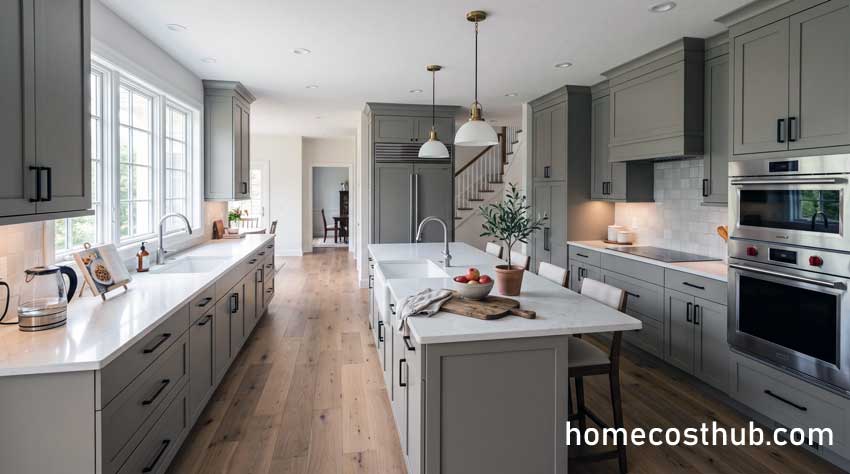
Marble Countertop Calculator

Marble Countertop Calculator Cost Guide
A Marble Countertop Calculator helps homeowners estimate the potential cost of installing or replacing marble kitchen countertops before requesting professional quotations.
Marble can vary widely in price depending on stone type, slab quality, veining, thickness, surface area, fabrication requirements, installation complexity, existing conditions, and optional features.
This cost calculator supports both USA cost and UK cost estimates, displaying results in USD or GBP while allowing users to enter countertop area in square feet or square meters.
It separates material cost, labour cost, installation cost, additional features, and removal expenses to provide a practical price estimate for Carrara, Calacatta, Statuario, cultured marble, and more distinctive specialty marble projects.
Marble Countertop Calculator
Estimate marble countertop costs in the USA or UK based on project size, marble type, material quality, project scope, existing condition, installation complexity, labour difficulty, removal, and optional upgrades.
Please enter a valid value.
USA Marble Countertop Estimate
$0
Countertop Size: 0 ft²
Cost Breakdown
Materials$0
Labour$0
Installation$0
Additional$0
Removal$0
FREE PDF ESTIMATE
Get Your Marble Countertop Cost PDF
Enter your details below to receive your marble countertop estimate, selected options, and complete cost breakdown as a downloadable PDF.
✓ Your PDF is ready!
This estimate is intended for preliminary budgeting. Actual marble countertop costs may vary based on slab type, color, veining, thickness, fabrication, seams, edge details, cutouts, site access, cabinet condition, sealing, local labour rates, taxes, and contractor pricing.
Free Marble Countertop Calculator
Material / Project Types
Marble countertops are available in several types and grades, each with different visual characteristics and pricing.
Cultured marble is a manufactured product designed to provide a marble-like appearance at a lower price. It is often suitable for homeowners looking for a Budget option while maintaining the general appearance of stone.
Carrara marble is one of the most recognizable natural marble choices. It typically features a light gray or white background with softer gray veining and is commonly used in kitchens and bathrooms.
Calacatta marble generally features a brighter background with more dramatic and distinctive veining. Its appearance and relative scarcity can make it more expensive than standard Carrara marble.
Also Read:
Statuario marble is a premium natural stone known for its white background and bold veining. High-quality slabs can carry a substantial material cost, particularly when strong pattern matching is required.
Exotic or specialty marble can include rare colors, unusual veining, premium imported slabs, or highly distinctive natural stone selections. These materials typically fall within the highest price ranges.
Project scope is another important consideration. A single counter section usually costs less than completing an entire kitchen. Full projects involving layout changes can require additional templating, fabrication, seams, supports, cabinet modifications, and installation work.
Main Factors Affecting Cost
Countertop area is one of the biggest factors affecting marble cost because larger surfaces require more slab material and additional fabrication.
Material quality also changes the price estimate considerably. Budget marble selections may use more widely available slabs, while Premium and Luxury options can involve carefully selected stone, dramatic veining, bookmatched patterns, thicker profiles, or specialist finishes.
Existing condition affects both replacement cost and repair cost. Installing marble over properly prepared cabinets is generally simpler than replacing an existing countertop. Replacement work may involve demolition, disposal, adhesive removal, sink disconnection, backsplash removal, or cabinet repairs.
Installation complexity is especially important because marble requires careful handling. Straight countertop runs can be relatively straightforward, while large islands, waterfall ends, complicated seams, irregular walls, oversized slabs, and detailed edge profiles increase the installation cost.
Labour difficulty also affects the estimate. Marble is heavy and can be more vulnerable to cracking or chipping during transportation and installation. Difficult access, stairs, narrow openings, complicated templates, or extensive on-site adjustments can increase labour cost.
Optional features such as sink cutouts, cooktop openings, marble backsplashes, waterfall edges, premium edge profiles, and professional sealing can further increase the total project budget.
Cost Breakdown
Material Cost: Material cost represents the marble required for the countertop. The amount is influenced by project area, marble type, quality level, project scope, and existing condition.
Labour Cost: Labour cost covers professional measuring, handling, preparation, fabrication-related work, fitting, seam preparation, adjustments, and finishing. More complicated projects generally require additional labour.
Installation Cost: Installation cost represents fitting and securing the fabricated marble countertop. Basic installation is intended for straightforward layouts, while custom installation accounts for difficult shapes, oversized pieces, specialized seams, additional supports, and detailed fitting.
Additional Cost: Additional expenses can include sink cutouts, cooktop cutouts, marble backsplash installation, waterfall ends, premium edge profiles, and professional stone sealing. Basic, Standard, and Advanced feature levels adjust these allowances.
Removal Cost: Removal cost applies when an existing countertop needs to be dismantled and disposed of before installation. Heavy existing stone, difficult access, damaged substrates, or extensive demolition can increase the removal expense.
The calculator combines material cost, labour cost, installation cost, additional cost, and removal cost to create the estimated total project price.
Why Use This Calculator?
The Marble Countertop Calculator provides homeowners with a practical starting point for budgeting before contacting stone suppliers, fabricators, kitchen installers, or remodeling contractors.
It allows different specifications to be compared quickly. Homeowners can compare Carrara marble with Calacatta or Statuario, evaluate Budget materials against Premium or Luxury selections, and see how complex installation affects the final price estimate.
The calculator can also help identify costs beyond purchasing the marble slab itself. Professional countertop projects may require templating, slab fabrication, transportation, edge polishing, sink and cooktop openings, seam work, installation, removal of existing countertops, and sealing.
USA and UK pricing are handled independently from measurement units. Selecting USA displays dollar pricing, while selecting UK displays costs in pounds. Users may choose square feet or square meters regardless of country. When square meters are selected, the calculator converts the entered area internally using 1 square meter = 10.7639 square feet while continuing to display the original countertop size in square meters.
The result is intended as a preliminary budgeting estimate rather than a guaranteed contractor quotation, but it can help homeowners compare marble countertop installation cost, replacement cost, repair cost, material cost, and labour cost before making a remodeling decision.
Marble Countertop Calculator for Realistic Project Budgeting
Quick Answer
A Marble Countertop Calculator gives you a useful planning range based on your project, but the final price can change once the actual slab, usable yield, fabrication details, installation conditions, and local market are confirmed. Use the estimate as a budgeting benchmark rather than a binding contractor quote.
Two kitchens can have almost identical countertop measurements and still produce very different marble quotes. One layout may fit efficiently onto the selected slabs, while another needs extra stone to preserve veining, reduce awkward seams, cover a waterfall end, or work around natural features in the material.
That is why the number from a marble countertop cost calculator is most useful as a decision-making range. It gives you a baseline before you walk into a stone yard, approve a slab, or compare proposals from fabricators. From there, the goal is not to find a quote that exactly matches the estimate. The goal is to understand why a real quote moves above or below it.
For US projects, you will usually see countertop measurements discussed in square feet and pricing in USD. UK suppliers are more likely to describe a marble worktop in square metres, linear metres, or project-specific GBP pricing. The same budgeting principles apply in both markets.
How to Read Your Marble Countertop Calculator Estimate
A realistic countertop estimate should be treated as a range rather than a single precision number. Natural stone is not a manufactured sheet product with perfectly repeatable patterning, and the cost of turning a slab into a finished countertop cannot always be inferred from finished surface area alone.
The lower end of an estimate is most relevant when the project has efficient slab usage, straightforward fabrication, accessible installation conditions, and relatively simple visual requirements. The upper end becomes more plausible when the selected stone is harder to source, the layout wastes more slab area, seams need careful positioning, or the finished design requires more specialist work.
Use the midpoint as a planning number, not a promised price
If your calculator produces a range, the midpoint can help when establishing an early remodeling budget. It is especially useful before you have selected a specific slab. Once a fabricator has templated the kitchen and created a slab layout, the estimate becomes easier to compare against a real proposal.
Suppose two homeowners each need roughly the same finished countertop area. One selects a relatively uniform slab and accepts an efficient seam position. The other chooses highly directional veining, wants the island to become the visual focal point, and expects the backsplash pattern to align with the countertop. Their finished square footage may be similar, but their usable slab requirements can be different.
The quote may also change with local labor rates, transportation distance, fabrication capacity, site access, tax treatment, and the exact stone available at the time of purchase. Those differences are why a marble countertop estimator is strongest as a budgeting tool rather than a substitute for measured, written bids.
Expert Tip
Compare the calculator range with at least a few written quotes that use the same scope. A lower total is not necessarily cheaper if it excludes templating, cutouts, removal, delivery, installation, plumbing work, or the exact slab you expect to receive.
Why Your Countertop Area Is Not Always Your Marble Purchase Area
The finished surface you see in the kitchen is only one part of the material equation. A 40 sq ft countertop does not automatically mean that exactly 40 sq ft of marble can be purchased, cut, and installed without loss.
Fabricators work with physical slabs. Each slab has fixed dimensions, natural variation, edges that may not be usable, and a vein pattern that influences where pieces can be cut. The fabricator must arrange the countertop pieces within those physical limits.
Net countertop area
Net area is the combined finished surface area of the countertop sections that will actually be installed. It is useful for comparing project size and creating an initial marble countertop cost estimate.
Gross stone requirement
The gross requirement is the amount of slab material that may need to be available so those finished pieces can be produced. It can be higher because of layout restrictions, pattern direction, seams, sink openings, backsplashes, waterfall panels, or portions of the slab that the owner and fabricator decide not to use.
Planning Formula
Finished countertop area + layout/waste allowance + special panels = approximate stone requirement.
This is a budgeting concept, not a supplier purchasing formula. Actual slab requirements depend on the dimensions and characteristics of the slabs available and the fabricator’s cutting layout.
A simple worked example
Imagine a kitchen with three perimeter runs and an island. The measured finished surfaces total 40 sq ft. If every piece nests efficiently onto the available stone, material use can be relatively efficient. Now add a full-height backsplash behind the range and a waterfall panel at one end of the island. The stone requirement rises even though the horizontal countertop area has not changed.
Also Read:
A second issue appears when the homeowner wants the vein on the island to run in a specific direction. Rotating a piece to save slab area might technically work, but the visual result may be unacceptable. The chosen layout can leave a larger unused section of slab.
This distinction between finished area and purchased slab capacity is one reason marble pricing should not be judged by square footage alone.
How Vein Matching and Slab Layout Change a Marble Project
Veining is part of what makes natural marble appealing, but it can also complicate budgeting. The fabricator is not only fitting rectangles onto a slab. On design-led projects, those rectangles may need to be positioned so the finished surfaces look intentional once installed.
Continuous-looking veining
A homeowner may want a prominent vein to continue visually from one section to another. Achieving that effect can restrict where each piece is cut. A layout that saves the most stone may not create the best visual continuity.
Bookmatching
Bookmatching refers to arranging adjoining stone surfaces so their patterns mirror each other, similar to opening the pages of a book. It can produce a dramatic result on backsplashes, feature walls, and large islands, but it depends heavily on how consecutive slabs relate to one another.
Islands and focal slabs
A large island often becomes the visual centerpiece of the kitchen. Instead of placing the island wherever it fits most efficiently on the slab, a designer or homeowner may center a particular vein or avoid a visually undesirable area. That choice can reduce material yield.
Backsplash-to-countertop matching
Using marble for both the countertop and backsplash creates another decision. Some homeowners prioritize getting both pieces from visually compatible areas of the slab. Others prefer to use remaining material efficiently and accept less pattern continuity.
Neither approach is automatically correct. The choice is between material efficiency and visual control. If budget is the priority, tell the fabricator that you are open to an efficient slab layout. If continuous veining is central to the design, ask to approve the proposed slab map before fabrication begins.
Carrara vs Calacatta vs Statuario: Which Fits Your Budget?
Choosing between Carrara, Calacatta, and Statuario should go beyond asking which name carries the highest price. Individual slabs vary in appearance, availability, quality, and how efficiently their pattern works with a specific kitchen layout.
| Marble | Typical Visual Character | Relative Availability | Relative Budget Position | Best Suited To | Main Budget Concern |
|---|---|---|---|---|---|
| Carrara | Often softer gray veining on a white to gray background | Generally broader availability | Often the more accessible of the three | Classic kitchens, bathrooms, and understated natural-stone schemes | Slab quality and individual pattern still affect selection |
| Calacatta | Often stronger, more dramatic veining with greater visual contrast | More selective | Typically positioned higher | Statement islands and high-contrast luxury designs | Feature-vein placement may reduce usable yield |
| Statuario | Bright appearance with distinctive, often bold veining | More limited in many inventories | Usually premium | High-impact projects where slab appearance is a major design element | Availability and desired pattern can influence slab requirements |
The table is deliberately relative rather than assigning one national price per square foot. Stone inventories change, individual slabs differ, and local supply chains matter. A dramatic Carrara slab that works poorly with the kitchen layout could require more material than a higher-tier slab that happens to fit the project efficiently.
When comparing stone options, ask to see the actual slabs or detailed slab photographs rather than relying on a small sample. A sample can show color and finish, but it cannot show the complete vein pattern that determines how the material will read across an island or long counter run.
Honed vs Polished Marble: Cost Is Only Part of the Choice
A polished finish reflects more light and emphasizes color and veining. Honed marble has a softer, lower-sheen appearance. Both can work in kitchens, but they age differently in appearance and should be selected with realistic expectations about daily use.
Etching matters here. Marble is a calcareous stone, so acidic substances can react with its surface. The Natural Stone Institute warns that products containing lemon, vinegar, and other acids may dull or etch calcareous stone. Its natural stone care guidance also explains that sealing increases stain resistance rather than making stone stain-proof.
On a highly reflective polished surface, a dull etch mark may stand out under certain lighting. A honed surface already has a lower sheen, so some owners find everyday surface changes less visually disruptive. That does not make honed marble immune to etching or staining.
Fact
Sealer can help reduce liquid absorption and staining risk, but it does not stop acids from reacting with marble's calcareous surface.
The Natural Stone Institute’s stone stain and etch guidance distinguishes acid etching from staining and explains that acids can damage the finish itself.
Choose the finish for the way you expect the surface to age
If a pristine high-gloss appearance is important, ask yourself how comfortable you will be with visible etching around food-preparation zones. If you prefer a softer finish and are comfortable with natural patina, honed marble may fit your expectations better.
The strongest decision is not “Which finish is best?” It is “Which finish will still look acceptable to me after the kitchen has been used?”
Case Study: Turning a Calculator Estimate Into a Bid-Ready Budget
Illustrative Case Study
Consider a US homeowner planning a mid-size kitchen remodel. The design has perimeter countertops plus an island. The project includes natural marble, an undermount sink, a cooktop opening, and replacement of the existing countertop.
Step 1: Start with finished measurements
The homeowner enters the measured countertop area into the Marble Countertop Calculator and receives a planning range. At this stage, the number helps reserve part of the renovation budget, but no actual slab has been selected.
Step 2: Review real slabs
At the stone yard, the homeowner prefers a slab with strong directional veining. The island should showcase the most attractive section, while the perimeter pieces need a quieter pattern.
That visual preference immediately changes the discussion. The fabricator cannot simply maximize cutting efficiency without considering where the veins will appear.
Step 3: Confirm the fabrication plan
The homeowner asks the fabricator to identify proposed seam positions, island orientation, sink placement, and how the cooktop opening affects the surrounding stone. Those details make the eventual quote easier to understand.
Step 4: Compare matching scopes
Three bids are requested using the same requirements: selected marble, finish, edge, sink cutout, cooktop cutout, delivery, installation, existing countertop removal, and agreed slab orientation.
One proposal is lower but excludes plumbing reconnection and removal. Another includes both. The homeowner now compares like with like instead of assuming the lower headline number represents the better value.
Step 5: Use the calculator as a reasonableness check
If the written bids cluster near the planning range, the budget is broadly supported by local quotations. If every professional bid is materially higher, the homeowner can review the inputs and identify what the calculator could not know—such as slab count, specialist layout, difficult access, or a premium stone selection.
The same method works in the UK. Replace USD and square feet with GBP and the supplier’s preferred worktop measurements, then compare identical scope, VAT treatment, installation responsibilities, and exclusions.
How to Compare a Fabricator Quote With Your Estimate
“Is my marble quote too high?” cannot be answered from the total alone. A quote is only comparable when you know what has been included.
A proposal based on a specific selected slab is not the same as an online material price. A supply-only price is not comparable with a fabricated and installed worktop. One installer may include templating, delivery, sealing, and removal while another lists them separately.
The Natural Stone Institute maintains dedicated countertop installation standards resources covering topics such as stone types and finishes, seam placement, sink cutouts, overhangs, cantilevers, joint widths, and tolerances. Those topics show why a countertop proposal involves much more than raw stone area.
For UK worktops, Stone Federation Great Britain’s published guidance addresses the design, manufacture, installation, stone selection, and support requirements of natural-stone worktops.
Marble Quote Comparison Checklist
- Confirm the exact marble and selected slab or slab allowance.
- Check whether fabrication is included.
- Confirm sink and cooktop cutouts.
- Review edge-profile charges.
- Check seam locations and vein-matching expectations.
- Confirm delivery and installation.
- Check existing-countertop removal and disposal.
- Confirm plumbing or appliance work exclusions.
- Review sales tax or VAT treatment.
- Compare warranties, exclusions, and final scope—not just the total price.
Ask for clarity before asking for a discount
If one quote looks unusually high, first find the difference in scope. The proposal may allow for an extra slab, difficult site access, more elaborate edge work, additional support, or a more expensive stone selection.
If one looks unusually cheap, confirm that the supplier has not omitted work you assumed was included. A clean comparison usually reveals more than negotiating from the headline total alone.
UK readers who want to identify natural-stone specialists can also use Stone Federation Great Britain’s member directory, which includes a Kitchens/Worktops specialty filter.
Is Marble the Right Countertop for Your Budget and Lifestyle?
Cost is only useful when compared with what you expect from the finished surface. Marble offers genuine natural variation, but that same material behaves differently from engineered quartz, granite, quartzite, or wood.
If you want another natural-stone option with a different maintenance profile, compare the same project through the Granite Countertop Calculator. That gives you a more meaningful comparison than comparing isolated material prices from different suppliers.
| Material | Material Type | Visual Character | Maintenance Level | Etching Sensitivity | Heat Considerations | Repair / Refinishing | Relative Budget Position | Best Fit |
|---|---|---|---|---|---|---|---|---|
| Marble | Natural stone | Unique veining and natural variation | Moderate to higher | High sensitivity to acids | Stone is heat resistant, but installed surfaces should still be treated with care | Professional refinishing may address some surface wear | Mid to premium depending on stone and project | Owners who value natural character and accept patina |
| Granite | Natural stone | Speckled, flowing, or mineral-rich natural patterns | Moderate | Generally lower than marble | Generally strong heat performance; installation details still matter | Stone repair is possible in some situations | Broad range | Busy kitchens seeking natural stone |
| Quartz | Engineered surface | Consistent patterns or marble-look designs | Lower | Not subject to marble-style acid etching | Resin content means direct high heat should be avoided | Repair options vary | Mid to premium | Owners prioritizing lower routine maintenance |
| Quartzite | Natural stone | Some varieties resemble marble | Moderate | True quartzite generally behaves differently from marble | Good stone heat characteristics; fabrication and installation remain important | Professional stone repair may be possible | Often mid to premium | Natural-stone buyers seeking a marble-like appearance with different performance |
| Butcher Block | Wood | Warm grain and natural timber appearance | Regular care | Not applicable | Direct high heat can damage wood | Can often be sanded and refinished | Highly project-dependent | Warm, tactile kitchens and homeowners comfortable maintaining wood |
Wood creates a very different kitchen character, so a homeowner considering a warmer surface can run the project through the Butcher Block Countertop Calculator rather than assuming a material is cheaper simply because its raw price appears lower.
The countertop is also only one part of a renovation. Cabinetry, plumbing, appliances, flooring, lighting, backsplash work, and labor may carry more budget weight than the stone itself. The broader Kitchen Remodeling resources can help place the countertop decision inside the total project budget.
Pros and Cons of Choosing Marble Countertops
Pros
- Every slab is different. Natural variation gives the finished kitchen a surface that is not mechanically repeated.
- Veining can become a design feature. A carefully selected island or backsplash can act as the visual center of the room.
- Many aesthetic directions are available. Marble ranges from subtle gray movement to bold, high-contrast veining.
- Surface restoration may be possible. Professional stone specialists can address some forms of scratching, dullness, and etching depending on the condition of the surface.
- It develops character with use. Some owners actively prefer the softer patina marble develops rather than expecting a permanently factory-new appearance.
Cons
- Acids can etch the surface. Lemon juice, vinegar, and other acidic products can dull calcareous stone.
- Sealing does not make marble stain-proof. It can improve resistance to absorption, but maintenance expectations remain.
- Pattern selection can affect material efficiency. A visually demanding layout may require more slab capacity than the finished area suggests.
- Actual slabs vary. A small showroom sample does not represent every vein, mineral feature, or tonal shift in a full slab.
- Fabrication requires planning. Seam positions, openings, supports, and large pieces need to be coordinated before cutting.
- Owners who expect a permanently flawless surface may be frustrated. Marble rewards realistic expectations more than perfectionism.
What to Budget Beyond the Marble Itself
The best way to use a marble cost calculator after the initial estimate is to turn the result into a scope checklist. That prevents an attractive material number from being mistaken for a completed project price.
| Budget Item | Why It May Appear | Usually Confirm With |
|---|---|---|
| Selected slab(s) | Represents the physical stone being purchased or allocated | Stone supplier / fabricator |
| Templating | Creates the verified dimensions used for fabrication | Fabricator |
| Edge treatment | Complexity and total finished edge length can affect fabrication | Fabricator |
| Sink and cooktop cutouts | Require accurate fabrication around appliance or fixture openings | Fabricator |
| Vein matching | May change the cutting layout and usable slab yield | Fabricator / designer |
| Support work | Some spans, overhangs, cabinets, and layouts may require additional support | Installer / cabinet professional |
| Delivery and access | Large stone pieces need a safe route into the building | Installer |
| Removal | Relevant when existing surfaces must be dismantled and disposed of | Installer / remodeling contractor |
| Plumbing reconnection | Sink and faucet work may be a separate trade | Plumber / contractor |
| Appliance work | Cooktop removal or reconnection may not be part of the stone scope | Relevant trade / contractor |
| Sales tax or VAT | Treatment varies by jurisdiction, supplier, and quoted scope | Supplier / installer |
Notice that this table does not assign a universal dollar or pound value to each line. Local prices, individual stone selections, project complexity, and supplier practices vary too much for a single national allowance to replace a real quotation.
Should You Choose Marble?
Use this decision tree before approving the slab:
Also Read:
Do you want genuine natural-stone variation?
→ No: Compare engineered alternatives such as quartz.
→ Yes: Continue.
Would visible etching, minor scratches, or developing patina bother you?
→ Yes: Marble may not match your expectations for a busy kitchen.
→ No, or I accept natural wear: Continue.
Are you prepared to use suitable cleaners and respond quickly to spills?
→ No: Consider a lower-maintenance surface.
→ Yes: Continue.
Is continuous-looking veining important?
→ Yes: Allow room in the budget for slab selection and a potentially less efficient cutting layout.
→ No: Ask the fabricator to prioritize efficient slab use.
Does marble still fit the complete kitchen budget?
→ Yes: Request scope-matched quotations and approve the actual slab and layout.
→ No: Compare a different marble selection or another countertop material.
Common Marble Budgeting Mistakes
1. Assuming finished area equals purchased stone
The measured countertop area is not automatically the amount of slab capacity needed. Layout and visual constraints can create unused material.
2. Comparing quotes with different scopes
A supply-only figure and an installed figure are not competing prices. Normalize the scope before judging the total.
3. Choosing marble from a small sample alone
Samples cannot communicate the full pattern of a large slab. Review the actual slab whenever practical, especially for islands and full-height backsplashes.
4. Treating every white marble as financially equivalent
Stone identity, appearance, source, availability, slab quality, and supplier inventory all matter. Color alone does not determine price.
5. Ignoring seam and vein decisions until fabrication
Once the slab has been cut, changing seam locations or pattern orientation can be difficult or impossible. Approve major layout decisions before cutting starts.
6. Assuming sealer makes marble acid-proof
Sealing addresses absorption and stain resistance; it does not stop acidic substances from etching calcareous stone.
7. Confusing marble with quartzite
Some quartzite slabs visually resemble marble, and material names used in retail settings can be confusing. Ask the supplier to identify the stone accurately before comparing maintenance or performance expectations.
8. Ignoring support requirements
Large overhangs, cantilevers, sink areas, and unusual layouts deserve proper structural review rather than assumptions based on appearance. The Natural Stone Institute’s technical resources specifically address countertop overhangs, sink areas, seams, and related installation issues.
9. Forgetting tax, VAT, or excluded trades
Check whether tax, VAT, plumbing, appliance work, cabinetry repairs, removal, and disposal appear in the quoted total.
10. Comparing material advertising with installed cost
A price attached to a slab does not represent the cost of turning that slab into a measured, cut, edged, transported, fitted, and finished countertop.
11. Choosing marble without considering the household
A showroom-perfect slab may not be the right surface for someone who wants zero visible change from daily cooking. Budget decisions should include ownership expectations, not only purchase price.
Marble Myths That Can Distort Your Budget
Fact
Finished square footage is only a starting point. Slab dimensions, usable yield, vein direction, seams, special panels, and fabrication decisions can change the actual material requirement.
Fact
They can occupy different market positions and have different vein characteristics, availability, and slab-selection considerations. Compare the actual stone and project layout rather than the color name alone.
Fact
A lower quote may have a different slab allowance, fabrication scope, installation responsibility, edge treatment, removal allowance, warranty, or exclusions. Compare identical scope before comparing totals.
Fact
Sealing can improve stain resistance, but acids can still etch calcareous stone and alter the finish.
Expert Tips Before You Approve a Marble Countertop Order
- Inspect the actual slab when practical. Full slabs reveal veining, tonal changes, and features that small samples cannot show.
- Photograph the approved slab. Keep a record of the slab and, where available, the proposed cutting orientation.
- Discuss seams before fabrication. Ask where seams are likely to appear and why those positions were selected.
- Confirm honed or polished finish in writing. Do not rely on verbal descriptions alone.
- Provide the final sink model before fabrication. The fabricator needs the correct specifications for the opening and edge treatment.
- Do the same for the cooktop. Appliance dimensions should be finalized before stone cutting.
- Ask about supports. Overhangs and large spans should be reviewed as part of the installation plan.
- Approve the island orientation. If a specific vein is important, make that preference explicit before cutting.
- Ask about backsplash sourcing. If visual continuity matters, confirm whether countertop and backsplash pieces can be coordinated from suitable slabs.
- Compare written scopes. A good proposal should make it clear what is included and what remains the homeowner’s responsibility.
- Retain a small offcut if practical. It can be useful as a future reference for color, finish, or repair discussions.
Expert Tip
Do not approve fabrication from the material name alone. Confirm the actual slab, finish, major seam positions, edge profile, openings, and visually important vein orientation before the stone is cut.
The Natural Stone Institute’s current Dimension Stone Design Manual resource library includes stone selection, countertop, installation, testing, maintenance, and restoration guidance for natural dimension stone.
Marble Countertop Calculator FAQs
How much do marble countertops cost per square foot?
There is no reliable single per-square-foot figure for every marble countertop because the selected stone, slab yield, fabrication, finish, edge work, cutouts, installation, location, and project scope all change the result. Use the Marble Countertop Calculator for a planning range, then compare it with local quotes based on the same specifications.
How much do marble worktops cost per square metre?
Marble worktop cost per m² varies with the selected slab, fabrication requirements, installation scope, and local UK supplier pricing. A square-metre calculation is useful for budgeting, but the fabricator must still determine how the pieces fit onto physical slabs and what work is included in the quotation.
How accurate is a Marble Countertop Calculator?
A Marble Countertop Calculator is most accurate as an early budgeting tool when the dimensions and project options are entered correctly. It cannot see the actual slab, confirm vein placement, assess site access, or create the final fabrication layout, so a templated professional quote should replace the calculator estimate before ordering.
How much extra marble should I allow for waste?
Do not apply one universal waste percentage to every marble project. The required allowance depends on slab dimensions, countertop geometry, vein orientation, seams, visual selection, backsplash pieces, waterfall panels, and unusable portions of the slab. Ask the fabricator to show how the pieces fit on the selected slabs before purchase.
Why can two marble countertops with the same square footage cost different amounts?
Equal finished area does not mean equal material use or fabrication effort. One project may fit efficiently onto the slabs, while another needs extra stone for pattern matching, an island focal section, complicated seams, specialty edges, difficult access, or additional panels.
Is Carrara marble cheaper than Calacatta?
Carrara is generally positioned as the more accessible option, while Calacatta is commonly treated as a more selective premium marble. The actual project price still depends on the particular slabs, supplier inventory, appearance, usable yield, and fabrication requirements rather than the marble name alone.
Is marble more expensive than granite?
Either material can cost more depending on the specific stone and project. Premium granite can exceed some marble selections, while rare or highly desirable marble can sit well above common granite. Compare complete installed scopes rather than assuming one material category always costs more. Use the Granite Countertop Calculator for a project-level comparison.
Is marble more expensive than quartz?
There is no fixed rule. Entry-level, mid-range, and premium products exist in both categories, and fabrication details affect the finished project. Quartz usually offers more consistent manufactured patterns and different maintenance behavior, while marble provides unique natural variation and is vulnerable to acid etching.
Is marble or quartzite better for a busy kitchen?
The better choice depends on what kind of wear you are willing to accept. Marble develops etching and patina more readily because it is a calcareous material. True quartzite has different mineral characteristics, but individual stones still need correct identification and care advice from the supplier.
Does marble need to be sealed?
Some marble installations may benefit from an impregnating sealer, but sealing requirements are not identical for every stone. The Natural Stone Institute recommends consulting the stone supplier or sealer manufacturer and explains that some stones may not require sealing. Sealing increases stain resistance rather than making stone stain-proof.
Does sealing marble prevent etching?
No. Sealing does not prevent the chemical reaction that causes acid etching. Lemon, vinegar, and other acidic substances can dull or etch calcareous stone even when stain resistance has been improved with a suitable impregnating product.
Is honed or polished marble better for a kitchen?
Neither finish is universally better. Polished marble has more sheen and can make dull etch marks more noticeable, while honed marble has a softer appearance that some owners find more forgiving visually. Both still require appropriate care and realistic expectations about staining, scratching, and etching.
How can I tell if a marble countertop quote is reasonable?
Compare the quote with other proposals using the same stone, slab quantity, finish, edges, cutouts, seams, delivery, installation, removal, tax or VAT treatment, and exclusions. A total that appears expensive may include work that a cheaper proposal leaves out.
Why does vein matching increase marble requirements?
Vein matching can limit where pieces are cut from the slab. Instead of rotating or moving a section to minimize waste, the fabricator may need to place it in a specific position so the finished pattern aligns. That can leave more unused stone.
Can I use a marble remnant for a small countertop or vanity?
Yes, a suitable remnant can sometimes work well for a small vanity, shelf, or compact countertop if its dimensions, condition, finish, and pattern fit the project. Availability is local and unpredictable, so ask fabricators or stone yards what offcuts they currently hold rather than assuming a specific remnant will be available.
Does a marble island need extra support?
Some islands and overhangs need additional support, but the correct solution depends on stone thickness, material properties, span, cabinet construction, cutouts, and geometry. Do not choose support by rule of thumb alone. Have the fabricator and cabinet or installation professional review the design before fabrication.
How long can marble countertops last with appropriate care?
Marble is a natural dimension stone that can remain serviceable for a very long period when correctly selected, installed, maintained, and repaired when necessary. A precise lifespan should not be treated as guaranteed because use, installation quality, stone characteristics, cleaning habits, and physical damage vary widely.
Is real marble worth the maintenance?
Real marble can be worth it if you value genuine natural variation and accept that the surface may develop etching, scratches, or patina. If you expect the countertop to retain a nearly unchanged finish under heavy daily use, a lower-maintenance alternative may fit your priorities better.
Marble Countertop Budget Summary
Use the calculator as a planning range: the final contract price comes from measured, written quotations.
Separate finished area from slab requirement: physical slab layout can require more material than net countertop area.
Stone selection matters: actual slabs, veining, finish, and layout can change usable yield.
Compare identical scope: confirm fabrication, cutouts, seams, delivery, installation, removal, and exclusions.
Budget for ownership: marble requires realistic expectations about staining, etching, cleaning, and surface wear.
Verify local pricing: US and UK labor, supplier conditions, tax or VAT, and available inventory differ by market.
Use Your Estimate to Get Better Marble Quotes
A Marble Countertop Calculator is most valuable before the final buying decision, when you still have room to change the material, layout, finish, or project scope. Use the estimate to define a sensible planning budget, then replace assumptions with real slab information and scope-matched quotations.
Before approving an order, confirm the actual stone, slab quantity, finish, major vein orientation, seam locations, edge profile, sink and cooktop details, support requirements, delivery, installation, removal, and exclusions. Those details explain far more about the final cost than square footage alone.
If the marble allowance begins to pressure the rest of the renovation budget, compare it with the complete Kitchen Remodeling plan rather than evaluating the countertop in isolation. A countertop choice is successful when the material, maintenance expectations, visual result, and full project budget all make sense together.
About the Author
Arden Cole Linscott (Expert — Residential Construction & Remodeling Cost Analysis)
Arden Cole Linscott focuses on residential construction cost analysis, remodeling budgets, material comparisons, and practical interpretation of project estimates. His work helps homeowners evaluate cost variables, compare project scopes, and make more informed budgeting decisions without treating generalized estimates as guaranteed contractor quotations.

Scroll to bottom
Remodeling Cost Calculators