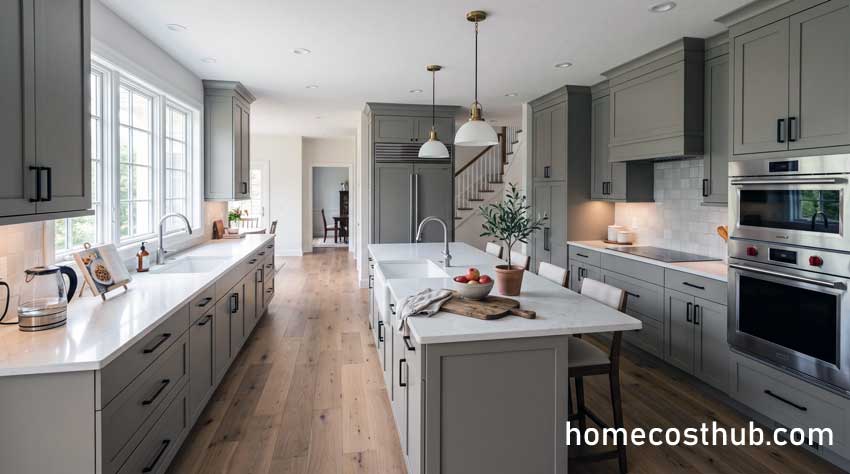
Quartz Countertop Calculator

Quartz Countertop Calculator Cost Guide
A Quartz Countertop Calculator helps homeowners estimate the potential cost of installing or replacing engineered quartz kitchen countertops before requesting professional quotations.
Quartz countertop prices can vary considerably depending on surface area, slab design, material quality, fabrication requirements, project scope, existing condition, installation complexity, labour difficulty, removal, and optional features.
This cost calculator supports both USA cost and UK cost estimates, displaying results in USD or GBP while allowing countertop size to be entered in square feet or square meters.
By separating material cost, labour cost, installation cost, additional upgrades, and removal expenses, the calculator provides a practical price estimate for basic, standard, premium, designer-veined, and luxury quartz projects.
Quartz Countertop Calculator
Estimate quartz countertop costs in the USA or UK based on project size, quartz style, material quality, project scope, existing condition, installation complexity, labour difficulty, removal, and optional upgrades.
Please enter a valid value.
USA Quartz Countertop Estimate
$0
Countertop Size: 0 ft²
Cost Breakdown
Materials $0
Labour $0
Installation $0
Additional $0
Removal $0
This estimate is intended for preliminary budgeting. Actual quartz countertop prices may vary based on brand, slab design, thickness, fabrication, seams, edge details, cutouts, site access, cabinet condition, local labour rates, plumbing requirements, taxes, and contractor pricing.
FREE PDF ESTIMATE
Get Your Quartz Countertop Estimate PDF
Enter your details below to unlock a downloadable PDF containing your quartz countertop estimate, cost breakdown, selected project options, and optional upgrades.
✓ Your PDF is ready!
Free Quartz Countertop Calculator
Material / Project Types
Quartz countertops are engineered surfaces typically manufactured using mineral content combined with binders and pigments. Different product ranges can vary significantly in price, appearance, thickness, pattern complexity, and manufacturing quality.
Basic quartz generally includes simpler colors and patterns and can be suitable for homeowners focused on controlling material cost.
Standard quartz offers a wider selection of colors and designs and is commonly used for typical residential kitchen projects.
Premium quartz may provide more sophisticated patterns, finishes, higher-end product ranges, or increased design choice.
Also Read:
Designer or veined quartz is manufactured to replicate the visual movement and veining often associated with marble and other natural stones. Large-scale patterns and more realistic veining can increase the price.
Luxury or specialty quartz can include premium collections, uncommon colors, detailed patterns, specialty surface finishes, or designer products.
Project scope also affects the estimate. A single counter section requires less material and labour than a full kitchen. Projects involving layout changes may require additional fabrication, cabinet preparation, support work, seams, plumbing modifications, or customized countertop sections.
Main Factors Affecting Cost
Countertop area is one of the primary factors affecting quartz material cost. Larger kitchens require additional slabs and may create more fabrication work, seams, transportation requirements, and installation time.
Material quality can significantly change the final price estimate. Budget quartz generally uses economical selections, while Premium and Luxury options may include designer patterns, thicker profiles, specialty finishes, or higher-priced collections.
Existing condition also affects replacement cost and repair cost. New cabinets that are level and properly supported may require minimal preparation. Replacement projects can involve demolition, adhesive removal, sink disconnection, wall repairs, or cabinet adjustments.
Installation complexity is particularly important with quartz. Standard straight countertop runs are usually less expensive than oversized islands, waterfall panels, complicated corners, multiple seams, unusual shapes, or highly detailed edge profiles.
Labour difficulty also affects the total. Quartz slabs are heavy and require careful handling. Difficult property access, stairs, narrow entrances, complex templates, uneven cabinets, or extensive on-site adjustments can increase labour cost.
Additional features can also increase the project budget. Sink cutouts, cooktop openings, full-height or matching quartz backsplashes, waterfall edges, premium edge profiles, and plumbing reconnection each involve extra material, fabrication, or professional work.
Cost Breakdown
Material Cost: Material cost represents the quartz surface required for the project. The estimate varies according to countertop size, quartz style, material quality, project type, and existing condition.
Labour Cost: Labour cost covers measuring, handling, preparation, fabrication-related work, positioning, seam preparation, fitting, and adjustments. Complex projects generally require more professional labour.
Installation Cost: Installation cost represents fitting and securing the fabricated quartz countertop. Basic installation is intended for straightforward layouts, while custom installation accounts for more complicated shapes, large slabs, difficult seams, detailed fitting, and other specialist requirements.
Additional Cost: Additional expenses may include sink cutouts, cooktop cutouts, quartz backsplash installation, waterfall edges, premium edge profiles, and plumbing reconnection. The Basic, Standard, and Advanced feature levels adjust these allowances.
Removal Cost: Removal cost applies when existing countertops must be dismantled and disposed of before the new quartz surfaces can be installed. Difficult access, heavy existing countertops, damaged substrates, and complicated layouts can increase this expense.
The calculator combines material cost, labour cost, installation cost, additional cost, and removal cost to provide the estimated total project price.
Why Use This Calculator?
The Quartz Countertop Calculator provides homeowners with a convenient way to create an initial remodeling budget before contacting countertop suppliers, fabricators, kitchen contractors, or installers.
It allows different specifications to be compared quickly. Homeowners can evaluate Basic quartz against Premium or Luxury products, compare a partial countertop project with a complete kitchen installation, or see how complex installation affects the total price estimate.
The calculator also helps identify costs beyond purchasing the quartz itself. A professional countertop project can involve templating, slab fabrication, transportation, edge finishing, sink and cooktop cutouts, seam preparation, installation, removal of old countertops, and plumbing work.
Users can independently select USA or UK pricing and their preferred measurement unit. USA estimates are displayed in dollars, while UK estimates are displayed in pounds. Square feet and square meters can be selected independently of country. When square meters are used, the area is converted internally using 1 square meter = 10.7639 square feet, while the displayed countertop size remains in square meters.
The result is intended as a preliminary planning estimate rather than a guaranteed contractor quotation, but it provides a useful starting point for comparing quartz countertop installation cost, replacement cost, repair cost, material cost, and labour cost.
Quartz Countertop Calculator: Measure, Price & Plan Costs
Quick Answer
A quartz worktop estimator gives you a practical starting estimate for your project, but the number becomes more useful when you understand the measurements, slab requirements, fabrication work, installation scope, and local pricing behind it. Use the estimate as a budgeting benchmark, then compare it with an itemized fabricator or installer quote.
A countertop estimate can look precise down to the dollar or pound, yet the real project may still price differently. The usual reason is not that the calculation is wrong. It is that finished countertop area, purchased slab area, fabrication work, and installed scope are four different things.
That distinction matters when you use a Quartz Countertop Calculator. A homeowner may measure 40 square feet of finished surface, receive an estimate based on that area, then discover that a fabricator needs more material because of slab layout, veining, seams, or an island panel.
The same principle applies in the UK, where quartz worktops are commonly measured in square metres and quotes may separately account for templating, fabrication, fitting, sink or hob openings, upstands, and VAT.
How to Read Your Quartz Countertop Calculator Estimate
Start with three numbers: the finished countertop area, the estimated installed total, and the effective cost per square foot or square metre.
Suppose your Quartz Countertop Calculator shows:
- Finished countertop area: 40 sq ft
- Estimated installed total: $4,800
- Effective installed rate: $120 per sq ft
The $120 figure is calculated by dividing the estimated installed total by the finished surface area. It is useful for comparing budgets, but it does not mean the fabricator is selling every square foot of slab for $120.
Installed Cost Formula
Effective Installed Cost = Estimated Total Project Cost ÷ Finished Countertop Area
Example:
$4,800 ÷ 40 sq ft = $120 per sq ft
An installed rate may represent much more than raw quartz. Depending on the quotation, it can reflect templating, fabrication, edge finishing, delivery, fitting, seam work, and other services.
| Calculator Result | What It Tells You | What It Does Not Prove |
|---|---|---|
| Finished area | Approximate visible countertop surface | The exact amount of slab that must be purchased |
| Estimated total | A planning budget for the selected scope | A guaranteed local contractor price |
| Effective $/sq ft or £/m² | A useful comparison metric | The raw material price alone |
| Low-to-high range | Possible budget variation | A promise that every local quote will fall within it |
Current US cost references illustrate why ranges should be interpreted cautiously. Angi’s July 2026 quartz cost data reports substantial variation by slab count, quality, fabrication, and project scope rather than a single universal installed rate. Angi quartz countertop cost data provides one current benchmark.
For UK worktops, pricing structures can differ again. Checkatrade’s quartz worktop estimator separates the worktop from items such as sink or hob cutouts and drainer grooves, illustrating why two quotations with the same measured area can produce different totals. Checkatrade quartz worktop pricing data provides a UK reference point.
How to Measure Quartz Countertops Accurately
Accurate budgeting starts with the finished geometry of the countertop, not simply the length of the base cabinets.
For a rectangular section, multiply length by depth. Measure each section separately, then add the areas together. A kitchen island is calculated using its finished length and width.
Measurement Formula
Countertop Area = Length × Depth
Also Read:
For several countertop sections:
Total Countertop Area = Area A + Area B + Area C + Island Area
For measurements in inches, calculate square inches first and divide by 144 to convert the result to square feet.
A 120-inch-long counter that is 25.5 inches deep, for instance, contains:
120 × 25.5 = 3,060 square inches
3,060 ÷ 144 = 21.25 sq ft
For metric measurements, convert millimetres to metres before multiplying. A 3,000 mm × 650 mm worktop becomes 3 m × 0.65 m, giving a finished area of 1.95 m².
Measure the countertop, not just the cabinet boxes
Cabinet length is useful as a rough reference, but the countertop can extend past the cabinet face or cabinet ends. Islands and breakfast bars may have much larger overhangs.
Measure the planned finished dimensions wherever possible.
Appliance gaps also matter. A freestanding range may interrupt a countertop run, while an undermount sink normally sits within the countertop rather than removing the need to fabricate that area.
Break irregular layouts into simple shapes
For an L-shaped counter, treat each rectangular leg as a separate section. The same approach works for peninsulas and stepped layouts.
Be careful not to count an overlapping corner twice.
Expert Tip
Use homeowner measurements for budgeting, not final fabrication. Walls can be out of square, cabinet runs can vary slightly, and finished overhangs must be coordinated with the actual cabinetry. Final quartz fabrication should rely on the fabricator’s approved template or digital measurements.
The UK Health and Safety Executive also emphasizes accurate measurements and off-site preparation when installing stone worktops. Its guidance recommends completing items such as sink and tap openings in a suitably equipped workplace where possible. HSE guidance for installing stone worktops.
Finished Countertop Area vs. Quartz You Actually Need to Buy
This is one of the most useful distinctions to understand after using a Quartz Countertop Calculator.
Finished countertop area is the surface that ends up in your kitchen.
Purchased slab area is the quartz needed to cut those finished pieces from available slabs.
They are not automatically equal.
A kitchen with 45 sq ft of visible countertop does not necessarily require exactly 45 sq ft of purchased quartz. Fabrication works more like cutting pattern pieces from a fixed sheet than ordering paint by the gallon.
Several issues affect slab yield:
- Available slab dimensions
- Length and width of each countertop section
- Island size
- Vein direction
- Desired seam locations
- Waterfall panels
- Matching adjacent pieces
- Sink and cooktop placement
- Usable remnants
- Defects or areas the fabricator chooses not to use
A sink opening removes material from the finished surface, but it does not mean the original slab can be ordered with that area already missing. The fabricator still needs enough continuous slab to cut the surrounding countertop.
The same applies to cooktop and hob openings.
Directional veining can reduce slab efficiency
A plain or subtly patterned quartz may allow more flexibility when nesting pieces onto a slab. A strong directional vein can restrict how sections are rotated because neighboring pieces need to look intentional.
That can leave usable material on the slab that is technically large enough for another piece but visually unsuitable for the design.
Seam strategy can change material demand
Fewer seams may require longer uninterrupted pieces. Those pieces may fit less efficiently onto the available slab.
A fabricator might propose an additional seam to improve slab yield. Another homeowner may prefer fewer seams and accept the possibility of buying more material.
This is why a Quartz Countertop Calculator is best used as a planning tool, while the fabricator’s cutting layout determines the final slab requirement.
How Many Quartz Slabs Could Your Kitchen Need?
There is no universal slab count for a given kitchen area because quartz slab dimensions vary between products and manufacturers. Layout can be just as important as total square footage.
| Project Situation | Why Slab Demand May Change |
|---|---|
| Small straight countertop | Simple geometry may allow efficient piece placement |
| L-shaped kitchen | Long runs and corner seams affect cutting layout |
| Large island | A single large island piece may dictate the slab selection |
| Strong directional veining | Pieces may need matching orientation |
| Waterfall island | Vertical side panels require substantial additional surface |
| Matched veining | Visual continuity may take priority over maximum slab yield |
A small kitchen can sometimes create an awkward slab requirement if one long counter exceeds the usable length of a particular piece arrangement. A larger kitchen with several short sections might use its slabs more efficiently.
The fabricator should be able to explain how many slabs are being charged and why. For premium veined quartz, ask to see the proposed layout if seam location and pattern continuity are important to you.
Why a Contractor Quote May Differ From the Calculator
A quotation and a Quartz Countertop Calculator can start with the same measured area and still produce different totals.
The useful question is not simply, “Which number is right?” Ask what changed between the assumptions.
A fabricator may be pricing the exact selected color rather than an average material allowance. The quote may require two full slabs even though your finished area looks small enough to fit within the nominal area of one.
Templating, fabrication minimums, difficult cutouts, edge work, delivery access, local labor conditions, cabinet correction, removal, plumbing, tax, or VAT may also be handled differently.
Compare the scope before comparing the bottom line
Imagine these two quotes:
Quote A: $5,200
Quote B: $4,650
Quote B looks cheaper, but the difference is meaningless until you know whether both include the same:
- Quartz collection and color
- Thickness
- Number of slabs
- Edge profile
- Sink fabrication
- Cooktop or hob opening
- Templating
- Delivery
- Installation
- Removal
- Plumbing work
- Tax or VAT treatment
If Quote B excludes removal and plumbing while Quote A includes them, the real difference may be much smaller.
Expert Tip
When a professional quote is higher than your Quartz Countertop Calculator estimate, ask the fabricator to identify the difference by line item. An itemized explanation is more useful than negotiating from a single cost-per-square-foot figure.
How to Check Whether a Quartz Quote Is Reasonable
Price checking works best when you normalize each quote to the same specification.
Do not compare “white quartz” with “white quartz.” Compare the exact brand, collection, color, thickness, edge, cutouts, number of slabs, and installation scope.
Quartz Countertop Quote Checklist
- Confirm the measured countertop area.
- Check the exact quartz brand, collection, color, and thickness.
- Ask how many full slabs are included in the quote.
- Confirm sink, cooktop or hob cutouts and edge fabrication.
- Check whether templating, delivery, installation, and removal are included.
- Ask whether plumbing reconnection is included or excluded.
- Check sales tax or VAT treatment.
- Compare at least two itemized quotations on the same specification.
Calculate an effective installed rate
Dividing each full-project quotation by finished countertop area gives you a quick comparison metric.
If Quote A is $5,200 for 45 sq ft, its effective rate is about $115.56 per finished sq ft.
If Quote B is $4,650 for the same 45 sq ft, its effective rate is about $103.33 per finished sq ft.
That comparison identifies a difference. It does not explain it.
Next, compare the line items.
Ask what is specifically excluded
Exclusions often reveal more than inclusions.
Plumbing reconnection, electrical changes, cabinet leveling, wall repair, disposal, or additional site visits can move to another trade. A lower countertop quote may therefore create costs elsewhere in the project.
Also Read:
Quartz Countertop Cost Scenarios
Rather than treating every project as a simple area multiplied by a unit rate, consider how the geometry and specification affect the budget.
The table below uses qualitative budget implications rather than pretending that one national price applies to every city, supplier, quartz collection, and installation.
| Scenario | Project Description | What Changes the Estimate | Budget Implication |
|---|---|---|---|
| Small straight kitchen | Simple perimeter run with limited fabrication | Few seams and straightforward geometry | Often easier to price and compare |
| L-shaped kitchen | Two connected runs with sink area | Corner seam planning and fabrication | Moderate complexity |
| Kitchen with large island | Perimeter counters plus central island | Large-piece handling, slab selection, overhangs | Material use can rise quickly |
| Premium veined quartz | Strong marble-look pattern | Pattern alignment and slab layout | Material and fabrication choices matter more |
| Waterfall island | Horizontal island top plus vertical ends | Extra surface area, mitred edges, vein continuity | Can require significantly more material and fabrication |
For a current US reference, Angi reports a broad 2026 range because slab count, grade, edge work, preparation, cutouts, and other project details vary widely. That spread is a useful reminder not to treat a national average as your local bid.
In the UK, Checkatrade’s published estimator similarly separates certain fabrication items from the core worktop figure. Its values are ballpark estimates rather than a substitute for a site-specific quotation.
2 cm vs. 3 cm Quartz: What Changes?
Quartz thickness changes appearance, weight, edge detailing, fabrication choices, and sometimes support requirements.
In the US, you may see 2 cm and 3 cm terminology. UK suppliers commonly describe comparable thickness categories as 20 mm and 30 mm.
Thinner quartz
A thinner profile can suit contemporary cabinetry and may create a lighter visual line. Depending on the application and fabrication system, additional support or a built-up edge may be used.
Thicker quartz
A thicker slab creates a more substantial visible edge and may eliminate the need to imitate thickness through edge build-up in some designs.
Neither option is universally better.
The right choice depends on the product, cabinetry, span, edge design, manufacturer requirements, local fabrication practice, and desired appearance.
When comparing Quartz Countertop Calculator results with quotations, check that both quotes use the same thickness. A cheaper proposal based on a different thickness is not a like-for-like comparison.
How Islands and Waterfall Panels Change Quartz Requirements
Kitchen islands are where simple square-foot calculations often stop matching slab reality.
A large island may need one uninterrupted piece because the homeowner wants a clean surface with no visible seam. That single design choice can dictate which slab size is acceptable.
Overhangs matter too. A cabinet box measuring 36 × 72 inches does not mean the finished quartz top is exactly 36 × 72 inches.
Waterfall panels add vertical area
A waterfall design carries the countertop material down one or both sides of the island.
Suppose the island top is 9 ft × 4 ft:
Top area = 36 sq ft
If each waterfall side measures roughly 4 ft wide × 3 ft high:
One side = 12 sq ft
Two sides = 24 sq ft
The design now contains about 60 sq ft of finished quartz surface before accounting for fabrication layout.
That extra material is only part of the story. A visually continuous waterfall often requires careful vein positioning and mitred edge fabrication.
Expert Tip
If you want a veined waterfall island, approve the proposed slab layout and vein direction before cutting. The lowest-waste cutting plan is not always the best-looking plan.
Quartz vs. Granite: Which Makes More Sense for Your Budget?
Quartz and granite can both work well in residential kitchens, but they behave differently as materials and as purchasing decisions.
Quartz is engineered from mineral material combined with binders and pigments. Granite is quarried natural stone, so every slab has its own variation.
If granite is still on your shortlist, compare your quartz estimate with the Granite Countertop Calculator using the same approximate countertop area and project scope.
| Feature | Quartz | Granite |
|---|---|---|
| Material type | Engineered surface | Natural stone |
| Pattern consistency | Generally more predictable | Natural variation between slabs |
| Routine sealing | Many engineered quartz products do not require routine sealing | Sealing requirements vary with the stone and finish |
| Heat | Manufacturers commonly recommend trivets or hot pads | Natural stone generally tolerates heat differently, though thermal shock and finishes still matter |
| Slab appearance | Controlled colors and manufactured patterns | Unique natural mineral variation |
| Buying priority | Collection, color, vein design, fabrication | Specific slab appearance, stone quality, fabrication |
Quartz should not be confused with quartzite. Quartzite is a natural metamorphic stone, while quartz countertops are engineered surfaces made with mineral content and binders.
Quartz Countertop Pros & Cons
| Pros | Cons |
|---|---|
| Nonporous surface for many engineered quartz products | Direct and sustained high heat can damage the surface or binder |
| Routine sealing is generally not required for major quartz products such as Cambria | Seams may remain visible |
| Consistent colors and engineered patterns are widely available | Premium veining may reduce efficient slab use |
| Routine cleaning is simple | Large pieces are heavy and require professional handling |
| Broad choice of stone-look designs | Professional fabrication is normally required for finished kitchens |
Cambria states that its quartz surfaces are nonabsorbent and do not require sealing, and it advises using trivets or hot pads to protect against direct or sustained heat. See the manufacturer’s Cambria quartz care recommendations.
Myth vs. Fact: Quartz Countertops
Fact
Engineered quartz is heat resistant, but manufacturers generally recommend using trivets or hot pads to protect the surface from sustained or direct high heat.
Fact
Quartz countertops are engineered surfaces made with mineral material and binders, while quartzite is a naturally formed stone that is quarried into slabs.
Fact
Finished countertop area and purchased slab area are different. Slab dimensions, piece layout, seam locations, veining, islands, waterfall panels, and usable offcuts can change how much material must be purchased.
Fact
The opening removes part of the finished surface, but the fabricator still needs an intact slab section around the sink and must perform the cutout and edge fabrication required by the sink design.
Common Quartz Countertop Planning Mistakes
Confusing linear feet with square feet
A 10-foot counter is not 10 square feet unless it happens to be only one foot deep. Cost calculations based on surface area need both length and depth.
Forgetting overhangs
The finished countertop usually extends beyond the cabinet edge. Islands and seating areas can have larger planned overhangs.
Assuming sink and hob openings reduce the quote proportionally
A cutout reduces visible surface area, but fabrication still starts with the surrounding slab and requires precision cutting.
Comparing different quartz collections
Two quotes labeled “quartz” may specify entirely different products. Compare the exact collection, color, thickness, finish, and edge.
Comparing material-only pricing with installed pricing
A slab price is not equivalent to a templated, fabricated, delivered, and installed countertop.
Assuming finished area equals purchased slab area
This mistake is especially common with large islands and directional veining.
Ignoring seam placement
A low-cost layout is not automatically the layout you will prefer visually. Ask where seams are planned.
Forgetting waterfall side panels
A waterfall end is a vertical countertop surface and should be included in the finished area calculation.
Ignoring tax or VAT
Check whether the quoted total is inclusive or exclusive of applicable taxes before comparing proposals.
Treating an online estimate as a binding quotation
A Quartz Countertop Calculator supports early budgeting. Final fabrication pricing requires the actual product, site conditions, approved measurements, and installation scope.
Confusing quartz with quartzite
The names are similar, but the materials, care requirements, fabrication characteristics, and pricing can differ.
Case Study: Interpreting a Quartz Countertop Estimate
Illustrative Case Study — based on a typical residential countertop replacement, not a documented HomeCostHub customer project.
A homeowner is replacing countertops in a US kitchen with an L-shaped perimeter and a medium-size island.
The preliminary measurement is 50 sq ft of finished countertop area. The project includes mid-range quartz, one undermount sink, one cooktop opening, and a standard edge.
The homeowner enters the scope into a Quartz Countertop Calculator and receives an illustrative planning estimate of $5,750.
That equals an effective budget rate of:
$5,750 ÷ 50 sq ft = $115 per finished sq ft.
Also Read:
A fabricator later provides an illustrative quotation of $6,350.
The homeowner does not immediately assume the calculator is inaccurate. Instead, the two scopes are compared.
What created the difference?
The fabricator’s proposed slab layout requires more purchased material than the homeowner expected because the island orientation and perimeter run must follow the same directional vein.
The quotation also includes:
- Digital templating
- Undermount sink fabrication
- Cooktop opening
- Delivery
- Removal of the existing surface
- Final installation
The calculator estimate had provided a planning allowance for the project, but the exact slab layout was not known at that stage.
What the homeowner checked
The homeowner confirms the exact quartz collection, verifies that both estimates use the same finished area, checks the proposed seam location, and asks how many slabs are being charged.
A second fabricator is then asked to quote the same specification.
The lesson is not that $6,350 is “correct” or that $5,750 is “too low.” Both figures are illustrative. The useful lesson is that a difference becomes understandable only when material allocation, fabrication, and installation scope are compared line by line.
How the same process works in the UK
A UK homeowner can use the same logic with square metres instead of square feet. Compare the finished worktop area, product and thickness, templating, sink or hob openings, fitting, upstands, removal, and VAT treatment on the same basis.
Decision Tree: Is Quartz the Right Choice for Your Kitchen?
Do you prefer a nonporous engineered surface that generally needs no routine sealing?
→ Yes: Continue.
→ No: Compare natural stone choices as well.
Do you routinely place very hot cookware directly on the work surface?
→ Yes: Decide whether using trivets or hot pads fits your habits, or compare materials with different heat characteristics.
→ No: Continue.
Do you prefer predictable colors or engineered veining?
→ Yes: Quartz may suit the design well.
→ No: If natural slab variation is important, compare granite or other natural stone.
Does the installed quartz estimate fit your project budget?
→ Yes: Request like-for-like quotations and confirm fabrication details.
→ No: Compare another quartz collection, simplify the edge or waterfall design, or price alternative materials.
Do you want a unique natural slab rather than an engineered surface?
→ Yes: Granite or another natural stone may better fit that priority.
→ No: Quartz remains a strong candidate.
Expert Tips Before Ordering Quartz
- Compare the exact same quartz product. Brand, collection, color, finish, and thickness should match before you compare two prices.
- Ask where the seams will be. Seam location affects both appearance and slab efficiency.
- Review the full slab when veining matters. A small showroom sample cannot show the complete movement of a dramatic pattern.
- Confirm vein orientation before fabrication. This matters around corners, islands, and waterfall ends.
- Have the sink model ready before templating. Undermount sink fabrication relies on the correct sink dimensions and mounting details.
- Coordinate cabinet readiness. Countertop templating normally works best after the supporting cabinetry is installed, secured, and ready for accurate measurement according to the fabricator’s requirements.
- Clarify plumbing responsibility. The countertop crew may not be responsible for disconnecting or reconnecting sinks, faucets, disposals, or appliances.
- Record product details. Save the quartz collection, color name, thickness, selected finish, quote date, and warranty information.
- Check the quote validity period. Material availability and supplier pricing can change between budgeting and fabrication.
- Do not approve unexplained on-site dry cutting. Cutting engineered and natural stone can generate respirable crystalline silica. OSHA identifies countertop manufacturing, finishing, and installation as worker-exposure settings, while HSE recommends minimizing stone cutting and shaping on site. OSHA guidance on respirable crystalline silica and the HSE worktop guidance provide detailed workplace safety information.
Quartz Countertop Planning Summary
Quartz Countertop Planning Summary
- Measure the finished countertop area carefully, including islands and planned overhangs.
- Treat finished surface area and purchased slab requirements as separate figures.
- Compare installed project cost rather than slab price alone.
- Review quotations using identical quartz specifications.
- Confirm slab count, seams, cutouts, edge work, templating, delivery, installation, and exclusions.
- Use the Quartz Countertop Calculator as a budgeting estimate rather than a binding fabricator quote.
FAQs About the Quartz Countertop Calculator
How much do quartz countertops cost per square foot?
US quartz prices vary widely by material grade, slab count, fabrication, installation, edge treatment, and local market. Angi’s July 2026 data places quartz across a broad range of roughly $50 to $200 per square foot, with many projects concentrated within a narrower portion of that range. Use local itemized quotes for the final price rather than treating a national average as a bid.
How much do quartz worktops cost per square metre in the UK?
UK pricing varies by quartz selection, fitting, fabrication, cutouts, edge details, and location. Checkatrade’s published worktop calculator lists £375 per m² as a ballpark supply-and-install benchmark, while separately pricing several fabrication items. Treat that figure as a market reference rather than a guaranteed local quote.
How do I calculate how much quartz I need?
Measure the length and depth of each finished countertop section, multiply them to find each area, then add the sections together. Include islands, peninsulas, and waterfall panels. Your finished area is useful for a Quartz Countertop Calculator, but the fabricator determines actual slab requirements.
How many quartz slabs will I need?
Slab count depends on the selected product’s slab dimensions, your countertop geometry, island size, seams, vein direction, waterfall panels, and cutting layout. Finished square footage alone cannot determine the final slab count reliably.
Does quartz pricing include installation?
Sometimes. A quoted price may be material-only, fabricated, or fully installed. Ask whether templating, fabrication, delivery, fitting, cutouts, removal, and applicable tax or VAT are included.
Why is my quartz quote higher than the calculator estimate?
A professional quote may use the exact slab allocation and include fabrication minimums, additional slabs, complex cutouts, premium edges, access costs, removal, tax, or other items that a preliminary Quartz Countertop Calculator can only estimate.
Are sink cutouts included in quartz countertop prices?
Not always. Some installers bundle standard cutouts into fabrication, while others price them separately. Undermount sinks can also require polished or finished opening edges. Check the quotation rather than assuming the opening is included.
Is 2 cm or 3 cm quartz better?
Neither thickness is automatically better. The choice depends on the quartz product, edge appearance, support, cabinetry, span, fabrication method, local practice, and design preference.
Is 20 mm or 30 mm quartz better?
For UK worktops, 20 mm can create a slimmer modern appearance, while 30 mm produces a more substantial edge. Product requirements, support, fabrication, design, and price should guide the choice.
Is quartz cheaper than granite?
Either material can be less expensive depending on the exact slab or product, fabrication, local market, and installation. Compare equivalent installed specifications rather than assuming one material is always cheaper.
Is premium quartz worth the extra cost?
Premium quartz can make sense when a particular veining pattern, color, finish, or branded collection is central to the design. If the visual difference has little value to you, a less expensive quartz collection may meet the same practical needs.
Does quartz need sealing?
Many engineered quartz surfaces do not require routine sealing. Cambria specifically states that its nonabsorbent quartz does not require sealing. Always follow the care instructions for the product you purchase.
Can you put hot pans directly on quartz?
Manufacturers generally recommend against placing very hot cookware directly on quartz. Cambria advises using a hot pad or trivet to protect against direct and sustained heat.
Is quartz the same as quartzite?
No. Quartz countertops are engineered surfaces made from mineral content combined with binders and pigments. Quartzite is a naturally formed metamorphic stone quarried into slabs.
How accurate is a Quartz Countertop Calculator?
A Quartz Countertop Calculator can provide a useful preliminary budget when the measurements and project selections are realistic. It cannot predict the exact slab layout, local labor market, site conditions, supplier pricing, or every fabricator-specific charge.
How can I tell if my quartz countertop quote is too high?
First calculate the effective installed price per square foot or square metre, then compare at least two itemized quotes using the same product and scope. Check slab count, thickness, seams, edges, cutouts, templating, delivery, removal, installation, taxes, and exclusions before deciding that a quote is high.
Why do I need more quartz than my countertop measures?
Finished countertop area describes what remains in the kitchen. Quartz is purchased and cut from larger slabs, so piece geometry, vein direction, seams, islands, and offcuts can leave material that cannot be efficiently reused on your project.
Do I pay for the quartz removed for a sink hole?
The slab normally starts as a continuous piece before the sink opening is fabricated. You are therefore not simply purchasing “finished visible square feet.” The opening may also involve a separate fabrication charge, especially for an undermount sink.
What makes a quartz quote expensive?
A high quote may reflect a premium quartz collection, inefficient slab layout, an additional full slab, strong vein matching, large islands, waterfall sides, detailed edges, complex openings, difficult access, removal work, or a broader installation scope. Compare line items before judging the total.
Final Practical Takeaway
A Quartz Countertop Calculator is most useful when you treat its result as a reference point rather than the final purchasing number. Measure the visible surfaces carefully, separate finished area from slab requirements, and compare professional quotes using the exact same quartz specification and installation scope.
If the fabricator’s number differs from your estimate, ask what changed. Slab allocation, seam strategy, vein direction, cutouts, edge work, removal, taxes, or another excluded trade often explains the gap more clearly than a simple price-per-square-foot comparison.
Countertops are also only one part of a kitchen budget. Cabinet work, plumbing, appliances, lighting, backsplash, flooring, and layout changes can affect the project around them. Use the Kitchen Remodeling resources to place the countertop estimate within the wider renovation plan.
About the Author
Arden Cole Linscott (Pakar)
Expert — Residential Construction & Remodeling Cost Analysis
Arden Cole Linscott writes about residential construction costs, remodeling estimates, project budgeting, and material comparisons. His work focuses on helping homeowners interpret early cost estimates, compare project specifications, and make better-informed remodeling decisions without treating online estimates as guaranteed contractor bids.
Scroll to bottom
Remodeling Cost Calculators