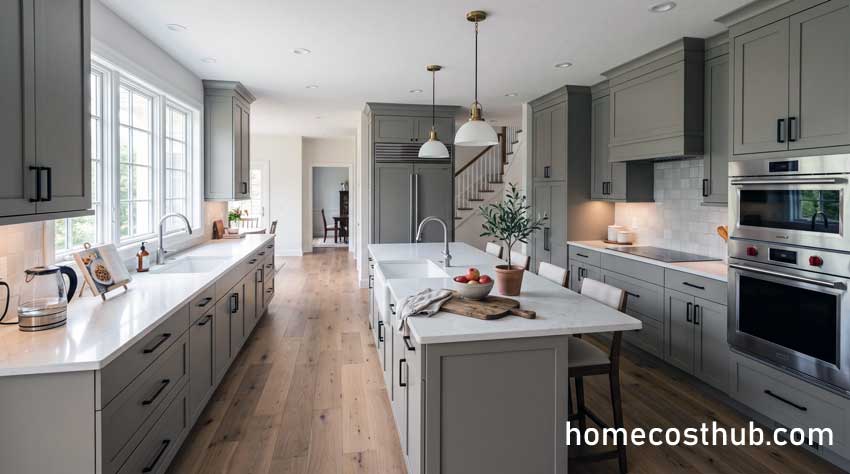
Luxury Kitchen Calculator

Luxury Kitchen Calculator Cost Guide
A Luxury Kitchen Calculator helps homeowners estimate the potential cost of creating a high-end kitchen with custom cabinetry, premium surfaces, sophisticated appliances, designer lighting, and specialist installation.
Luxury kitchen budgets can vary widely depending on kitchen size, material package, quality level, project scope, existing condition, installation complexity, labour difficulty, demolition, and optional architectural features.
This cost calculator supports both USA cost and UK cost estimates, displaying results in USD or GBP while allowing kitchen size to be entered in square feet or square meters. It separates material cost, labour cost, installation cost, additional features, and removal expenses to provide a practical price estimate for premium, custom, designer, bespoke, and ultra-luxury kitchen remodeling projects.
Luxury Kitchen Calculator
Estimate the cost of a luxury kitchen remodel in the USA or UK based on kitchen size, premium material package, quality level, project scope, existing condition, installation type, labour difficulty, demolition, and high-end design features.
Please enter a valid value.
USA Luxury Kitchen Estimate
$0
Kitchen Size: 0 ft²
Cost Breakdown
Materials$0
Labour$0
Installation$0
Additional$0
Removal$0
FREE PDF ESTIMATE
Get Your Luxury Kitchen Cost PDF
Enter your details below to receive your luxury kitchen estimate, selected options, and complete cost breakdown as a downloadable PDF.
✓ Your PDF is ready!
This estimate is intended for preliminary budgeting. Actual luxury kitchen remodeling costs may vary based on bespoke cabinetry, imported materials, slab selection, appliance brands, custom fabrication, architectural work, structural changes, specialist labour, delivery, permits, taxes, and local contractor pricing.
Free Luxury Kitchen Calculator
Material / Project Types
Luxury kitchens typically use materials and construction methods that go beyond a standard remodeling project.
Premium semi-custom packages can combine upgraded cabinetry, quality hardware, premium countertops, professional-grade fixtures, and higher-end finishes while retaining some standardized dimensions and components.
Custom luxury cabinetry and stone packages use made-to-measure cabinet construction combined with premium quartz, granite, marble, quartzite, or similar surfaces. Custom sizing allows the kitchen to fit the room more precisely and can support integrated storage and appliances.
Designer European-style packages may include frameless cabinetry, integrated handles, sophisticated hardware, contemporary surfaces, concealed appliances, specialty lighting, and highly coordinated finishes.
Bespoke architectural packages can include individually designed cabinetry, custom millwork, book-matched stone, specialty metals, integrated wall panels, concealed doors, structural modifications, and architectural detailing.
Also Read:
Ultra-luxury imported materials can include rare natural stone, imported cabinetry, artisan finishes, specialty fixtures, premium hardware, and highly customized fabrication.
Project type also has a major influence on the final budget. A luxury finish upgrade that keeps the existing layout is generally less expensive than a complete remodel. Layout changes and architectural remodeling can involve structural work, utility relocation, custom fabrication, and substantially more professional labour.
Main Factors Affecting Cost
Kitchen size is one of the primary factors affecting a luxury kitchen price estimate. Larger kitchens generally require more cabinetry, stone, flooring, lighting, trim, decorative finishes, and installation labour.
Material quality has an especially large impact in luxury projects. Premium and Luxury selections may involve higher cabinet construction standards, rare stone, designer fixtures, imported finishes, and custom hardware.
Cabinetry can represent one of the largest material cost categories. Bespoke cabinets may include integrated lighting, concealed storage, pull-out systems, custom finishes, appliance panels, and specialized internal organizers.
Countertop selection can also significantly affect cost. Large-format stone, waterfall edges, book-matched slabs, thick profiles, unusual edge treatments, and difficult fabrication increase both material cost and installation cost.
Appliances are another major consideration. Luxury kitchens often include integrated refrigeration, professional-style cooking equipment, steam ovens, wine storage, induction systems, warming drawers, or other specialty appliances.
Existing condition influences replacement cost and repair cost. Older kitchens may require electrical upgrades, plumbing modifications, subfloor repairs, wall correction, ventilation changes, or structural work before high-end materials can be installed.
Labour difficulty increases with custom millwork, precise stone fabrication, hidden lighting, integrated appliances, complex layouts, and detailed architectural finishes.
Cost Breakdown
Material Cost: Material cost represents cabinetry, stone, flooring, hardware, fixtures, panels, specialty finishes, and other products used in the luxury remodel. It varies according to kitchen size, material package, quality, project scope, and existing condition.
Labour Cost: Labour cost includes skilled carpentry, cabinetry fitting, stone coordination, finish work, appliance integration, plumbing, electrical coordination, and other professional remodeling tasks.
Installation Cost: Installation cost reflects the precision and complexity required to fit premium materials. Bespoke cabinetry, architectural panels, integrated appliances, specialty lighting, and custom stone generally require more detailed installation than standard kitchen products.
Additional Cost: Additional expenses can include bespoke cabinetry and millwork, premium stone countertops, integrated appliances, an oversized island, designer lighting, smart controls, wine storage, or a butler pantry. Basic, Standard, and Advanced feature levels adjust these allowances.
Removal Cost: Removal cost applies when existing cabinets, countertops, appliances, flooring, walls, or other components must be removed before the new luxury kitchen is installed. Major layout or architectural projects generally involve more demolition and disposal.
The calculator combines material cost, labour cost, installation cost, additional cost, and removal cost to generate the estimated total luxury kitchen remodeling price.
Why Use This Calculator?
The Luxury Kitchen Calculator provides homeowners with a practical starting point for budgeting a high-end kitchen renovation before committing to design fees, material orders, or contractor quotations.
It makes it easier to compare different levels of luxury. Homeowners can evaluate a premium semi-custom package against bespoke cabinetry, compare Premium and Luxury quality levels, or see how integrated appliances and architectural features change the overall price estimate.
The calculator also highlights expenses that may be underestimated during early planning. A luxury kitchen may require cabinet design, custom fabrication, stone templating, specialty delivery, appliance panels, lighting controls, electrical upgrades, plumbing changes, structural work, demolition, and detailed finish labour.
USA and UK pricing are selected independently from measurement units. USA estimates are shown in dollars, while UK estimates are displayed in pounds. Users may enter kitchen size in square feet or square meters regardless of country. Square-meter inputs are converted internally using 1 square meter = 10.7639 square feet while the original measurement unit remains visible in the result.
The estimate is intended for preliminary budgeting rather than a guaranteed contractor quotation. Luxury projects can vary considerably based on brands, custom design, imported products, supplier lead times, fabrication, local labour rates, and architectural requirements. Even so, the calculator offers a useful starting point for comparing installation cost, replacement cost, repair cost, USA cost, UK cost, price estimate, material cost, and labour cost.
Luxury Kitchen Calculator: Plan a Realistic High-End Kitchen Budget
Quick Answer
A Luxury Kitchen Calculator gives you a planning estimate, not a fixed contractor quote. Use the result as a budget range, then test it against your cabinetry, appliances, layout, professional fees, and contingency before committing to the project.
Two kitchens with almost identical floor areas can require very different budgets. One may keep every service in place and invest heavily in cabinetry; another may move walls, relocate plumbing, integrate professional appliances, and require structural or electrical work.
That is why the number generated by a Luxury Kitchen Calculator becomes more useful when you interpret the estimate rather than treating it as a final price. The real planning question is not simply, “How much is my kitchen?” It is, “Does my budget match the level of specification and construction scope I expect?”
Luxury Kitchen Budget Snapshot
Use your estimate as a planning range, not a contract price.
• Specification can matter as much as room size.
• Custom cabinetry and premium appliances can reshape how the budget is allocated.
• Moving utilities or altering structure increases cost uncertainty.
• US and UK projects require different tax, approval, terminology, and local-market assumptions.
• Keep contingency separate from money reserved for optional upgrades.
What Does Your Luxury Kitchen Calculator Estimate Actually Mean?
A Luxury Kitchen Calculator estimate is most useful as an early financial boundary. It gives you enough information to judge whether your intended project is broadly aligned with your available budget before detailed drawings, supplier quotations, and contractor pricing are complete.
The mistake is focusing on one precise number.
If a preliminary estimate suggests a project around $125,000, that does not mean a contractor should eventually submit a $125,000 quotation. At this stage, cabinet specifications may still change, appliances may not have been finalized, walls may not have been opened, and detailed electrical or ventilation requirements may not yet be known.
A more practical approach is to separate three numbers.
1. Base Project Estimate
This represents the expected scope based on the information currently available. It should reflect the kitchen you intend to build rather than a stripped-down version created only to fit an arbitrary budget.
2. Contingency Allowance
Contingency protects the project from genuine uncertainty: concealed conditions, coordination problems, design development, or necessary work that was difficult to identify during preliminary planning.
It should not become an informal allowance for adding more premium finishes during selection meetings.
3. Recommended Planning Budget
Your planning budget combines the expected project cost with appropriate contingency and known expenses that are outside the initial estimate.
Budget Formula
Recommended Planning Budget = Base Project Estimate + Contingency Allowance + Known Professional or Approval Costs Not Included in the Estimate
This formula is a planning framework rather than a guaranteed construction price.
The distinction becomes particularly important in high-specification kitchens because design decisions are interconnected. Changing refrigeration can affect cabinetry. Changing the range can affect ventilation. Moving an island may affect electrical or plumbing work. Selecting thicker or more complex stone details may alter fabrication and structural support requirements.
The current NKBA Kitchen & Bath Planning Guidelines specifically cover areas such as cabinetry, electrical planning, lighting, ventilation, equipment, systems coordination, and code compliance—an indication of how many disciplines may intersect inside one kitchen design.
Premium vs Luxury vs Bespoke: What Does Your Budget Buy?
“Premium,” “luxury,” and “bespoke” are useful planning labels, but they are not standardized legal price categories. A $100,000 project does not automatically become a luxury kitchen, nor does a lower-budget kitchen become ordinary simply because it costs less.
Also Read:
A better distinction is the amount of customization, coordination, craftsmanship, and architectural intervention involved.
| Level | Typical Buyer Priority | Customization | Appliance Strategy | Cabinet Approach | Architectural Complexity | Budget Sensitivity |
|---|---|---|---|---|---|---|
| Premium | Better quality without making every element one-off | Selective | Premium or selected luxury appliances | Semi-custom or carefully specified manufactured cabinetry | Usually limited | Higher |
| Luxury | Performance, appearance, integration, and personalization | High | Integrated or professional-grade package | Custom or highly configurable cabinetry | Moderate to high | Moderate |
| Bespoke / Ultra-Luxury | Architecture-led design and individualized fabrication | Very high | Premium integrated systems and specialty appliances | Made-to-order cabinetry or architectural millwork | Potentially extensive | Lower, although cost control still matters |
The biggest difference is often not the presence of marble, a large island, or an expensive range. It is how many elements must be designed, manufactured, and coordinated specifically for that room.
A premium kitchen might use excellent products within relatively standardized dimensions. A bespoke project may need cabinetry built around existing architecture, appliance panels manufactured to exact tolerances, individually selected stone slabs, concealed services, and custom junctions between cabinetry, walls, ceilings, and flooring.
For UK homeowners, current 2026 guidance from Homebuilding & Renovating quotes a specialist suggesting that a genuinely bespoke British-made kitchen can begin around £60,000–£70,000 for a smaller room before specification and scale push the project higher. Treat that figure as market context rather than a universal benchmark. See the Homebuilding & Renovating kitchen cost analysis.
How to Allocate a Luxury Kitchen Budget
A Luxury Kitchen Calculator result should not be divided into rigid percentages without considering what kind of kitchen you are building.
A homeowner who prioritizes handcrafted cabinetry needs a different allocation from someone building around professional cooking equipment. A third project may direct more of its money into construction because walls, openings, flooring levels, ventilation routes, and utilities are being redesigned.
The table below is intentionally illustrative. It demonstrates how the same broad budget can behave differently; the percentages are not national averages.
| Budget Category | Cabinetry-Led Luxury Kitchen | Appliance-Led Luxury Kitchen | Architectural Remodel |
|---|---|---|---|
| Cabinetry & Millwork | 35% | 24% | 22% |
| Appliances | 17% | 32% | 15% |
| Surfaces & Finish Materials | 14% | 12% | 12% |
| Construction & Installation | 16% | 14% | 30% |
| Lighting / Fixtures | 5% | 5% | 6% |
| Design / Professional Coordination | 5% | 5% | 7% |
| Planning Contingency | 8% | 8% | 8% |
Illustrative allocation only—not national cost data.
The useful lesson is how quickly one decision can change the allocation.
A homeowner who upgrades from a premium appliance package to built-in refrigeration, a larger professional range, specialty ovens, wine storage, and dedicated ventilation may need to move tens of thousands of dollars toward appliances before changing anything else.
Yale Appliance’s 2026 luxury-kitchen analysis puts many complete luxury appliance packages around $45,000 to $90,000+, with major differences driven by cooking equipment, refrigeration, ventilation, specialty appliances, installation, and package configuration. See Yale Appliance’s 2026 luxury kitchen appliance cost analysis.
That is why appliances should be specified early rather than treated as items that can be dropped into the design at the end.
What Can Different Luxury Kitchen Budgets Realistically Support?
Budget numbers become easier to understand when they are attached to realistic project scopes.
The scenarios below are planning examples. They are not contractor quotations, national averages, or guarantees. Local labor rates, room size, product brands, existing conditions, tax, professional services, and construction complexity can move actual costs substantially.
United States Planning Scenarios
| Illustrative Budget | Potential Project Direction | Likely Compromises | What Could Push It Higher |
|---|---|---|---|
| Around $75,000 | Premium-to-entry-luxury specification, strong cabinetry package, quality surfaces, selected high-end appliances, controlled construction scope | Fewer bespoke details, selective rather than full professional appliance package, limited structural work | Major layout changes, extensive custom cabinetry, built-in refrigeration, large stone requirements |
| Around $125,000 | Higher customization, custom cabinetry, premium stone, stronger appliance specification, upgraded lighting and integrated details | Some ultra-premium finishes or architectural changes may still need prioritization | Structural redesign, large appliance package, extensive millwork, difficult site conditions |
| $200,000+ | Potential for bespoke cabinetry, premium integrated appliances, architectural detailing, complex stone, extensive lighting and broader construction work | Budget still requires control; imported or one-off specifications can consume allowances quickly | Extensions, major structural intervention, rare materials, specialist fabrication, very large kitchens |
A $75,000 kitchen can still feel exceptionally refined if the existing footprint works well and money is concentrated on the features used every day. By contrast, $125,000 can disappear quickly when the project combines professional appliances, made-to-order cabinetry, utility relocation, and major construction.
At $200,000 and above, the owner gains more design freedom, but the need for disciplined scope control does not disappear. Bespoke projects actually create more opportunities for individual decisions to expand the budget.
United Kingdom Planning Scenarios
The UK examples should not be read as converted versions of the US budgets.
| Illustrative Budget | Potential Project Direction | Likely Constraints |
|---|---|---|
| Around £40,000–£60,000 | High-quality premium renovation with selective customization and controlled building work | Fully bespoke cabinetry or major architectural changes can challenge the allowance |
| Around £60,000–£100,000 | Potential bespoke cabinetry, higher specification appliances, premium worktops, tailored storage and stronger design input | Large rooms, structural alterations, extensive building works, or very high-end brands may push beyond the range |
| £100,000+ | Greater scope for architecture-led renovation, substantial bespoke joinery, premium appliance packages and specialist detailing | Extensions, London/South East costs, complex construction, exceptional materials and professional fees can raise the total further |
The £60,000–£70,000 starting context cited by Homebuilding for some genuinely bespoke British-made kitchens illustrates why a homeowner seeking extensive bespoke work should not assume that a premium fitted-kitchen budget automatically covers an architecture-led project.
Save vs Splurge in a Luxury Kitchen
A luxury budget is rarely improved by buying the most expensive version of every product. Better results usually come from concentrating money where durability, daily use, integration, or difficult future replacement justify the premium.
| Category | When Spending More May Make Sense | When You Can Control Cost |
|---|---|---|
| Cabinet Construction | Heavy daily use, unusual dimensions, integrated appliances, long-term ownership | Standardized cabinet sizes work well and extensive customization adds little practical value |
| Cabinet Hardware | Frequently used drawers, large pull-outs, heavy doors and internal storage systems | Decorative handles can often be changed later without redesigning cabinetry |
| Countertops / Worktops | Large islands, highly visible surfaces, demanding durability requirements | Complex edge profiles, excessive thickness, or rare slab selections are primarily aesthetic |
| Cooking Appliances | You cook frequently and will use the added capability | A professional specification adds little value if advanced features are rarely used |
| Refrigeration | Integrated design, high storage requirements, specialized temperature zones | Premium freestanding solutions may meet functional needs at lower cost |
| Ventilation | Higher-output cooking equipment requires properly coordinated extraction | Do not overspecify equipment purely for appearance |
| Lighting | Task lighting, controls, cabinet integration, layered illumination | Decorative fixtures can be selected strategically rather than everywhere |
| Backsplash | It is central to the design concept or requires specialist fabrication | Decorative tile is one of the easier areas to simplify without altering kitchen function |
| Specialty Appliances | You already use or clearly need steam, speed cooking, wine storage, or coffee systems | Avoid equipment included mainly because it appears on luxury specification lists |
| Bespoke Details | They solve architectural problems or create meaningful functionality | Reduce purely decorative one-off elements that add fabrication hours but little utility |
A useful rule is to protect the parts that would be expensive or disruptive to change later. Cabinet carcasses, internal storage planning, utility infrastructure, ventilation, and major worktops are harder to revisit than decorative hardware or some surface finishes.
How Layout Decisions Change the Budget Risk
The cost issue with changing a layout is not simply that “moving things costs more.” The larger concern is scope uncertainty.
Every time a design crosses an existing service, alters an opening, or changes how appliances connect to the building, another trade or technical decision may enter the project.
| Layout Scope | Cost Uncertainty | Design Flexibility | Typical Coordination |
|---|---|---|---|
| Keep Existing Layout | Lower | Lower to Moderate | Cabinet fit, appliances, surfaces, finishes |
| Minor Reconfiguration | Moderate | Moderate | Selected electrical, plumbing, ventilation or flooring changes |
| Major Reconfiguration | Higher | High | Multiple services, floor/wall repairs, lighting, ventilation, new appliance locations |
| Structural Remodel | Highest | Very High | Design professionals, structural review, approvals, multiple trades and sequencing |
Consider a large island that moves six feet from the original design location. Visually, the change may appear simple. Technically, it may affect receptacles, lighting positions, sink waste, water lines, floor penetrations, ventilation strategy, stone dimensions, seating clearances, and cabinet drawings.
That is why layout should become stable before expensive made-to-order elements enter fabrication.
Also Read: Kitchen Layout Change Calculator
Luxury Kitchen Decision Tree
Use this decision tree after reviewing your Luxury Kitchen Calculator result.
Are you keeping the existing kitchen footprint?
→ YES
Can the primary appliances, sink, and major services remain in roughly their existing locations?
→ YES: Focus the budget on cabinetry, surfaces, appliances, storage, lighting, and finish quality.
→ NO: Add an allowance for service coordination before increasing finish specifications.
Do you want full custom or bespoke cabinetry?
→ YES: Lock appliance dimensions, major service locations, and design decisions before fabrication.
→ NO: Compare premium semi-custom options before paying for customization you may not need.
Are professional-grade or integrated appliances a priority?
→ YES: Confirm electrical, gas where applicable, ventilation, refrigeration clearances, panels, and installation requirements early.
→ NO: Keep more of the budget available for cabinetry, surfaces, lighting, or construction.
Are you changing walls, openings, extensions, or structural elements?
→ YES: Treat the project as an architectural remodel. Obtain appropriate design, engineering, contractor, and approval input before relying on finish-level budgets.
→ NO: Construction uncertainty may be lower, but existing conditions still need checking.
Does the desired specification exceed the planning budget?
→ YES: Reduce optional specification before using contingency.
→ NO: Keep the contingency protected until major unknowns have been resolved.
This approach prevents a common failure in luxury projects: solving an early budget conflict by consuming the money intended to protect the project later.
Also Read:
United States vs United Kingdom Luxury Kitchen Planning
The US and UK should be treated as separate remodeling markets. Converting dollars into pounds does not account for different tax treatment, approval systems, terminology, labor structures, or procurement practices.
| Planning Issue | United States | United Kingdom |
|---|---|---|
| Currency | USD ($) | GBP (£) |
| Typical Measurement | Square feet | Square metres |
| Common Project Term | Kitchen remodel | Kitchen renovation / refurbishment |
| Main Installation Role | General contractor / specialist installer | Main contractor / kitchen fitter / specialist trades |
| Approvals | Permits and inspection requirements vary by state and local jurisdiction | Building Regulations and other approvals can apply depending on the work and UK nation |
| Tax | Sales-tax treatment varies by jurisdiction and transaction | VAT can materially affect quotations; most qualifying ordinary building work is generally standard-rated, subject to exceptions |
| Cabinet Terminology | Custom cabinetry / millwork | Bespoke cabinetry / joinery |
| Regional Variation | Large differences among states and metropolitan markets | London, South East and regional markets can produce different labour and logistics costs |
For England, GOV.UK states that Building Regulations approval may be needed for a range of alterations and that building-regulation approval is distinct from planning permission. Project-specific requirements should be checked with the appropriate building control body rather than assumed from the kitchen’s visual scope. See GOV.UK guidance on when Building Regulations approval may be required.
Ventilation also has its own regulatory framework. The government’s Approved Document F guidance supports Part F of the Building Regulations for England.
For UK budgeting, do not assume a contractor’s headline figure includes or excludes VAT without checking the quotation. GOV.UK states that the standard VAT rate is 20%, and most work on houses and flats by builders and trades is normally charged at the standard rate, although qualifying exceptions exist. See GOV.UK VAT guidance for builders.
These UK references largely concern England or UK tax treatment. Scotland, Wales, and Northern Ireland can have different building-control arrangements, so the relevant authority should be checked for the property location.
How Much Contingency Should a Luxury Kitchen Need?
Contingency should reflect uncertainty rather than a fashionable percentage.
A newer property with a stable layout, completed design documents, accessible services, and standardized products carries a different risk profile from an older property where walls will be opened, plumbing moved, bespoke joinery installed, and imported products coordinated.
| Project Condition | Relative Contingency Need | Why |
|---|---|---|
| Stable layout, well-documented property, limited intervention | Lower | Fewer unknown construction interfaces |
| Several utility changes or incomplete design selections | Moderate | Pricing and coordination remain partly unresolved |
| Older building with concealed conditions | Higher | Demolition may reveal repairs or incompatible existing work |
| Structural alterations | Higher | Engineering, sequencing and building interfaces increase uncertainty |
| Extensive bespoke fabrication | Moderate to Higher | Late design changes can become expensive once fabrication starts |
| Imported or long-lead products | Moderate to Higher | Freight, replacement, timing and specification changes may have larger consequences |
Three budget categories are often confused.
Contingency protects against legitimate uncertainty.
Upgrade allowance is money intentionally reserved for optional improvements.
Change-order spending occurs when the contracted scope changes.
If you use contingency to select a more expensive stone before construction starts, that money is no longer available if demolition reveals a problem.
Protect the Contingency
Treat contingency as project protection, not as the final line of your shopping budget. Upgrade allowances and contingency solve different problems and should remain separate.
How to Check Whether Your Luxury Kitchen Calculator Estimate Is Realistic
Before treating the estimate as your working budget, compare the assumptions behind it with the scope you are actually asking contractors, designers, cabinetmakers, or kitchen fitters to deliver.
Luxury Kitchen Estimate Review Checklist
- Confirm that the project scope matches the calculator assumptions.
- Separate must-have features from optional upgrades.
- Check whether custom cabinetry includes installation and finishing.
- Confirm appliance delivery, ventilation, electrical, and installation requirements.
- Identify plumbing, structural, or layout changes before ordering materials.
- Allow for design, engineering, permits, Building Regulations, or professional fees where applicable.
- Keep a contingency allowance for unknown conditions.
- Compare detailed contractor or kitchen-fitter quotations on the same scope.
One of the most useful checks is quote normalization. Two quotations cannot be compared fairly if one includes demolition, waste removal, installation, appliance connections, and finishing while another excludes several of those items.
The cheapest headline number may simply represent the smallest scope.
Illustrative Luxury Kitchen Planning Case Study
Illustrative Case Study — not an actual HomeCostHub customer project.
A homeowner planning a medium-to-large high-end kitchen begins with two priorities: bespoke cabinetry and a substantial premium appliance package. The Luxury Kitchen Calculator result initially appears compatible with the available budget.
Initial Priorities
The planned specification includes:
- Made-to-order cabinetry
- A large island with prep sink
- Built-in refrigeration
- Professional cooking equipment
- Integrated task lighting
- Premium natural-stone surfaces
The homeowner assumes the remaining decisions will mostly concern colors and finishes.
Budget Pressure Discovered
Once equipment specifications are coordinated, the project requires more than cabinet openings for appliances.
The cooking package affects ventilation. The new island requires water, waste, and electrical coordination. Integrated refrigeration changes cabinet-panel detailing. The selected stone creates fabrication decisions around the island edges and support.
None of these items makes the original concept unreasonable. They simply reveal that part of the budget belongs to infrastructure and coordination rather than visible finishes.
Adjustment
Instead of consuming contingency, the homeowner separates priorities.
The cabinetry remains bespoke because it solves storage and architectural requirements. Core cooking and refrigeration appliances remain. A secondary specialty appliance is removed. Decorative stone detailing is simplified, and several nonessential custom interior accessories are postponed.
Final Planning Approach
The project retains the features that are hardest to change later:
- Cabinet structure and dimensions
- Appliance integration
- Ventilation
- Island services
- Primary work surfaces
Easy-to-change decorative elements receive less money.
Lesson
The strongest luxury budget is not the one with the longest specification list. It is the one that protects the design decisions with the greatest functional value and highest future replacement cost while preserving enough financial capacity for the construction needed to support them.
Expert Tips for Planning a High-End Kitchen Budget
Price the Appliance Package Before Cabinetry Is Finalized
Do not design generic appliance openings and choose equipment afterward. Built-in refrigerators, professional ranges, ventilation equipment, wall ovens, coffee systems, and wine storage may have specific dimensions, power requirements, ventilation conditions, and panel details.
Coordinate Cabinet Drawings With Actual Appliance Specifications
Model numbers matter. “48-inch range” or “built-in refrigerator” is not enough information for final fabrication.
NKBA’s current planning guidance specifically recognizes equipment, cabinetry, electrical planning, ventilation, lighting, and systems coordination as interconnected design areas.
Decide Early Whether the Layout Is Really Moving
A late layout change affects more than construction. It can invalidate cabinet drawings, stone dimensions, lighting positions, flooring work, plumbing routes, and appliance coordination.
Also Read: Kitchen Layout Change Calculator
Separate Bespoke Wants From Functional Requirements
Custom fabrication is valuable when it solves a real spatial, storage, ergonomic, or architectural problem. It provides less financial value when a standardized solution would perform equally well and the customization is barely visible.
Do Not Finalize Stone Too Early
Stone should be coordinated with actual installed conditions and the fabricator’s process. Detailed edge treatments, waterfalls, seams, slab dimensions, cutouts, and support can affect what is practical.
Compare Scope, Not Cabinet Price Alone
A cabinetry proposal may or may not include installation, finishing, internal accessories, appliance panels, handles, fillers, delivery, site measurement, and modification work.
Normalize the scope before comparing suppliers.
Protect Contingency During Design Development
Upgrading from one attractive finish to another is a design choice. Discovering that existing electrical work must be corrected is a project condition.
Do not fund both from the same allowance.
Ask Who Owns Coordination
Luxury kitchens involve overlapping responsibilities. Establish who checks the relationship between cabinetmaker, appliance supplier, electrician, plumber, ventilation installer, stone fabricator, designer, and contractor.
High-cost components can still fail when nobody owns the interfaces between them.
Pros and Cons of a High-Specification Luxury Kitchen
| Pros | Cons |
|---|---|
| Greater customization: storage and dimensions can respond closely to the room and homeowner. | Higher capital cost: custom products and specialist labor require a larger investment. |
| Better integration: cabinetry, appliances, lighting, and architectural elements can be coordinated as one design. | Longer lead times: bespoke fabrication and specialist products may take longer to manufacture or replace. |
| Functional storage: tailored internal systems can improve daily use. | More coordination: appliances, cabinetry, services, stone, and construction must align accurately. |
| Material choice: homeowners gain access to a wider range of finishes and construction methods. | Replacement complexity: highly integrated products may be harder to replace independently. |
| Architectural problem-solving: custom design can address awkward rooms or unusual requirements. | Diminishing returns: some highly personalized upgrades may deliver little functional or resale benefit. |
| Design consistency: details can be coordinated across cabinetry, walls, lighting, and finishes. | Change-order exposure: late revisions become expensive once custom work enters fabrication. |
The resale value of a luxury kitchen should never be treated as guaranteed repayment of the remodeling cost. Highly personalized features may be valuable to the current owner without being valued equally by the next buyer.
Also Read: Kitchen Remodel ROI Calculator
Common Luxury Kitchen Budgeting Mistakes
1. Treating the Preliminary Estimate as a Fixed Quote
Problem: Early estimates are based on assumptions that may change as design and construction details become clearer.
Better approach: Use your Luxury Kitchen Calculator result to establish a planning range and then replace assumptions with project-specific quotations.
Also Read:
2. Spending the Contingency During Specification
Problem: The project looks affordable only because the reserve has already been allocated to upgrades.
Better approach: Keep optional upgrades and contingency in separate budget lines.
3. Choosing Appliances After Cabinetry Is Locked
Problem: Appliance dimensions, panel requirements, ventilation, power, and clearances may conflict with completed cabinet drawings.
Better approach: Select or at least technically specify major appliances before final cabinet fabrication.
4. Comparing Quotes With Different Scopes
Problem: One contractor appears cheaper because exclusions are hidden in the detail.
Better approach: Compare demolition, installation, trade work, materials, professional fees, approvals, allowances, and exclusions side by side.
5. Assuming “Custom” Means the Same Thing Everywhere
Problem: One supplier may use “custom” for made-to-order cabinetry while another uses it for configurable standard components.
Better approach: Compare construction method, dimensions, finishes, internals, materials, installation, and warranty—not the label.
6. Missing Delivery, Commissioning, or Specialist Installation
Problem: The product price looks complete while essential installation services remain outside the allowance.
Better approach: Ask who delivers, connects, commissions, tests, and signs off each specialist item.
7. Changing the Layout After Fabrication Decisions
Problem: A small plan revision creates cabinet, stone, lighting, electrical, or flooring rework.
Better approach: Freeze critical dimensions and service positions before custom production begins.
8. Overspending on Visible Finishes While Underfunding Construction
Problem: The design allowance is consumed by surfaces while essential electrical, structural, plumbing, or ventilation work remains unresolved.
Better approach: Fund the building conditions before treating decorative upgrades as committed expenditure.
9. Assuming Every Luxury Upgrade Improves Resale Value
Problem: Highly personal features may not appeal to another buyer.
Better approach: Separate improvements chosen for your own use from decisions justified primarily by expected resale.
10. Ignoring Long Lead Times
Problem: Bespoke cabinets, specialty hardware, stone, or imported appliances can alter sequencing and create expensive delays.
Better approach: Confirm realistic lead times before setting the installation program.
Also Read: Kitchen Remodel Timeline Calculator
Luxury Kitchen Myth vs Fact
Fact
Size matters, but cabinetry specification, appliance package, structural work, bespoke fabrication, and layout complexity can make a smaller kitchen more expensive than a larger, simpler project.
Fact
Price alone does not define luxury. Location, kitchen size, cabinetry, appliance specification, construction scope, professional input, and site conditions determine what a given budget can realistically support.
Fact
Custom cabinetry can be highly valuable when it solves unusual dimensions, storage needs, appliance integration, or architectural problems. Paying for customization that provides no functional or design benefit may offer little additional value.
Fact
A stable footprint can reduce risk, but demolition may still expose outdated wiring, plumbing issues, damaged substrates, ventilation problems, or other conditions that were not visible during early planning.
Fact
Premium appliances can also require ventilation, electrical capacity, gas or water connections where applicable, manufacturer clearances, panel coordination, delivery planning, and specialist installation.
Fact
Resale impact depends on total project cost, local property values, buyer preferences, the quality of execution, and how appropriate the specification is for the home. A high project budget does not guarantee equivalent resale value.
Questions to Ask Before Approving a Luxury Kitchen Quote
A detailed quotation should make it possible to identify what you are buying, what is excluded, and what could still change.
Ask:
- Is demolition and disposal included?
- Does the cabinetry price include installation, finishing, fillers, panels, hardware, and internal accessories?
- Are appliance connections and commissioning included?
- Who supplies and installs the ventilation system?
- Are stone templating, fabrication, delivery, and installation included?
- Are electrical panel, consumer-unit, circuit, or capacity upgrades excluded?
- Are plumbing and waste modifications included?
- Does a UK quotation include VAT?
- Which permits, Building Regulations applications, inspections, or approvals are excluded?
- Who pays for revisions after design approval?
- What specifically triggers a change order?
- Which amounts are allowances rather than fixed-price items?
- What happens if an allowance is exceeded?
- What are the current manufacturing and delivery lead times?
- What deposit and payment schedule is required?
- Who is responsible for coordinating the cabinetmaker, stone fabricator, appliance installer, electrician, plumber, and other trades?
The goal is not to obtain the shortest quote. It is to obtain a scope detailed enough that competing quotations can be compared on the same basis.
Frequently Asked Questions
How much does a luxury kitchen cost?
A luxury kitchen can range from a controlled high-end remodel to a six-figure or substantially larger architectural project. Specification and scope are more useful than one national average. Custom cabinetry, appliances, construction work, location, professional fees, and bespoke fabrication can all shift the final budget.
Use the Luxury Kitchen Calculator as a planning benchmark rather than assuming every kitchen of the same size should cost the same.
What is considered a luxury kitchen?
A luxury kitchen is generally distinguished by a high level of design coordination, customization, material specification, appliance integration, craftsmanship, and installation quality rather than by a single price threshold.
A relatively small custom kitchen can involve more technical and fabrication work than a much larger premium kitchen built mainly from standardized products.
Is $100,000 enough for a luxury kitchen?
$100,000 can support a luxury kitchen in some US projects, but the achievable specification depends heavily on scope. Keeping the existing footprint and controlling structural work may leave more money for cabinetry, surfaces, and appliances. Major reconfiguration, extensive bespoke cabinetry, premium refrigeration, or structural changes can consume that budget much faster.
What might a $150,000 kitchen remodel include?
An illustrative $150,000 US project could support custom cabinetry, premium surfaces, a strong appliance package, upgraded lighting, and meaningful installation work where the construction scope remains controlled.
The same budget may need substantial reprioritization if the project includes load-bearing alterations, extensive utility relocation, very large cabinetry quantities, or a $60,000+ appliance package.
How much does a bespoke kitchen cost in the UK?
Bespoke UK kitchens vary substantially according to room size, cabinetry craftsmanship, appliances, worktops, installation, and associated building work. Homebuilding’s 2026 analysis cites specialist guidance suggesting that some genuinely bespoke British-made kitchens start around £60,000–£70,000 for a smaller room, with costs rising as scale and specification increase.
That figure should be treated as market context rather than a universal minimum.
What is usually the biggest expense in a luxury kitchen?
Cabinetry is frequently a major expense, but it is not automatically the largest item in every project. Appliance-led kitchens can shift a very large share of the budget toward cooking, refrigeration, ventilation, and specialist equipment, while architectural remodels may direct more money into construction.
Yale’s 2026 analysis places many luxury appliance packages alone in the $45,000–$90,000+ range.
Are custom kitchen cabinets worth the cost?
Custom cabinets can justify their premium when they solve unusual room dimensions, integrate appliances, improve storage, accommodate architectural features, or deliver a finish that cannot reasonably be achieved with standardized cabinetry.
They provide less obvious value when the room accepts standard dimensions easily and customization is being purchased mainly for the label.
Also Read: Kitchen Cabinet Replacement Calculator
How much do luxury kitchen appliances cost?
Luxury appliances can represent tens of thousands of dollars before the rest of the kitchen is considered. Yale Appliance’s current 2026 analysis estimates many complete luxury packages at roughly $45,000–$90,000+, depending on range size, refrigeration configuration, ventilation, specialty appliances, installation, and other selections.
This is why the appliance package should be established early in a high-end kitchen budget.
Why are luxury kitchen quotes so different?
Luxury kitchen quotes often differ because they do not contain identical scopes. Cabinet specifications, appliances, installation, demolition, professional services, stone fabrication, electrical work, plumbing, allowances, taxes, and exclusions can all be treated differently.
Before choosing the lowest number, normalize each quotation so the same work is being compared.
Why did my kitchen remodel quote come in much higher than expected?
A quotation may exceed an early Luxury Kitchen Calculator estimate when the contractor identifies work that was not fully defined during preliminary planning. Common examples include utility relocation, additional electrical work, custom fabrication, site preparation, professional fees, specialist installation, or a higher product specification than initially assumed.
Compare the estimate assumptions against the detailed quote line by line before deciding that either figure is wrong.
Should I spend more on cabinetry or appliances?
Spend according to how the kitchen will be used. A homeowner who needs extensive storage and integrated architecture may gain more from cabinetry. A serious home cook may place greater value on cooking equipment, refrigeration, and ventilation.
The mistake is allowing one category to consume the budget before the other major requirements have been priced.
How much contingency should I keep for a luxury kitchen?
Contingency should match the project’s uncertainty rather than a universal percentage. Projects with stable layouts and well-documented conditions may require less protection than older homes, structural remodels, extensive utility relocation, or schemes involving large amounts of bespoke fabrication.
Set the contingency after evaluating risk, then avoid spending it on optional upgrades.
Does a luxury kitchen increase home value?
A well-designed kitchen may contribute to buyer appeal and property value, but a luxury remodel does not guarantee that every dollar spent will be recovered at resale.
Also Read:
Local property values, buyer expectations, project cost, design quality, and the degree of personalization all matter. Treat resale value as one consideration rather than the sole justification for an expensive specification.
Also Read: Kitchen Remodel ROI Calculator
Do I need an architect for a luxury kitchen remodel?
A straightforward kitchen replacement does not automatically require an architect. Professional architectural or structural input becomes more relevant when the project changes walls, structural openings, extensions, circulation, building services, or the relationship between the kitchen and the rest of the home.
In England, some alteration work can also require Building Regulations approval, which is separate from planning permission.
Do luxury kitchen appliances require special installation?
Some do. Professional cooking equipment, built-in refrigeration, integrated appliances, and specialist products may create requirements for ventilation, electrical supply, water, drainage, gas where applicable, cabinetry clearances, panels, delivery access, or commissioning.
The appliance specification should be reviewed by the relevant designer and trades before cabinetry enters production.
How accurate is a Luxury Kitchen Calculator?
A Luxury Kitchen Calculator is most useful for preliminary budgeting and comparing project scenarios. It cannot inspect concealed site conditions, finalize a supplier specification, confirm local labor pricing, or replace detailed contractor and trade quotations.
Accuracy improves as assumptions about layout, cabinetry, appliances, materials, construction, and location become more specific.
Is it cheaper to keep the existing kitchen layout?
Keeping the main sink, appliances, and services close to their existing positions can reduce construction uncertainty, but it does not guarantee a low-cost project. High-specification cabinetry, appliances, stone, lighting, or concealed defects can still produce a substantial luxury budget.
Use layout stability as one risk-control tool rather than as proof that the renovation will be inexpensive.
What should I finalize first in a luxury kitchen?
Start with the functional plan, major appliance requirements, service locations, and cabinet strategy before locking detailed finishes. These decisions affect multiple downstream trades and products.
NKBA’s planning framework recognizes cabinetry, equipment, electrical planning, lighting, ventilation, and systems coordination as interconnected parts of kitchen planning.
From Calculator Estimate to Contractor Quote
Once your Luxury Kitchen Calculator result is within a budget you are comfortable funding, the next step is not to spend the remaining allowance on upgrades.
Turn the estimate into a defined scope.
Document the layout. Identify the cabinetry level. Establish major appliance models or technical requirements. Record the surfaces and major finishes. Identify structural and utility changes. Separate fixed requirements from optional features. Clarify professional services, approvals, taxes, and contingency.
Then ask contractors, designers, cabinetmakers, or kitchen fitters to price the same scope.
A detailed $140,000 quotation and a vague $115,000 quotation cannot be compared fairly until you know what each number contains.
That transition—from calculator estimate to normalized project scope—is where a preliminary budget becomes useful construction planning.
About the Author
Ethan Caldwell (Expert — Residential Construction & Remodeling Cost Analysis)
Ethan Caldwell writes about residential construction, remodeling cost analysis, project budgeting, and scope evaluation for homeowners planning major improvements. His work focuses on translating construction-cost concepts into practical decisions, including how to interpret estimates, compare project scopes, recognize budget risk, and avoid misleading cost assumptions. His analysis is educational and does not replace project-specific advice from licensed or qualified professionals where required.
Use Your Luxury Kitchen Calculator Result as a Planning Baseline
Your Luxury Kitchen Calculator result is most valuable when it helps you make decisions before expensive commitments are made.
Use the estimate to establish a realistic financial boundary. Then compare that boundary against the cabinetry, appliances, layout, construction scope, professional services, and contingency your project actually requires. For appliance-related costs, it can also help to estimate individual installation expenses separately—for example, an Oven Installation Calculator can give you a clearer allowance for fitting an oven within the wider kitchen budget.
If those pieces fit inside the planning budget, you have a stronger basis for requesting detailed contractor or kitchen-fitter quotations. If they do not, revise optional specifications before cutting the money reserved for unresolved project risk.
A luxury kitchen is easier to control when the budget follows the scope—not when the scope keeps expanding to consume the budget.
Scroll to bottom
Remodeling Cost Calculators