Interior Painting Calculator

Interior Painting Calculator Cost Guide
An Interior Painting Calculator helps homeowners estimate the potential cost of repainting walls, ceilings, trim, and other interior surfaces before requesting professional quotations.
Interior painting prices can vary depending on total surface area, paint type, material quality, room scope, existing surface condition, preparation requirements, labour difficulty, and removal work. This cost calculator supports both USA cost estimates in US dollars and UK cost estimates in pounds sterling.
Users can enter the painting area in square feet or square meters and compare projects ranging from walls-only painting to full-room or whole-house interiors.
The resulting price estimate separates material cost, labour cost, installation cost, additional preparation or finishing features, and removal expenses, giving homeowners a practical starting point for creating a realistic interior painting budget.
Interior Painting Calculator
Estimate interior painting costs in the USA or UK based on project size, paint type, material quality, room scope, existing condition, application method, labour difficulty, removal work, and optional features.
Please enter a valid value.
Removal Required
Additional Features
Additional features may include primer, trim and baseboards, doors, accent walls, stain blocking, crack filling, caulking, high-ceiling access, decorative finishes, or specialty coatings.
USA Interior Painting Estimate
Total Estimate
$0
Painting Area: 0 ft²
Cost Breakdown
Materials $0
Labour $0
Installation $0
Additional $0
Removal $0
This calculator provides a preliminary planning estimate. Actual interior painting costs can vary based on wall height, surface preparation, paint coverage, number of coats, trim details, colour changes, repairs, room access, local labour rates, contractor pricing, taxes, and project-specific conditions.
FREE PDF ESTIMATE
Get Your Interior Painting Estimate PDF
Enter your details below to receive your interior painting estimate, selected options, and complete cost breakdown as a downloadable PDF.
✓ Your PDF is ready!
Free Interior Painting Calculator
Material / Project Types
Interior paints are available in several formulations designed for different rooms, lifestyles, and performance requirements.
Standard interior latex or emulsion paint is suitable for many bedrooms, living rooms, hallways, and general residential spaces. It is typically one of the most economical options.
Washable or scrubbable paint offers improved durability where surfaces need frequent cleaning. It can be particularly useful in family rooms, hallways, kitchens, children’s bedrooms, and high-traffic areas.
Moisture-resistant interior paint is designed for rooms where humidity is more common, such as bathrooms, utility areas, kitchens, or certain basement spaces.
Also Read:
Designer or specialty interior paint may include premium architectural coatings, decorative finishes, specialty colours, or products designed for enhanced appearance and durability. These options usually carry a higher material cost.
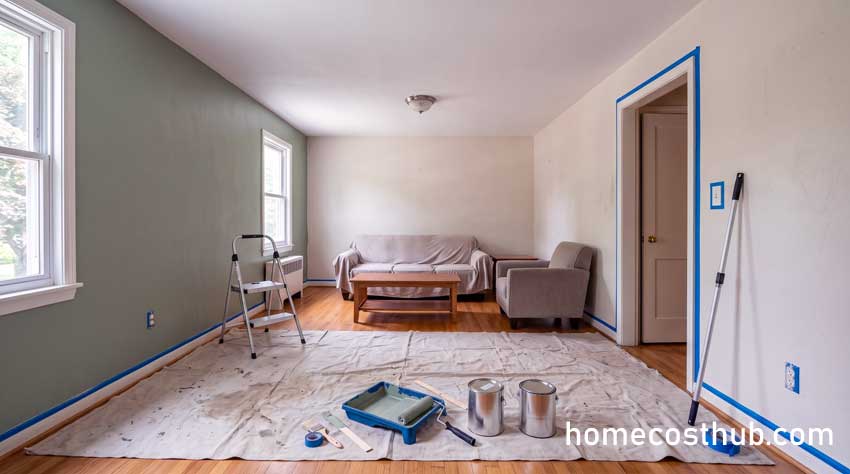
Project type also affects the estimate. Walls-only painting is generally straightforward, while walls and ceilings require additional overhead work. A full-room project may also include trim, doors, baseboards, and detailed cutting-in. Whole-house projects can benefit from scale but involve significantly more total surface area.
Main Factors Affecting Cost
Project size directly affects the amount of paint, primer, caulk, masking material, and labour required. A larger painting area generally leads to a higher total price estimate.
Material type changes the cost of paint and associated products. Standard coatings are usually less expensive than washable, moisture-resistant, or specialty paints.
Material quality also has a strong impact on material cost. Budget paints can lower initial spending, while premium and luxury products may provide improved coverage, durability, finish consistency, and colour performance.
Project type affects the amount of detail involved. Painting walls alone is usually simpler than completing ceilings, trim, doors, or an entire house interior.
Existing condition determines how much preparation is needed. New or well-prepared surfaces generally require less work, while cracked walls, damaged drywall, stains, peeling coatings, or rough plaster can increase repair cost and replacement cost.
Labour difficulty accounts for high ceilings, staircases, detailed trim, awkward rooms, extensive masking, occupied spaces, and other conditions that slow down the work.
Installation type represents the preparation and finish standard. A basic application costs less than standard preparation with two coats, while custom finishes may require specialty techniques, additional colour changes, or more detailed workmanship.
Removal work increases the budget when wallpaper, peeling coatings, or damaged paint layers must be stripped before repainting.
Cost Breakdown
The Interior Painting Calculator divides the estimated project cost into five categories.
Material Cost: Material cost includes interior paint, primer, caulk, masking products, rollers, brushes, trays, protective coverings, and other consumables required for the selected project.
Labour Cost: Labour cost covers preparation, masking, cutting-in, rolling, brushing, cleanup, and the time required to complete the painting work. More complex rooms and difficult access typically increase labour cost.
Installation Cost: Installation cost reflects the selected application and finish level. Standard prep and two-coat work costs more than basic application, while detailed or specialty finishes can increase this category further.
Additional Cost: Additional work may include primer, trim and baseboards, doors, accent walls, stain blocking, crack filling, caulking, high-ceiling access, decorative finishes, or specialty coatings.
Removal Cost: Removal cost covers scraping, wallpaper stripping, or removal of deteriorated coatings. If no removal is required, the calculator still displays this category with a zero value.
Actual USA cost and UK cost figures can vary according to regional labour rates, contractor demand, paint brand, room configuration, surface condition, taxes, and project specifications.
Why Use This Calculator?
An Interior Painting Calculator provides homeowners with a convenient way to create an initial decorating budget before contacting professional painters or remodeling contractors.
Instead of relying on a single generic cost-per-square-foot figure, the calculator adjusts the price estimate according to project size, paint type, material quality, room scope, existing condition, application method, labour difficulty, removal requirements, and optional features.
It can also help compare different project scenarios. Homeowners can evaluate walls-only painting against a full-room project, compare budget products with premium paint, or estimate how high ceilings, trim work, and extensive preparation affect the overall cost.
The detailed breakdown makes it easier to see how projected spending may be divided between material cost, labour cost, installation cost, additional features, and removal work.
The estimate should be treated as a preliminary planning guide rather than a guaranteed contractor quotation. Final pricing may also include drywall or plaster repairs, stain treatment, specialist primers, furniture moving, hazardous-material precautions, repair cost, replacement cost, and other property-specific requirements.
Interior Painting Calculator: How to Use Your Estimate
Quick Answer
An Interior Painting Calculator gives you a planning benchmark, not a guaranteed contract price. Before comparing the estimate with painter quotes, make sure the scope matches: the same surfaces, preparation, number of coats, trim and doors, finish level, protection, cleanup, and exclusions.
How to Read Your Interior Painting Calculator Estimate
Your calculator result is most useful as a budget and scope benchmark. It gives you a reference point for evaluating different project scenarios and later checking whether a professional quote covers roughly the same work.
Three numbers may appear similar during planning but serve different purposes:
- Calculator estimate: a planning figure based on the project details entered and the cost assumptions behind the calculator.
- Contractor quotation: a price or estimate prepared after a painter considers the actual property, work sequence, preparation, access, and requested finish.
- Final invoice: the amount due after approved changes, variations, added repairs, or other contract adjustments are accounted for.
A contractor quote that differs from the calculator result is not automatically unreasonable. The useful question is why the numbers differ.
For example, your calculator scenario may assume paint, normal preparation, and two finish coats. A contractor may discover damaged plaster around a window, stained drywall that requires a specialist primer, or intricate trim that needs separate preparation. Those conditions change the scope rather than simply changing the painter’s price.
When reviewing the result, look beyond the total. Pay attention to how much of the estimate relates to the core painting work and how much comes from preparation, optional surfaces, removal, repairs, or finishing details. Those categories give you a checklist for reviewing professional proposals.
Before Comparing Painter Quotes, Normalize the Scope
Two painting quotes are comparable only when they describe substantially the same job. A lower total may simply exclude ceilings, trim, repairs, furniture handling, or primer that another painter has included.
A vague proposal such as “paint bedroom” gives you very little information. A useful quotation should make it possible to understand what will be prepared, protected, painted, excluded, and cleaned up.
| Scope Item | Quote A | Quote B | Why It Matters |
|---|---|---|---|
| Walls | Included | Included | This part is broadly comparable. |
| Ceiling | Included | Excluded | The totals describe different finished scopes. |
| Baseboards / skirting | Included | Excluded | Detailed brushing, masking, and preparation can add labor. |
| Doors | 2 doors | None | Door preparation and coating are additional work. |
| Crack repairs | Allowance | Defined repair scope | The homeowner carries different levels of cost uncertainty. |
| Primer | Spot prime | Full prime | The preparation specification is not the same. |
| Finish coats | Two | “As required” | Clarify what finish standard is actually promised. |
| Furniture moving | Included | Owner responsibility | The cheaper quote may require more homeowner work. |
| Cleanup | Included | Included | This item is comparable if the cleanup scope is similar. |
| Tax / VAT | Clarify | Clarify | Confirm the amount you will actually pay. |
A useful way to compare bids is to create one master scope and mark each item as included, excluded, allowance-based, or unclear. Questions become much easier to resolve once the comparison is based on scope rather than the headline total.
Expert Tip
Before comparing total prices, rewrite every quote into the same scope: surfaces, preparation, number of coats, trim and doors, furniture protection, cleanup, and exclusions. Price differences become meaningful only after scope differences are removed.
The cheapest quote can become the more expensive project if important work is added later. The opposite can also happen: a higher initial quotation may simply include work that another painter expects the homeowner to handle separately.
What Contractors See That a Calculator Cannot
A calculator can model the conditions you enter. A site inspection can reveal conditions that are difficult to identify from measurements alone, especially when the existing finish is old, damaged, heavily repaired, or partly concealed.
Examples include loose paint that fails during preparation, cracks that are deeper than they first appear, deteriorated plaster, damaged drywall paper, recurring water stains, failed caulk, greasy or contaminated surfaces, dense decorative trim, or awkward access around staircases.
Also Read:
Occupied homes add another layer. A painter may need to sequence rooms around furniture, children, pets, working-from-home arrangements, or access routes through the property. Protection and repeated setup can affect the job even when the paintable area has not changed.
Predictable Scope vs Allowances
Work that can be inspected and described clearly should usually be separated from uncertain conditions. This distinction makes quotations easier to understand.
- Predictable scope: defined work such as painting specified walls, ceilings, doors, and trim to an agreed finish.
- Allowance: a budget amount reserved for work whose final extent is not yet known.
- Provisional or contingency work: work that may become necessary after preparation exposes the actual condition.
- Change order or variation: an agreed change to the original work after the contract or quotation is accepted.
US contractors commonly use terms such as change order, while UK quotations may refer to a variation. The terminology matters less than having a clear process for approving additional work before it becomes an unexpected invoice item.
If a contractor identifies possible staining, failing plaster, or extensive patching, ask how that uncertainty is handled. A clearly described allowance is easier to budget for than a vague statement such as “extra prep may be charged.”
Walls Only vs Full-Room Painting: Compare the Same Project
The decision is not simply about paying more or less. Painting walls alone can be sensible when the ceiling, doors, and trim remain in good condition. A broader scope can make more sense when fresh walls would create a visible contrast with yellowed ceilings, worn woodwork, or discolored trim.
| Scope | Typical Visual Result | Disruption / Detail | When It Can Make Sense | Common Exclusion to Check |
|---|---|---|---|---|
| Walls only | Refreshes the largest colored surfaces | Lower detail | Ceiling and trim are already clean and compatible | Ceiling, trim, doors |
| Walls + ceiling | More uniform upper-room finish | More protection and overhead work | Ceiling is stained, dull, or visibly older | Trim and woodwork |
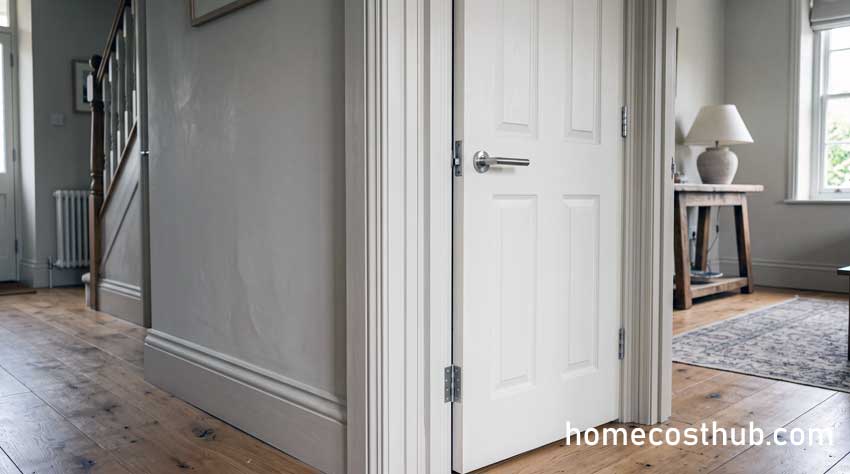
| Walls + ceiling + baseboards/skirting | More complete room refresh | More cutting-in and detail work | Existing trim looks worn beside new wall paint | Doors, frames, specialty repairs |
| Full-room scope | Coordinated walls, ceiling, doors, and detailed trim | Highest level of room-by-room coordination | Major redecoration or broader renovation | Cabinetry, specialist finishes, hidden repairs |
One practical issue is color contrast. Fresh light-colored walls can make an older ceiling look noticeably duller, even if the ceiling seemed acceptable before work began. White trim can show the same effect when the existing coating has aged differently from the new wall finish.
That does not mean every room needs a full repaint. It means the choice should be deliberate. Ask the painter to price optional surfaces separately if you are unsure. You can then judge the visual benefit against the additional work instead of discovering the mismatch after the walls are complete.
DIY or Professional Painting? Use Project Complexity, Not Just Price
DIY painting is most practical when surfaces are sound, access is simple, preparation is limited, and you can give the work enough time. Professional painting becomes more attractive as repair work, height, stair access, occupied-room sequencing, detailed trim, or finish expectations become more demanding.
| Option | Pros | Cons |
|---|---|---|
| DIY Painting | Control over schedule; avoids professional labor expense; practical for simple accessible rooms; allows work to be divided into stages. | Preparation can take substantial time; requires tools and protection; finish quality depends on technique; disruption may last longer; mistakes can require rework. |
| Professional Painting | Better suited to difficult access and detailed work; preparation and protection can be specified in the contract; larger projects may progress faster; responsibility for defined scope is clearer. | Higher direct cash cost; quotation quality varies; exclusions need careful review; contractor selection matters. |
Projects That Tend to Be More DIY-Friendly
- Standard-height bedroom or home office
- Sound walls with minor nail holes or light patching
- Limited trim and simple room geometry
- No significant peeling, staining, or moisture damage
- A homeowner who can allow enough time for preparation, drying, and cleanup
Projects Where Professional Help May Be More Practical
- High ceilings or stairwells
- Extensive plaster or drywall repair
- Detailed moldings, woodwork, doors, or built-ins
- Large occupied whole-house projects
- Heavy stain blocking or coating compatibility concerns
- Older painted surfaces where lead may be a concern
DIY cost is not simply the price of a can of paint. Even a straightforward project may require patching materials, primer, masking products, brushes, rollers, extension poles, floor protection, ladders or access equipment, cleaning supplies, and disposal materials.
Time also has value. A homeowner who can comfortably repaint one simple room over a weekend faces a different decision from someone attempting several occupied rooms, ceilings, doors, and detailed trim while other renovation trades are still working.
Interior Painting During a Larger Remodel
Painting should be coordinated with the work around it. The wrong sequence can damage finished surfaces, create unnecessary touch-ups, or force contractors to repeat masking and protection.
For projects in the Whole House Remodeling category, final painting generally belongs toward the finish stage rather than before dusty or destructive work is complete.
Resolve demolition, major wall changes, drywall or plaster repairs, and other dust-producing work before final finish coats whenever the project sequence allows it. New trim and replacement doors should also be coordinated before deciding which surfaces are included in the painting contract.
Flooring requires more judgment. Some projects benefit from painting before the finished flooring is installed, while others need trim installation, floor completion, and final touch-ups in a different sequence. The right order depends on the flooring material, protection plan, baseboard or skirting work, and the trades involved.
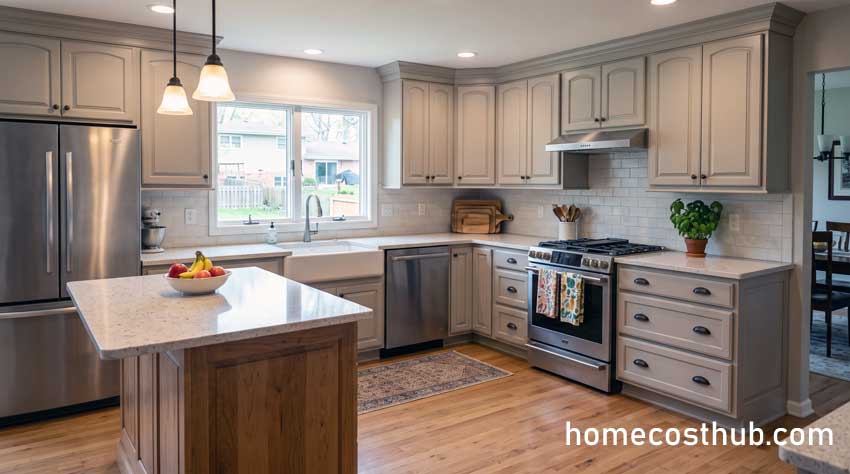
Kitchen projects need another scope check. Painting walls around cabinetry is not the same task as refinishing cabinet doors, face frames, or panels. When cabinetry is part of the plan, review it as a separate finishing scope with the Cabinet Painting Cost Calculator rather than assuming it is included in a general room-painting quote.
The goal is to protect completed work. Final coats applied too early can be scratched by installers, marked during trim work, or damaged when materials are carried through the room. That can turn a single painting scope into a sequence of repair visits.
Interior vs Exterior Painting Estimates Are Not Interchangeable
An interior price should not be judged against an exterior painting rate simply because both involve paint. Exterior work may involve weather exposure, different substrates, exterior preparation, access equipment, environmental conditions, and coating systems that do not apply indoors.
Interior jobs often contain their own labor-intensive details, including room protection, occupied spaces, doors, baseboards or skirting, window casings, cabinetry interfaces, and precise cutting-in.
If you are budgeting both sides of the property, use the Exterior Painting Calculator for the outside work rather than applying an interior estimate to exterior surfaces.
Special Considerations for Older US and UK Homes
Older coatings deserve more attention before sanding, scraping, or other preparation begins. The relevant guidance differs between the United States and the United Kingdom, so homeowners should not assume the same rules apply in both countries.
United States: Pre-1978 Homes
The US Environmental Protection Agency states that renovation, repair, or painting work in a pre-1978 home with lead-based paint can create dangerous lead dust. EPA recommends lead-safe work practices and says contractors performing covered renovation, repair, and painting work in pre-1978 homes must meet applicable RRP certification requirements. Review the EPA guidance for lead-safe renovations in pre-1978 homes before treating old painted surfaces as ordinary sanding or scraping work.
This can affect project planning because the preparation method, containment, cleanup, and contractor qualification may matter as much as the final paint finish. A low painting estimate that assumes ordinary surface preparation should not be treated as equivalent to a proposal that includes appropriate lead-safe procedures.
United Kingdom: Older Painted Surfaces
The UK Health and Safety Executive identifies removal of existing paint coatings in properties built before the 1980s, use of blow lamps or gas torches on old paint, and dry sanding old paint as activities with higher lead-exposure risk. HSE advises safer methods based on the paint’s condition, including wet abrasive methods and dust-control measures where appropriate. See the HSE guidance on safely dealing with old lead paint.
For a UK quote, clarify how an older painted surface will be prepared rather than assuming “sand and repaint” describes a routine task. HSE’s guidance is occupational safety guidance, so it should not be treated as identical to US EPA rules or as a substitute for project-specific professional advice.
Illustrative Quote Comparison: When the Higher Quote Can Make More Sense
Illustrative scenario — not market pricing.
Consider a hypothetical US homeowner repainting a medium-size bedroom. The calculator provides a planning benchmark of $1,500 for the selected scope. The figure is illustrative only and is not presented as a US market average.
The homeowner then receives two hypothetical proposals:
| Scope | Quote A — $1,250 | Quote B — $1,750 |
|---|---|---|
| Walls | Included | Included |
| Ceiling | Excluded | Included |
| Baseboards and door frame | Excluded | Included |
| Minor crack repairs | Extra | Defined minor repair scope included |
| Primer | Spot primer if required, extra | Specified spot primer included |
| Finish coats | Two coats to walls | Two coats to included surfaces as specified |
| Furniture protection | Owner moves furniture | Protection and agreed furniture handling included |
| Cleanup | Basic cleanup | Included |
At first glance, Quote A is $500 cheaper. That does not establish that Painter A charges less for the same work. The two proposals describe different finished projects.
If the homeowner wants only wall painting and is happy to move furniture, leave the ceiling and trim untouched, and pay separately if repairs appear, Quote A may fit the project well.
If the homeowner wants a coordinated room refresh with ceiling, trim, defined minor repairs, protection, and cleanup, Quote B is much closer to that requested scope. Asking Painter A to add those excluded items may narrow the price gap substantially.
The calculator benchmark still did its job. It gave the homeowner a reference point, but the hiring decision required a like-for-like scope comparison rather than a simple comparison of $1,250, $1,500, and $1,750.
A Practical Decision Tree After You Get the Estimate
Start by deciding whether the project is a straightforward repaint or a preparation-heavy job. Then decide whether DIY is realistic and whether professional quotations match the same surfaces and finish specification used for your planning estimate.
Is the existing surface generally sound?
→ Yes: Is the room standard height with limited detail?
→→ Yes: Are you comfortable with patching, masking, cutting-in, rolling, and finish work?
→→→ Yes: DIY may be reasonable. Compare your material, equipment, and time requirements with the professional option.
→→→ No: Request professional quotations using a clearly defined scope.
→→ No: High ceilings, stairs, dense trim, or difficult access make professional quotations more useful. Ask contractors to identify access and detail work separately where practical.
→ No: Are there substantial cracks, deteriorated plaster or drywall, staining, peeling coatings, or potentially hazardous old paint?
→→ Yes: Diagnose and address the condition before treating the project as a simple repaint.
→→ No: Ask for preparation to be clearly described and priced rather than hidden behind a vague allowance.
Are the professional quotes substantially different from your calculator benchmark?
→ First normalize the scope.
Also Read:
→ Check walls, ceiling, trim, doors, preparation, primer, finish coats, access, furniture handling, protection, cleanup, tax or VAT treatment, and exclusions.
→ If the scope genuinely matches but the prices still differ significantly, ask each contractor to explain the assumptions behind the quotation. The explanation is often more useful than choosing the lowest figure automatically.
Common Quote Mistakes Homeowners Can Avoid
Comparing Different Finished Scopes
A walls-only quote and a full-room quotation are not competing prices for the same job. Confirm the surfaces before comparing totals.
Assuming “Two Coats” Means the Same Specification
Two finish coats do not tell you how much patching, sanding, caulking, stain treatment, or priming happens first. Preparation should be understood separately.
Assuming Trim and Doors Are Included
Baseboards, skirting boards, window casings, doors, frames, and crown molding can all be separate scope items. Do not rely on the phrase “paint room” to define them.
Ignoring Exclusions
Read what the contractor specifically excludes. Wallpaper removal, major crack repair, damaged plaster, specialist primer, high-access equipment, or furniture moving may sit outside the quoted total.
Comparing Tax or VAT Differently
Confirm whether the quoted amount represents the final payable figure and how applicable taxes or VAT are handled. A comparison is unreliable if one figure includes charges that another leaves outside the headline price.
Treating an Allowance as a Fixed Price
An allowance reserves budget for uncertain work. It is not automatically a promise that the work will cost exactly that amount. Ask what happens if the actual requirement is higher or lower.
Painting Too Early in a Remodel
Final finish coats applied before dusty demolition, wall repairs, door installation, or other disruptive work can lead to avoidable touch-ups and repainting.
Accepting “Prep as Necessary” Without Clarification
Ask what preparation is actually included. A contractor may mean light sanding and filling small holes, while the homeowner may assume substantial crack repair and stain treatment are included.
Interior Painting Myths That Can Distort Your Budget
Fact
Scope differences can make a lower quote more expensive after excluded preparation, ceilings, trim, doors, protection, or repairs are added.
Fact
A calculator is a planning benchmark. A contractor can inspect property-specific preparation, access, repairs, protection, and sequencing that may change the final quotation.
Fact
Older ceilings, doors, trim, baseboards, or skirting boards can look noticeably different beside newly painted walls, especially when the existing finishes have aged or discolored.
Fact
DIY work may also require primer, fillers, caulk, masking products, brushes, rollers, floor protection, access equipment, cleanup supplies, disposal, and substantial homeowner time.
Interior Painting Quote Review Checklist
Interior Painting Quote Review Checklist
- Confirm exactly which rooms and surfaces are included.
- Confirm whether ceilings are included or excluded.
- Confirm whether trim, baseboards/skirting boards, doors, and frames are included.
- Ask what preparation is included before painting starts.
- Confirm primer requirements and the specified number of finish coats.
- Identify repairs, stain treatment, wallpaper removal, or specialist preparation that may be extra.
- Clarify who moves furniture and protects floors and fixtures.
- Confirm cleanup and waste responsibilities.
- Check whether taxes or VAT are included where applicable.
- Compare quotes only after bringing them to the same scope.
Frequently Asked Questions
How accurate is an Interior Painting Calculator?
An Interior Painting Calculator is best used as a planning estimate rather than a promise of the final contract price. Accuracy improves when the project information closely matches the real scope. A site quotation can still differ because a painter can inspect preparation needs, access, repairs, protection requirements, and other property-specific conditions.
Why is my painter’s quote higher than the calculator estimate?
A higher quote may include work that was not fully represented in the planning scenario, such as extensive preparation, drywall or plaster repair, ceilings, doors, detailed trim, stain blocking, difficult access, furniture handling, or specialist coatings. Compare the scope line by line before deciding that the contractor’s rate is unusually high.
Should ceilings be included in an interior painting quote?
Only if the quotation says they are included. Ceiling painting is commonly treated as a separate scope item because it adds surface area, overhead work, protection, cutting-in, and sometimes extra preparation. Never assume “paint room” automatically includes the ceiling.
Are baseboards or skirting boards normally included?
Not automatically. US baseboards and UK skirting boards may be included in a full-room decorating scope, priced separately, or excluded. Their preparation and coating can be detail-intensive, especially where existing finishes are damaged or a different coating system is required.
Should I compare painters by price per square foot or square metre?
Unit pricing can be useful as a rough benchmark, but only when the scope is similar. A price per square foot or square metre can hide major differences in preparation, ceiling work, trim, doors, coats, access, repairs, and protection. For hiring decisions, compare the written scope as well as the unit price.
How many painting quotes should I compare?
There is no universal number that guarantees a better decision. Gather enough written quotations to understand how contractors define the work, what they include, and where their assumptions differ. A small set of clear, comparable proposals is more useful than many vague prices collected only to find the lowest total.
Can I save money by painting the interior myself?
DIY can reduce direct professional labor expense on simple, accessible rooms with sound surfaces. The comparison becomes less clear when you need significant repairs, ladders or access equipment, specialist preparation, detailed trim work, or substantial time away from other priorities. Include materials, tools, protection, cleanup, time, and possible rework in the decision.
Do painters charge by the hour, day, room, or project?
Pricing structure varies by contractor and market. US painters may use project totals, labor rates, or area-based benchmarks. UK painters and decorators may quote by project or use day rates for some work. The pricing method alone does not tell you whether a quote is good value; the included scope matters more.
Why can two painters quote very different prices for the same room?
They may not be pricing the same job. One painter may include preparation, ceilings, trim, two specified finish coats, protection, and cleanup while another quotes only the walls. Contractor overhead, scheduling, product specification, local labor conditions, and workmanship expectations can also differ.
Should painting happen before or after flooring work?
The best sequence depends on the flooring material, trim installation, protection strategy, and other trades. Painting before finished flooring can reduce the risk of paint damage to new floors, while some projects need flooring and skirting or baseboards installed before final touch-ups. Coordinate the sequence rather than applying one rule to every remodel.
Cost Summary
Treat the calculator result as a planning benchmark, then compare contractor proposals on a like-for-like basis. Confirm preparation, surfaces, coats, exclusions, protection, and tax or VAT treatment, and keep US and UK market assumptions separate. Large differences deserve a scope review before you accept or reject a quote.
About the Author
Arden Cole Linscott
Expert — Residential Construction & Remodeling Cost Analysis
Arden Cole Linscott provides practical analysis of residential construction and remodeling costs, helping homeowners understand project scope, compare estimates, interpret contractor pricing, and make informed renovation budgeting decisions.
Scroll to bottom
Remodeling Cost Calculators